🎉 Up to 70% Off Selected ItemsShop Sale

1 / 2
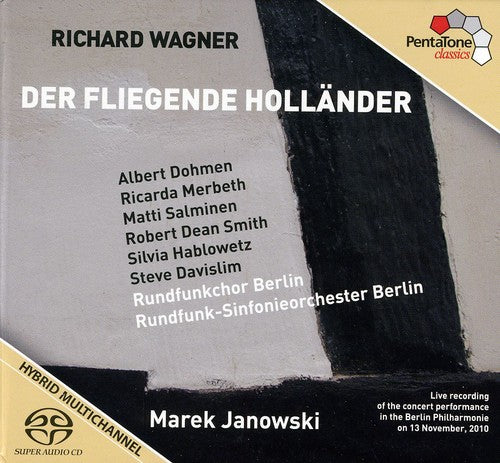
Wagner: Der Fliegende Hollander / Janowksi, Salminen, Merbeth, Hablowetz
This is a hybrid Super Audio CD playable on both regular and Super Audio CD players.
3534820.az_WAGNER_Der_Hollander_Marek.html
WAGNER Der fliegende Holländer • Marek Janowski, cond; Albert Dohman ( Dutchman ); Matti Salminen ( Daland ); Ricarda Merbeth ( Senta ); Robert Dean Smith ( Erik ); Silvia Hablowetz ( Mary ); Steve Davislim ( Steersman ); Berlin RSO & Ch • PENTATONE PTC 5186 400 (2 SACDs: 126:30 Text and Translation) Live: Berlin 11/13/2010
This release marks the beginning of an SACD traversal from PentaTone of the 10 frequently performed Wagner operas. In a charmingly old-fashioned gesture, PentaTone will provide with each of the first nine sets a voucher that, if you collect them all, entitles you to a 50-percent price reduction for the final item ( Götterdämmerung, due in November 2013) or—for free—a “special CD collection box.” A cool marketing idea. I wonder if other Wagnerian promotion schemes were kicked around: “Collect them all, kids, and get a free Tarnhelm!”
Something can be said for concert performances of Wagner’s operas. (Studio recordings, for economic reasons, are largely a thing of the past.) There’s no possibility of directorial malpractice, something that these works seem to attract. I just returned from the 100th Bayreuth Festival where I encountered, among much else of questionable merit, a Lohengrin where the good citizens of Brabant were all laboratory rats, a Parsifal with a transvestite Klingsor sporting black fishnet stockings, and a Tannhäuser set in a chemical plant for no good reason. The focus in concert, by default, is on the music, and this inaugural release has got the goods. Marek Janowski provides dramatic impetus to the proceedings but also assures that the orchestra’s role is never slighted. He lingers appealingly as he plays the excerpt from Senta’s Ballad heard in the overture, and there’s a joyous swing to the Entr’acte leading into Holländer ’s final two scenes. Janowski makes the most of the Italianate aspects of the score, including a lovely, lyrical Steersman’s Lied in act I (courtesy of the excellent Australian singer Steve Davislim) and, of course, the very Verdian finale of act II. The chorus, prepared by Eberhart Friedrich, director of the Bayreuth Festival Chorus since 2000, does its job with an incredible precision that would be impossible in the context of a staged production.
An excellent cast was assembled for this live recording that documents a single performance at the Berlin Philharmonie on November 13, 2010. Leading the charge are Albert Dohman, highly regarded for his Wotan (as heard on Et’Cetera SACDs with Harmut Haenchen, and on Opus Arte with Christian Thielemann from Bayreuth) and Matti Salminen, one of the world’s go-to basses for Gurnemanz, Marke, Hagan, and Hunding. Salminen sings a hearty Daland and makes the most of Wagner’s songful passages. His aria toward the end of act II (“Mögst du, mein Kind”) has a Mozartean grace and fluidity. Dohman’s performance is equally impressive. His voice, like Salminen’s, is inherently appealing yet imbued with the tortured quality the role demands; we sense the same anguish that Wotan radiates in act II of Die Walküre or the beginning of Siegfried ’s last act. The Dutchman’s bitterness and sorrow are powerfully portrayed without scenery-chewing.
To my taste, Ricarda Merbeth’s soprano is a bit squally and insufficiently youthful-sounding. There could be more of a sense of “ever-increasing agitation” (“immer zunehmender Aufregung fort”) as she progresses through the three stanzas of Senta’s Ballad. On the other hand, Kansas-born Robert Dean Smith’s handsome Heldentenor instrument—he’s been Bayreuth’s Tristan since 2005—assures that Erik is a more compelling character than is often the case.
As usual, PentaTone’s high-resolution sonics are superb. Multichannel makes clear a mid-hall audience perspective that still provides plenty of involving impact, but places offstage horns way off in the distance. (Spatially, the sound is still more than satisfactory in stereo.) PentaTone’s 140-page booklet is bound into the cardboard package and there are heavy paper sleeves attached as well to hold the two discs. There’s a German/English libretto that, unfortunately, isn’t indexed to the tracks on the discs. The booklet also includes substantial liner notes by Steffen Georgi, the dramaturge for the Berlin Radio Symphony Orchestra, which is to say that he gives lectures before many of the ensemble’s concerts. Recommended—and don’t lose that voucher!
FANFARE: Andrew Quint
WAGNER Der fliegende Holländer • Marek Janowski, cond; Albert Dohman ( Dutchman ); Matti Salminen ( Daland ); Ricarda Merbeth ( Senta ); Robert Dean Smith ( Erik ); Silvia Hablowetz ( Mary ); Steve Davislim ( Steersman ); Berlin RSO & Ch • PENTATONE PTC 5186 400 (2 SACDs: 126:30 Text and Translation) Live: Berlin 11/13/2010
This release marks the beginning of an SACD traversal from PentaTone of the 10 frequently performed Wagner operas. In a charmingly old-fashioned gesture, PentaTone will provide with each of the first nine sets a voucher that, if you collect them all, entitles you to a 50-percent price reduction for the final item ( Götterdämmerung, due in November 2013) or—for free—a “special CD collection box.” A cool marketing idea. I wonder if other Wagnerian promotion schemes were kicked around: “Collect them all, kids, and get a free Tarnhelm!”
Something can be said for concert performances of Wagner’s operas. (Studio recordings, for economic reasons, are largely a thing of the past.) There’s no possibility of directorial malpractice, something that these works seem to attract. I just returned from the 100th Bayreuth Festival where I encountered, among much else of questionable merit, a Lohengrin where the good citizens of Brabant were all laboratory rats, a Parsifal with a transvestite Klingsor sporting black fishnet stockings, and a Tannhäuser set in a chemical plant for no good reason. The focus in concert, by default, is on the music, and this inaugural release has got the goods. Marek Janowski provides dramatic impetus to the proceedings but also assures that the orchestra’s role is never slighted. He lingers appealingly as he plays the excerpt from Senta’s Ballad heard in the overture, and there’s a joyous swing to the Entr’acte leading into Holländer ’s final two scenes. Janowski makes the most of the Italianate aspects of the score, including a lovely, lyrical Steersman’s Lied in act I (courtesy of the excellent Australian singer Steve Davislim) and, of course, the very Verdian finale of act II. The chorus, prepared by Eberhart Friedrich, director of the Bayreuth Festival Chorus since 2000, does its job with an incredible precision that would be impossible in the context of a staged production.
An excellent cast was assembled for this live recording that documents a single performance at the Berlin Philharmonie on November 13, 2010. Leading the charge are Albert Dohman, highly regarded for his Wotan (as heard on Et’Cetera SACDs with Harmut Haenchen, and on Opus Arte with Christian Thielemann from Bayreuth) and Matti Salminen, one of the world’s go-to basses for Gurnemanz, Marke, Hagan, and Hunding. Salminen sings a hearty Daland and makes the most of Wagner’s songful passages. His aria toward the end of act II (“Mögst du, mein Kind”) has a Mozartean grace and fluidity. Dohman’s performance is equally impressive. His voice, like Salminen’s, is inherently appealing yet imbued with the tortured quality the role demands; we sense the same anguish that Wotan radiates in act II of Die Walküre or the beginning of Siegfried ’s last act. The Dutchman’s bitterness and sorrow are powerfully portrayed without scenery-chewing.
To my taste, Ricarda Merbeth’s soprano is a bit squally and insufficiently youthful-sounding. There could be more of a sense of “ever-increasing agitation” (“immer zunehmender Aufregung fort”) as she progresses through the three stanzas of Senta’s Ballad. On the other hand, Kansas-born Robert Dean Smith’s handsome Heldentenor instrument—he’s been Bayreuth’s Tristan since 2005—assures that Erik is a more compelling character than is often the case.
As usual, PentaTone’s high-resolution sonics are superb. Multichannel makes clear a mid-hall audience perspective that still provides plenty of involving impact, but places offstage horns way off in the distance. (Spatially, the sound is still more than satisfactory in stereo.) PentaTone’s 140-page booklet is bound into the cardboard package and there are heavy paper sleeves attached as well to hold the two discs. There’s a German/English libretto that, unfortunately, isn’t indexed to the tracks on the discs. The booklet also includes substantial liner notes by Steffen Georgi, the dramaturge for the Berlin Radio Symphony Orchestra, which is to say that he gives lectures before many of the ensemble’s concerts. Recommended—and don’t lose that voucher!
FANFARE: Andrew Quint
This is a hybrid Super Audio CD playable on both regular and Super Audio CD players.
3534820.az_WAGNER_Der_Hollander_Marek.html
WAGNER Der fliegende Holländer • Marek Janowski, cond; Albert Dohman ( Dutchman ); Matti Salminen ( Daland ); Ricarda Merbeth ( Senta ); Robert Dean Smith ( Erik ); Silvia Hablowetz ( Mary ); Steve Davislim ( Steersman ); Berlin RSO & Ch • PENTATONE PTC 5186 400 (2 SACDs: 126:30 Text and Translation) Live: Berlin 11/13/2010
This release marks the beginning of an SACD traversal from PentaTone of the 10 frequently performed Wagner operas. In a charmingly old-fashioned gesture, PentaTone will provide with each of the first nine sets a voucher that, if you collect them all, entitles you to a 50-percent price reduction for the final item ( Götterdämmerung, due in November 2013) or—for free—a “special CD collection box.” A cool marketing idea. I wonder if other Wagnerian promotion schemes were kicked around: “Collect them all, kids, and get a free Tarnhelm!”
Something can be said for concert performances of Wagner’s operas. (Studio recordings, for economic reasons, are largely a thing of the past.) There’s no possibility of directorial malpractice, something that these works seem to attract. I just returned from the 100th Bayreuth Festival where I encountered, among much else of questionable merit, a Lohengrin where the good citizens of Brabant were all laboratory rats, a Parsifal with a transvestite Klingsor sporting black fishnet stockings, and a Tannhäuser set in a chemical plant for no good reason. The focus in concert, by default, is on the music, and this inaugural release has got the goods. Marek Janowski provides dramatic impetus to the proceedings but also assures that the orchestra’s role is never slighted. He lingers appealingly as he plays the excerpt from Senta’s Ballad heard in the overture, and there’s a joyous swing to the Entr’acte leading into Holländer ’s final two scenes. Janowski makes the most of the Italianate aspects of the score, including a lovely, lyrical Steersman’s Lied in act I (courtesy of the excellent Australian singer Steve Davislim) and, of course, the very Verdian finale of act II. The chorus, prepared by Eberhart Friedrich, director of the Bayreuth Festival Chorus since 2000, does its job with an incredible precision that would be impossible in the context of a staged production.
An excellent cast was assembled for this live recording that documents a single performance at the Berlin Philharmonie on November 13, 2010. Leading the charge are Albert Dohman, highly regarded for his Wotan (as heard on Et’Cetera SACDs with Harmut Haenchen, and on Opus Arte with Christian Thielemann from Bayreuth) and Matti Salminen, one of the world’s go-to basses for Gurnemanz, Marke, Hagan, and Hunding. Salminen sings a hearty Daland and makes the most of Wagner’s songful passages. His aria toward the end of act II (“Mögst du, mein Kind”) has a Mozartean grace and fluidity. Dohman’s performance is equally impressive. His voice, like Salminen’s, is inherently appealing yet imbued with the tortured quality the role demands; we sense the same anguish that Wotan radiates in act II of Die Walküre or the beginning of Siegfried ’s last act. The Dutchman’s bitterness and sorrow are powerfully portrayed without scenery-chewing.
To my taste, Ricarda Merbeth’s soprano is a bit squally and insufficiently youthful-sounding. There could be more of a sense of “ever-increasing agitation” (“immer zunehmender Aufregung fort”) as she progresses through the three stanzas of Senta’s Ballad. On the other hand, Kansas-born Robert Dean Smith’s handsome Heldentenor instrument—he’s been Bayreuth’s Tristan since 2005—assures that Erik is a more compelling character than is often the case.
As usual, PentaTone’s high-resolution sonics are superb. Multichannel makes clear a mid-hall audience perspective that still provides plenty of involving impact, but places offstage horns way off in the distance. (Spatially, the sound is still more than satisfactory in stereo.) PentaTone’s 140-page booklet is bound into the cardboard package and there are heavy paper sleeves attached as well to hold the two discs. There’s a German/English libretto that, unfortunately, isn’t indexed to the tracks on the discs. The booklet also includes substantial liner notes by Steffen Georgi, the dramaturge for the Berlin Radio Symphony Orchestra, which is to say that he gives lectures before many of the ensemble’s concerts. Recommended—and don’t lose that voucher!
FANFARE: Andrew Quint
WAGNER Der fliegende Holländer • Marek Janowski, cond; Albert Dohman ( Dutchman ); Matti Salminen ( Daland ); Ricarda Merbeth ( Senta ); Robert Dean Smith ( Erik ); Silvia Hablowetz ( Mary ); Steve Davislim ( Steersman ); Berlin RSO & Ch • PENTATONE PTC 5186 400 (2 SACDs: 126:30 Text and Translation) Live: Berlin 11/13/2010
This release marks the beginning of an SACD traversal from PentaTone of the 10 frequently performed Wagner operas. In a charmingly old-fashioned gesture, PentaTone will provide with each of the first nine sets a voucher that, if you collect them all, entitles you to a 50-percent price reduction for the final item ( Götterdämmerung, due in November 2013) or—for free—a “special CD collection box.” A cool marketing idea. I wonder if other Wagnerian promotion schemes were kicked around: “Collect them all, kids, and get a free Tarnhelm!”
Something can be said for concert performances of Wagner’s operas. (Studio recordings, for economic reasons, are largely a thing of the past.) There’s no possibility of directorial malpractice, something that these works seem to attract. I just returned from the 100th Bayreuth Festival where I encountered, among much else of questionable merit, a Lohengrin where the good citizens of Brabant were all laboratory rats, a Parsifal with a transvestite Klingsor sporting black fishnet stockings, and a Tannhäuser set in a chemical plant for no good reason. The focus in concert, by default, is on the music, and this inaugural release has got the goods. Marek Janowski provides dramatic impetus to the proceedings but also assures that the orchestra’s role is never slighted. He lingers appealingly as he plays the excerpt from Senta’s Ballad heard in the overture, and there’s a joyous swing to the Entr’acte leading into Holländer ’s final two scenes. Janowski makes the most of the Italianate aspects of the score, including a lovely, lyrical Steersman’s Lied in act I (courtesy of the excellent Australian singer Steve Davislim) and, of course, the very Verdian finale of act II. The chorus, prepared by Eberhart Friedrich, director of the Bayreuth Festival Chorus since 2000, does its job with an incredible precision that would be impossible in the context of a staged production.
An excellent cast was assembled for this live recording that documents a single performance at the Berlin Philharmonie on November 13, 2010. Leading the charge are Albert Dohman, highly regarded for his Wotan (as heard on Et’Cetera SACDs with Harmut Haenchen, and on Opus Arte with Christian Thielemann from Bayreuth) and Matti Salminen, one of the world’s go-to basses for Gurnemanz, Marke, Hagan, and Hunding. Salminen sings a hearty Daland and makes the most of Wagner’s songful passages. His aria toward the end of act II (“Mögst du, mein Kind”) has a Mozartean grace and fluidity. Dohman’s performance is equally impressive. His voice, like Salminen’s, is inherently appealing yet imbued with the tortured quality the role demands; we sense the same anguish that Wotan radiates in act II of Die Walküre or the beginning of Siegfried ’s last act. The Dutchman’s bitterness and sorrow are powerfully portrayed without scenery-chewing.
To my taste, Ricarda Merbeth’s soprano is a bit squally and insufficiently youthful-sounding. There could be more of a sense of “ever-increasing agitation” (“immer zunehmender Aufregung fort”) as she progresses through the three stanzas of Senta’s Ballad. On the other hand, Kansas-born Robert Dean Smith’s handsome Heldentenor instrument—he’s been Bayreuth’s Tristan since 2005—assures that Erik is a more compelling character than is often the case.
As usual, PentaTone’s high-resolution sonics are superb. Multichannel makes clear a mid-hall audience perspective that still provides plenty of involving impact, but places offstage horns way off in the distance. (Spatially, the sound is still more than satisfactory in stereo.) PentaTone’s 140-page booklet is bound into the cardboard package and there are heavy paper sleeves attached as well to hold the two discs. There’s a German/English libretto that, unfortunately, isn’t indexed to the tracks on the discs. The booklet also includes substantial liner notes by Steffen Georgi, the dramaturge for the Berlin Radio Symphony Orchestra, which is to say that he gives lectures before many of the ensemble’s concerts. Recommended—and don’t lose that voucher!
FANFARE: Andrew Quint
$42.99
Wagner: Der Fliegende Hollander / Janowksi, Salminen, Merbeth, Hablowetz—
$42.99
Description
This is a hybrid Super Audio CD playable on both regular and Super Audio CD players.
3534820.az_WAGNER_Der_Hollander_Marek.html
WAGNER Der fliegende Holländer • Marek Janowski, cond; Albert Dohman ( Dutchman ); Matti Salminen ( Daland ); Ricarda Merbeth ( Senta ); Robert Dean Smith ( Erik ); Silvia Hablowetz ( Mary ); Steve Davislim ( Steersman ); Berlin RSO & Ch • PENTATONE PTC 5186 400 (2 SACDs: 126:30 Text and Translation) Live: Berlin 11/13/2010
This release marks the beginning of an SACD traversal from PentaTone of the 10 frequently performed Wagner operas. In a charmingly old-fashioned gesture, PentaTone will provide with each of the first nine sets a voucher that, if you collect them all, entitles you to a 50-percent price reduction for the final item ( Götterdämmerung, due in November 2013) or—for free—a “special CD collection box.” A cool marketing idea. I wonder if other Wagnerian promotion schemes were kicked around: “Collect them all, kids, and get a free Tarnhelm!”
Something can be said for concert performances of Wagner’s operas. (Studio recordings, for economic reasons, are largely a thing of the past.) There’s no possibility of directorial malpractice, something that these works seem to attract. I just returned from the 100th Bayreuth Festival where I encountered, among much else of questionable merit, a Lohengrin where the good citizens of Brabant were all laboratory rats, a Parsifal with a transvestite Klingsor sporting black fishnet stockings, and a Tannhäuser set in a chemical plant for no good reason. The focus in concert, by default, is on the music, and this inaugural release has got the goods. Marek Janowski provides dramatic impetus to the proceedings but also assures that the orchestra’s role is never slighted. He lingers appealingly as he plays the excerpt from Senta’s Ballad heard in the overture, and there’s a joyous swing to the Entr’acte leading into Holländer ’s final two scenes. Janowski makes the most of the Italianate aspects of the score, including a lovely, lyrical Steersman’s Lied in act I (courtesy of the excellent Australian singer Steve Davislim) and, of course, the very Verdian finale of act II. The chorus, prepared by Eberhart Friedrich, director of the Bayreuth Festival Chorus since 2000, does its job with an incredible precision that would be impossible in the context of a staged production.
An excellent cast was assembled for this live recording that documents a single performance at the Berlin Philharmonie on November 13, 2010. Leading the charge are Albert Dohman, highly regarded for his Wotan (as heard on Et’Cetera SACDs with Harmut Haenchen, and on Opus Arte with Christian Thielemann from Bayreuth) and Matti Salminen, one of the world’s go-to basses for Gurnemanz, Marke, Hagan, and Hunding. Salminen sings a hearty Daland and makes the most of Wagner’s songful passages. His aria toward the end of act II (“Mögst du, mein Kind”) has a Mozartean grace and fluidity. Dohman’s performance is equally impressive. His voice, like Salminen’s, is inherently appealing yet imbued with the tortured quality the role demands; we sense the same anguish that Wotan radiates in act II of Die Walküre or the beginning of Siegfried ’s last act. The Dutchman’s bitterness and sorrow are powerfully portrayed without scenery-chewing.
To my taste, Ricarda Merbeth’s soprano is a bit squally and insufficiently youthful-sounding. There could be more of a sense of “ever-increasing agitation” (“immer zunehmender Aufregung fort”) as she progresses through the three stanzas of Senta’s Ballad. On the other hand, Kansas-born Robert Dean Smith’s handsome Heldentenor instrument—he’s been Bayreuth’s Tristan since 2005—assures that Erik is a more compelling character than is often the case.
As usual, PentaTone’s high-resolution sonics are superb. Multichannel makes clear a mid-hall audience perspective that still provides plenty of involving impact, but places offstage horns way off in the distance. (Spatially, the sound is still more than satisfactory in stereo.) PentaTone’s 140-page booklet is bound into the cardboard package and there are heavy paper sleeves attached as well to hold the two discs. There’s a German/English libretto that, unfortunately, isn’t indexed to the tracks on the discs. The booklet also includes substantial liner notes by Steffen Georgi, the dramaturge for the Berlin Radio Symphony Orchestra, which is to say that he gives lectures before many of the ensemble’s concerts. Recommended—and don’t lose that voucher!
FANFARE: Andrew Quint
WAGNER Der fliegende Holländer • Marek Janowski, cond; Albert Dohman ( Dutchman ); Matti Salminen ( Daland ); Ricarda Merbeth ( Senta ); Robert Dean Smith ( Erik ); Silvia Hablowetz ( Mary ); Steve Davislim ( Steersman ); Berlin RSO & Ch • PENTATONE PTC 5186 400 (2 SACDs: 126:30 Text and Translation) Live: Berlin 11/13/2010
This release marks the beginning of an SACD traversal from PentaTone of the 10 frequently performed Wagner operas. In a charmingly old-fashioned gesture, PentaTone will provide with each of the first nine sets a voucher that, if you collect them all, entitles you to a 50-percent price reduction for the final item ( Götterdämmerung, due in November 2013) or—for free—a “special CD collection box.” A cool marketing idea. I wonder if other Wagnerian promotion schemes were kicked around: “Collect them all, kids, and get a free Tarnhelm!”
Something can be said for concert performances of Wagner’s operas. (Studio recordings, for economic reasons, are largely a thing of the past.) There’s no possibility of directorial malpractice, something that these works seem to attract. I just returned from the 100th Bayreuth Festival where I encountered, among much else of questionable merit, a Lohengrin where the good citizens of Brabant were all laboratory rats, a Parsifal with a transvestite Klingsor sporting black fishnet stockings, and a Tannhäuser set in a chemical plant for no good reason. The focus in concert, by default, is on the music, and this inaugural release has got the goods. Marek Janowski provides dramatic impetus to the proceedings but also assures that the orchestra’s role is never slighted. He lingers appealingly as he plays the excerpt from Senta’s Ballad heard in the overture, and there’s a joyous swing to the Entr’acte leading into Holländer ’s final two scenes. Janowski makes the most of the Italianate aspects of the score, including a lovely, lyrical Steersman’s Lied in act I (courtesy of the excellent Australian singer Steve Davislim) and, of course, the very Verdian finale of act II. The chorus, prepared by Eberhart Friedrich, director of the Bayreuth Festival Chorus since 2000, does its job with an incredible precision that would be impossible in the context of a staged production.
An excellent cast was assembled for this live recording that documents a single performance at the Berlin Philharmonie on November 13, 2010. Leading the charge are Albert Dohman, highly regarded for his Wotan (as heard on Et’Cetera SACDs with Harmut Haenchen, and on Opus Arte with Christian Thielemann from Bayreuth) and Matti Salminen, one of the world’s go-to basses for Gurnemanz, Marke, Hagan, and Hunding. Salminen sings a hearty Daland and makes the most of Wagner’s songful passages. His aria toward the end of act II (“Mögst du, mein Kind”) has a Mozartean grace and fluidity. Dohman’s performance is equally impressive. His voice, like Salminen’s, is inherently appealing yet imbued with the tortured quality the role demands; we sense the same anguish that Wotan radiates in act II of Die Walküre or the beginning of Siegfried ’s last act. The Dutchman’s bitterness and sorrow are powerfully portrayed without scenery-chewing.
To my taste, Ricarda Merbeth’s soprano is a bit squally and insufficiently youthful-sounding. There could be more of a sense of “ever-increasing agitation” (“immer zunehmender Aufregung fort”) as she progresses through the three stanzas of Senta’s Ballad. On the other hand, Kansas-born Robert Dean Smith’s handsome Heldentenor instrument—he’s been Bayreuth’s Tristan since 2005—assures that Erik is a more compelling character than is often the case.
As usual, PentaTone’s high-resolution sonics are superb. Multichannel makes clear a mid-hall audience perspective that still provides plenty of involving impact, but places offstage horns way off in the distance. (Spatially, the sound is still more than satisfactory in stereo.) PentaTone’s 140-page booklet is bound into the cardboard package and there are heavy paper sleeves attached as well to hold the two discs. There’s a German/English libretto that, unfortunately, isn’t indexed to the tracks on the discs. The booklet also includes substantial liner notes by Steffen Georgi, the dramaturge for the Berlin Radio Symphony Orchestra, which is to say that he gives lectures before many of the ensemble’s concerts. Recommended—and don’t lose that voucher!
FANFARE: Andrew Quint