🎉 Up to 70% Off Selected ItemsShop Sale

1 / 3
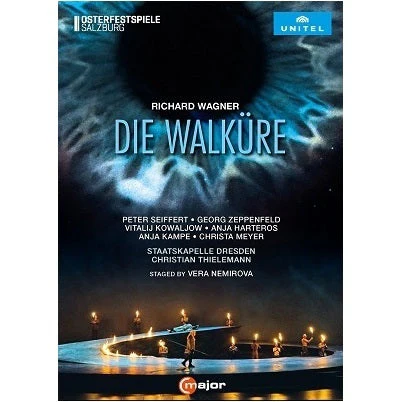
Wagner: Die Walküre / Thielemann, Staatskapelle Dresden
Christian Thielemann has recorded Die Walküre more than once before, not least as part of his Ring cycles for both the Vienna State Opera and the Bayreuth Festival. This is a little different. For its 50th anniversary in 2017, the Salzburg Easter Festival mounted a recreation of Herbert von Karajan’s 1967 production of Die Walküre, which had opened the very first Easter Festival. Gunther Schneider-Siemssen’s sets were reconstructed and the booklet also refers to his original “sophisticated lighting concept” and the “impressive video backdrops inspired by the original glass paintings”. Karajan’s biographer Richard Osborne recorded the disputes between designer and conductor over lighting – Karajan liked things a bit darker it seems. Costumes and stage direction are new, but seem generally in harmony with the concept of the stage as a timeless world, a universe bounded by a proscenium arch.
Overall this production, designed originally and very specifically for the very wide stage of the Festspielhaus, impresses as a worthwhile piece of theatrical archaeology, for the initial production concept of the Ring as a whole cosmos, and its homage to the stripped-back aesthetic of Wieland Wagner’s Bayreuth, remain highly effective scenically. There are just enough long shots to remind us of the epic scale within which the intimate drama is unfolding. The giant tree that also forms Hunding’s hut in Act I, and the ring-shaped platform for Act II, still functions well – simple, effective design does not date. The chalked up listing of the cast of characters on the floor, then back wall, in Act II is an intelligent reminder that after Das Rheingold, the Ring is deeply engaged with its own back-story, like the Oresteia of Aeschylus that formed part of its genesis. One wonders what Karajan would have made of some new directorial details, such as Hunding’s nastily aggressive groping of Sieglinde’s crotch, but generally the characters and their situations are well served by the direction. There is little here to upset a traditionalist, for Brünnhilde even has a winged helmet and a spear for the great ‘annunciation of death’ scene with Siegmund in Act II. The filming, editing and sound recording do it all justice.
Karajan liked younger, fresher voices rather than what he called the “old Wagnerian cannons”. He would not have liked Siegmund’s ill-focussed barking of “Wälse, Wälse” in Act I, but for much of the part Peter Seiffert still makes a very good Walsung. Anja Harteros has the measure of his twin Sieglinde to a still greater degree, vocally bright and secure through the range, and looking the part. Christa Mayer as Fricka is outstanding too, imposing in her insistence on her moral stance, but in full command of her rich voice so that she is never shrill or shrewish, which gives her an authority that makes the drama more interestingly ambiguous. It’s not just a case here, as it sometimes is, of ‘Fricka wrong, Wotan right’. The Wotan of Vitalij Kowaljow is splendidly focussed of voice and suitably imposing in presence – not at all the sort of woolly-voiced veteran Wotan which is the undoing of too many recordings of this work. Anja Kampe is on top vocal form as Brünnhilde, whose interactions with Wotan are the emotional heart of this most human of the Ring dramas. Her wide experience in Wagner really tells, and she acts and sings those scenes with her father most affectingly. Her eight spear-voiced (and spear-carrying) Valkyrie sisters make a joyous noise in the opening to Act III.
Christian Thielemann’s pedigree could hardly be more auspicious for this enterprise, since as a young man he was an assistant to Karajan, as well as to Barenboim at Bayreuth. He even followed the traditional route of progressing through smaller German opera houses, learning his craft en route to his current eminence as one of the world’s leading Wagner conductors. His musical direction is superb, for he has the essential long-term perception of Wagner’s musico-dramatic structures, control of the broad tempi he often favours, and a truly magnificent orchestra in the Dresden Staatskapelle. Like Karajan, he understands that the drama is essentially in the pit. Perhaps too Thielemann was inspired by this reclamation of a classic production by his mentor. Karajan once said in a BBC interview “When I see staging and lighting that is right, the music runs out of my hand without effort”. So it does for Thielemann here, not least in the magnificent account of Wotan’s moving farewell to his favourite daughter that closes the opera.
– MusicWeb International (Roy Westbrook)
The sound of Thielemann’s orchestra, darker-sounding than usual from more Western-based orchestras and with plangent winds and an aggressively present timpani balance, is one of the pleasures of this set. Thielemann has long been a ‘stopgoer’ in Wagner with large tempo contrasts. Now, perhaps following his Bayreuth Tristan, he is even more daringly slow in his pointing up of love and suffering. For that and the cast this set is valuable.
– Gramophone
Overall this production, designed originally and very specifically for the very wide stage of the Festspielhaus, impresses as a worthwhile piece of theatrical archaeology, for the initial production concept of the Ring as a whole cosmos, and its homage to the stripped-back aesthetic of Wieland Wagner’s Bayreuth, remain highly effective scenically. There are just enough long shots to remind us of the epic scale within which the intimate drama is unfolding. The giant tree that also forms Hunding’s hut in Act I, and the ring-shaped platform for Act II, still functions well – simple, effective design does not date. The chalked up listing of the cast of characters on the floor, then back wall, in Act II is an intelligent reminder that after Das Rheingold, the Ring is deeply engaged with its own back-story, like the Oresteia of Aeschylus that formed part of its genesis. One wonders what Karajan would have made of some new directorial details, such as Hunding’s nastily aggressive groping of Sieglinde’s crotch, but generally the characters and their situations are well served by the direction. There is little here to upset a traditionalist, for Brünnhilde even has a winged helmet and a spear for the great ‘annunciation of death’ scene with Siegmund in Act II. The filming, editing and sound recording do it all justice.
Karajan liked younger, fresher voices rather than what he called the “old Wagnerian cannons”. He would not have liked Siegmund’s ill-focussed barking of “Wälse, Wälse” in Act I, but for much of the part Peter Seiffert still makes a very good Walsung. Anja Harteros has the measure of his twin Sieglinde to a still greater degree, vocally bright and secure through the range, and looking the part. Christa Mayer as Fricka is outstanding too, imposing in her insistence on her moral stance, but in full command of her rich voice so that she is never shrill or shrewish, which gives her an authority that makes the drama more interestingly ambiguous. It’s not just a case here, as it sometimes is, of ‘Fricka wrong, Wotan right’. The Wotan of Vitalij Kowaljow is splendidly focussed of voice and suitably imposing in presence – not at all the sort of woolly-voiced veteran Wotan which is the undoing of too many recordings of this work. Anja Kampe is on top vocal form as Brünnhilde, whose interactions with Wotan are the emotional heart of this most human of the Ring dramas. Her wide experience in Wagner really tells, and she acts and sings those scenes with her father most affectingly. Her eight spear-voiced (and spear-carrying) Valkyrie sisters make a joyous noise in the opening to Act III.
Christian Thielemann’s pedigree could hardly be more auspicious for this enterprise, since as a young man he was an assistant to Karajan, as well as to Barenboim at Bayreuth. He even followed the traditional route of progressing through smaller German opera houses, learning his craft en route to his current eminence as one of the world’s leading Wagner conductors. His musical direction is superb, for he has the essential long-term perception of Wagner’s musico-dramatic structures, control of the broad tempi he often favours, and a truly magnificent orchestra in the Dresden Staatskapelle. Like Karajan, he understands that the drama is essentially in the pit. Perhaps too Thielemann was inspired by this reclamation of a classic production by his mentor. Karajan once said in a BBC interview “When I see staging and lighting that is right, the music runs out of my hand without effort”. So it does for Thielemann here, not least in the magnificent account of Wotan’s moving farewell to his favourite daughter that closes the opera.
– MusicWeb International (Roy Westbrook)
The sound of Thielemann’s orchestra, darker-sounding than usual from more Western-based orchestras and with plangent winds and an aggressively present timpani balance, is one of the pleasures of this set. Thielemann has long been a ‘stopgoer’ in Wagner with large tempo contrasts. Now, perhaps following his Bayreuth Tristan, he is even more daringly slow in his pointing up of love and suffering. For that and the cast this set is valuable.
– Gramophone
Christian Thielemann has recorded Die Walküre more than once before, not least as part of his Ring cycles for both the Vienna State Opera and the Bayreuth Festival. This is a little different. For its 50th anniversary in 2017, the Salzburg Easter Festival mounted a recreation of Herbert von Karajan’s 1967 production of Die Walküre, which had opened the very first Easter Festival. Gunther Schneider-Siemssen’s sets were reconstructed and the booklet also refers to his original “sophisticated lighting concept” and the “impressive video backdrops inspired by the original glass paintings”. Karajan’s biographer Richard Osborne recorded the disputes between designer and conductor over lighting – Karajan liked things a bit darker it seems. Costumes and stage direction are new, but seem generally in harmony with the concept of the stage as a timeless world, a universe bounded by a proscenium arch.
Overall this production, designed originally and very specifically for the very wide stage of the Festspielhaus, impresses as a worthwhile piece of theatrical archaeology, for the initial production concept of the Ring as a whole cosmos, and its homage to the stripped-back aesthetic of Wieland Wagner’s Bayreuth, remain highly effective scenically. There are just enough long shots to remind us of the epic scale within which the intimate drama is unfolding. The giant tree that also forms Hunding’s hut in Act I, and the ring-shaped platform for Act II, still functions well – simple, effective design does not date. The chalked up listing of the cast of characters on the floor, then back wall, in Act II is an intelligent reminder that after Das Rheingold, the Ring is deeply engaged with its own back-story, like the Oresteia of Aeschylus that formed part of its genesis. One wonders what Karajan would have made of some new directorial details, such as Hunding’s nastily aggressive groping of Sieglinde’s crotch, but generally the characters and their situations are well served by the direction. There is little here to upset a traditionalist, for Brünnhilde even has a winged helmet and a spear for the great ‘annunciation of death’ scene with Siegmund in Act II. The filming, editing and sound recording do it all justice.
Karajan liked younger, fresher voices rather than what he called the “old Wagnerian cannons”. He would not have liked Siegmund’s ill-focussed barking of “Wälse, Wälse” in Act I, but for much of the part Peter Seiffert still makes a very good Walsung. Anja Harteros has the measure of his twin Sieglinde to a still greater degree, vocally bright and secure through the range, and looking the part. Christa Mayer as Fricka is outstanding too, imposing in her insistence on her moral stance, but in full command of her rich voice so that she is never shrill or shrewish, which gives her an authority that makes the drama more interestingly ambiguous. It’s not just a case here, as it sometimes is, of ‘Fricka wrong, Wotan right’. The Wotan of Vitalij Kowaljow is splendidly focussed of voice and suitably imposing in presence – not at all the sort of woolly-voiced veteran Wotan which is the undoing of too many recordings of this work. Anja Kampe is on top vocal form as Brünnhilde, whose interactions with Wotan are the emotional heart of this most human of the Ring dramas. Her wide experience in Wagner really tells, and she acts and sings those scenes with her father most affectingly. Her eight spear-voiced (and spear-carrying) Valkyrie sisters make a joyous noise in the opening to Act III.
Christian Thielemann’s pedigree could hardly be more auspicious for this enterprise, since as a young man he was an assistant to Karajan, as well as to Barenboim at Bayreuth. He even followed the traditional route of progressing through smaller German opera houses, learning his craft en route to his current eminence as one of the world’s leading Wagner conductors. His musical direction is superb, for he has the essential long-term perception of Wagner’s musico-dramatic structures, control of the broad tempi he often favours, and a truly magnificent orchestra in the Dresden Staatskapelle. Like Karajan, he understands that the drama is essentially in the pit. Perhaps too Thielemann was inspired by this reclamation of a classic production by his mentor. Karajan once said in a BBC interview “When I see staging and lighting that is right, the music runs out of my hand without effort”. So it does for Thielemann here, not least in the magnificent account of Wotan’s moving farewell to his favourite daughter that closes the opera.
– MusicWeb International (Roy Westbrook)
The sound of Thielemann’s orchestra, darker-sounding than usual from more Western-based orchestras and with plangent winds and an aggressively present timpani balance, is one of the pleasures of this set. Thielemann has long been a ‘stopgoer’ in Wagner with large tempo contrasts. Now, perhaps following his Bayreuth Tristan, he is even more daringly slow in his pointing up of love and suffering. For that and the cast this set is valuable.
– Gramophone
Overall this production, designed originally and very specifically for the very wide stage of the Festspielhaus, impresses as a worthwhile piece of theatrical archaeology, for the initial production concept of the Ring as a whole cosmos, and its homage to the stripped-back aesthetic of Wieland Wagner’s Bayreuth, remain highly effective scenically. There are just enough long shots to remind us of the epic scale within which the intimate drama is unfolding. The giant tree that also forms Hunding’s hut in Act I, and the ring-shaped platform for Act II, still functions well – simple, effective design does not date. The chalked up listing of the cast of characters on the floor, then back wall, in Act II is an intelligent reminder that after Das Rheingold, the Ring is deeply engaged with its own back-story, like the Oresteia of Aeschylus that formed part of its genesis. One wonders what Karajan would have made of some new directorial details, such as Hunding’s nastily aggressive groping of Sieglinde’s crotch, but generally the characters and their situations are well served by the direction. There is little here to upset a traditionalist, for Brünnhilde even has a winged helmet and a spear for the great ‘annunciation of death’ scene with Siegmund in Act II. The filming, editing and sound recording do it all justice.
Karajan liked younger, fresher voices rather than what he called the “old Wagnerian cannons”. He would not have liked Siegmund’s ill-focussed barking of “Wälse, Wälse” in Act I, but for much of the part Peter Seiffert still makes a very good Walsung. Anja Harteros has the measure of his twin Sieglinde to a still greater degree, vocally bright and secure through the range, and looking the part. Christa Mayer as Fricka is outstanding too, imposing in her insistence on her moral stance, but in full command of her rich voice so that she is never shrill or shrewish, which gives her an authority that makes the drama more interestingly ambiguous. It’s not just a case here, as it sometimes is, of ‘Fricka wrong, Wotan right’. The Wotan of Vitalij Kowaljow is splendidly focussed of voice and suitably imposing in presence – not at all the sort of woolly-voiced veteran Wotan which is the undoing of too many recordings of this work. Anja Kampe is on top vocal form as Brünnhilde, whose interactions with Wotan are the emotional heart of this most human of the Ring dramas. Her wide experience in Wagner really tells, and she acts and sings those scenes with her father most affectingly. Her eight spear-voiced (and spear-carrying) Valkyrie sisters make a joyous noise in the opening to Act III.
Christian Thielemann’s pedigree could hardly be more auspicious for this enterprise, since as a young man he was an assistant to Karajan, as well as to Barenboim at Bayreuth. He even followed the traditional route of progressing through smaller German opera houses, learning his craft en route to his current eminence as one of the world’s leading Wagner conductors. His musical direction is superb, for he has the essential long-term perception of Wagner’s musico-dramatic structures, control of the broad tempi he often favours, and a truly magnificent orchestra in the Dresden Staatskapelle. Like Karajan, he understands that the drama is essentially in the pit. Perhaps too Thielemann was inspired by this reclamation of a classic production by his mentor. Karajan once said in a BBC interview “When I see staging and lighting that is right, the music runs out of my hand without effort”. So it does for Thielemann here, not least in the magnificent account of Wotan’s moving farewell to his favourite daughter that closes the opera.
– MusicWeb International (Roy Westbrook)
The sound of Thielemann’s orchestra, darker-sounding than usual from more Western-based orchestras and with plangent winds and an aggressively present timpani balance, is one of the pleasures of this set. Thielemann has long been a ‘stopgoer’ in Wagner with large tempo contrasts. Now, perhaps following his Bayreuth Tristan, he is even more daringly slow in his pointing up of love and suffering. For that and the cast this set is valuable.
– Gramophone
Select Format
From $9.09
Original: $25.98
-65%Wagner: Die Walküre / Thielemann, Staatskapelle Dresden—
$25.98
$9.09Description
Christian Thielemann has recorded Die Walküre more than once before, not least as part of his Ring cycles for both the Vienna State Opera and the Bayreuth Festival. This is a little different. For its 50th anniversary in 2017, the Salzburg Easter Festival mounted a recreation of Herbert von Karajan’s 1967 production of Die Walküre, which had opened the very first Easter Festival. Gunther Schneider-Siemssen’s sets were reconstructed and the booklet also refers to his original “sophisticated lighting concept” and the “impressive video backdrops inspired by the original glass paintings”. Karajan’s biographer Richard Osborne recorded the disputes between designer and conductor over lighting – Karajan liked things a bit darker it seems. Costumes and stage direction are new, but seem generally in harmony with the concept of the stage as a timeless world, a universe bounded by a proscenium arch.
Overall this production, designed originally and very specifically for the very wide stage of the Festspielhaus, impresses as a worthwhile piece of theatrical archaeology, for the initial production concept of the Ring as a whole cosmos, and its homage to the stripped-back aesthetic of Wieland Wagner’s Bayreuth, remain highly effective scenically. There are just enough long shots to remind us of the epic scale within which the intimate drama is unfolding. The giant tree that also forms Hunding’s hut in Act I, and the ring-shaped platform for Act II, still functions well – simple, effective design does not date. The chalked up listing of the cast of characters on the floor, then back wall, in Act II is an intelligent reminder that after Das Rheingold, the Ring is deeply engaged with its own back-story, like the Oresteia of Aeschylus that formed part of its genesis. One wonders what Karajan would have made of some new directorial details, such as Hunding’s nastily aggressive groping of Sieglinde’s crotch, but generally the characters and their situations are well served by the direction. There is little here to upset a traditionalist, for Brünnhilde even has a winged helmet and a spear for the great ‘annunciation of death’ scene with Siegmund in Act II. The filming, editing and sound recording do it all justice.
Karajan liked younger, fresher voices rather than what he called the “old Wagnerian cannons”. He would not have liked Siegmund’s ill-focussed barking of “Wälse, Wälse” in Act I, but for much of the part Peter Seiffert still makes a very good Walsung. Anja Harteros has the measure of his twin Sieglinde to a still greater degree, vocally bright and secure through the range, and looking the part. Christa Mayer as Fricka is outstanding too, imposing in her insistence on her moral stance, but in full command of her rich voice so that she is never shrill or shrewish, which gives her an authority that makes the drama more interestingly ambiguous. It’s not just a case here, as it sometimes is, of ‘Fricka wrong, Wotan right’. The Wotan of Vitalij Kowaljow is splendidly focussed of voice and suitably imposing in presence – not at all the sort of woolly-voiced veteran Wotan which is the undoing of too many recordings of this work. Anja Kampe is on top vocal form as Brünnhilde, whose interactions with Wotan are the emotional heart of this most human of the Ring dramas. Her wide experience in Wagner really tells, and she acts and sings those scenes with her father most affectingly. Her eight spear-voiced (and spear-carrying) Valkyrie sisters make a joyous noise in the opening to Act III.
Christian Thielemann’s pedigree could hardly be more auspicious for this enterprise, since as a young man he was an assistant to Karajan, as well as to Barenboim at Bayreuth. He even followed the traditional route of progressing through smaller German opera houses, learning his craft en route to his current eminence as one of the world’s leading Wagner conductors. His musical direction is superb, for he has the essential long-term perception of Wagner’s musico-dramatic structures, control of the broad tempi he often favours, and a truly magnificent orchestra in the Dresden Staatskapelle. Like Karajan, he understands that the drama is essentially in the pit. Perhaps too Thielemann was inspired by this reclamation of a classic production by his mentor. Karajan once said in a BBC interview “When I see staging and lighting that is right, the music runs out of my hand without effort”. So it does for Thielemann here, not least in the magnificent account of Wotan’s moving farewell to his favourite daughter that closes the opera.
– MusicWeb International (Roy Westbrook)
The sound of Thielemann’s orchestra, darker-sounding than usual from more Western-based orchestras and with plangent winds and an aggressively present timpani balance, is one of the pleasures of this set. Thielemann has long been a ‘stopgoer’ in Wagner with large tempo contrasts. Now, perhaps following his Bayreuth Tristan, he is even more daringly slow in his pointing up of love and suffering. For that and the cast this set is valuable.
– Gramophone
Overall this production, designed originally and very specifically for the very wide stage of the Festspielhaus, impresses as a worthwhile piece of theatrical archaeology, for the initial production concept of the Ring as a whole cosmos, and its homage to the stripped-back aesthetic of Wieland Wagner’s Bayreuth, remain highly effective scenically. There are just enough long shots to remind us of the epic scale within which the intimate drama is unfolding. The giant tree that also forms Hunding’s hut in Act I, and the ring-shaped platform for Act II, still functions well – simple, effective design does not date. The chalked up listing of the cast of characters on the floor, then back wall, in Act II is an intelligent reminder that after Das Rheingold, the Ring is deeply engaged with its own back-story, like the Oresteia of Aeschylus that formed part of its genesis. One wonders what Karajan would have made of some new directorial details, such as Hunding’s nastily aggressive groping of Sieglinde’s crotch, but generally the characters and their situations are well served by the direction. There is little here to upset a traditionalist, for Brünnhilde even has a winged helmet and a spear for the great ‘annunciation of death’ scene with Siegmund in Act II. The filming, editing and sound recording do it all justice.
Karajan liked younger, fresher voices rather than what he called the “old Wagnerian cannons”. He would not have liked Siegmund’s ill-focussed barking of “Wälse, Wälse” in Act I, but for much of the part Peter Seiffert still makes a very good Walsung. Anja Harteros has the measure of his twin Sieglinde to a still greater degree, vocally bright and secure through the range, and looking the part. Christa Mayer as Fricka is outstanding too, imposing in her insistence on her moral stance, but in full command of her rich voice so that she is never shrill or shrewish, which gives her an authority that makes the drama more interestingly ambiguous. It’s not just a case here, as it sometimes is, of ‘Fricka wrong, Wotan right’. The Wotan of Vitalij Kowaljow is splendidly focussed of voice and suitably imposing in presence – not at all the sort of woolly-voiced veteran Wotan which is the undoing of too many recordings of this work. Anja Kampe is on top vocal form as Brünnhilde, whose interactions with Wotan are the emotional heart of this most human of the Ring dramas. Her wide experience in Wagner really tells, and she acts and sings those scenes with her father most affectingly. Her eight spear-voiced (and spear-carrying) Valkyrie sisters make a joyous noise in the opening to Act III.
Christian Thielemann’s pedigree could hardly be more auspicious for this enterprise, since as a young man he was an assistant to Karajan, as well as to Barenboim at Bayreuth. He even followed the traditional route of progressing through smaller German opera houses, learning his craft en route to his current eminence as one of the world’s leading Wagner conductors. His musical direction is superb, for he has the essential long-term perception of Wagner’s musico-dramatic structures, control of the broad tempi he often favours, and a truly magnificent orchestra in the Dresden Staatskapelle. Like Karajan, he understands that the drama is essentially in the pit. Perhaps too Thielemann was inspired by this reclamation of a classic production by his mentor. Karajan once said in a BBC interview “When I see staging and lighting that is right, the music runs out of my hand without effort”. So it does for Thielemann here, not least in the magnificent account of Wotan’s moving farewell to his favourite daughter that closes the opera.
– MusicWeb International (Roy Westbrook)
The sound of Thielemann’s orchestra, darker-sounding than usual from more Western-based orchestras and with plangent winds and an aggressively present timpani balance, is one of the pleasures of this set. Thielemann has long been a ‘stopgoer’ in Wagner with large tempo contrasts. Now, perhaps following his Bayreuth Tristan, he is even more daringly slow in his pointing up of love and suffering. For that and the cast this set is valuable.
– Gramophone