🎉 Up to 70% Off Selected ItemsShop Sale

1 / 2
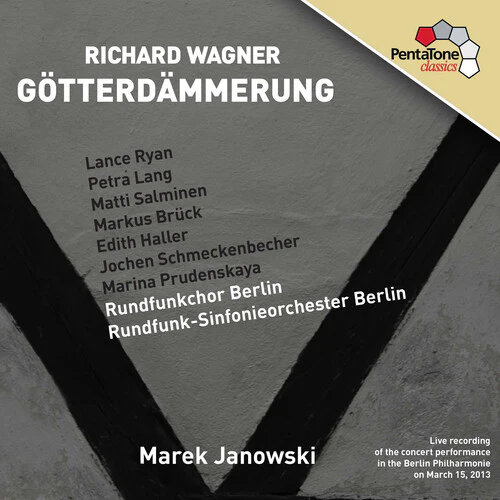
Wagner: Gotterdammerung / Janowski, Ryan, Lang, Haller, Salminen, Bruck
WAGNER Götterdämmerung • Marek Janowski, cond; Lance Ryan ( Siegfried ); Petra Lang ( Brünnhilde ); Matti Salminen ( Hagen ); Markus Brück ( Gunther ); Edith Haller ( Gutrune ); Jochen Schmeckenbecher ( Alberich ); Marina Prudenskaya ( Waltraute ); Julia Borchert ( Woglinde ); Katherine Kammerloher ( Wellgunde ); Kismara Pessatti ( Flosshilde ); Susanne Resmark ( First Norn ); Christa Mayer ( Second Norn ); Jacquelyn Wagner ( Third Norn ); Berlin R Ch & SO • PENTATONE 5186 409 (4 SACDs: 243:42 Text and Translation) Live: Berlin 3/15/2013
In the fall of 2010, PentaTone announced plans to release new concert recordings of Wagner’s 10 mature operas—all with the same conductor, orchestra, and chorus plus top Wagnerian singers—by the end of the composer’s 200th birthday year. A given was that, as with all PentaTone releases, these would be hybrid multichannel SACDs featuring the best possible sound that the Polyhymnia engineering team could muster. Well, they did it. My copy of Götterdämmerung , recorded in May of last year, arrived on my doorstep on December 11, 2013. Almost three weeks to spare. It’s a successful conclusion to an ambitious undertaking, even if a couple of key singers here were not in top form.
Marek Janowski, as usual, favors brisk tempos. He brings in this Götterdämmerung in about 4:04:00; a quick check of five other audio-only versions of the work, of various vintages, revealed a range of 4: 17:00 (Keilberth, 1955) to 4:34:00 (Thielemann, 2010). Sometimes, this penchant for speed is quite evident, as with a third act Funeral March that’s something other than a dirge. Mostly, Janowski’s tempo choices translate into an increased sense of dramatic urgency rather than seeming rushed or perfunctory.
As signaled above, two key performers were not at the top of their game. Lance Ryan sang Siegfried for Zubin Mehta in the Valencia Ring —my favored video version—and, as I noted there, while no Melchior, he gave a dramatically effective account of the misguided hero. Here, his voice seems closed-in, pinched, sometimes even a little nasal in character—though his softer singing, as when he remembers his history to Hagen’s men right before he’s murdered, is better. Petra Lang is a top-tier Wagnerian who always brings intelligence and strong sense of character to her portrayals. Best here is her scene with Waltraute (capably sung by Marina Prudenskaya) where she begins with the same aura of radiant happiness she manifested when she waved goodbye to Siegfried in the Prologue—and then evolves into defiant fury. Lang’s Brünnhilde is set up perfectly for the gigantic disappointment in the form of Siegfried-as-Gunther who is the next visitor to her rock. “Verrat!”—“Betrayed!”—she cries out, and really sounds like she means it. In the last act, though, Lang’s vocal instrument does show some wear in more demanding passages: The voice is a little rough on top with some imperfect intonation. Violeta Urmana was the Brünnhilde for PentaTone’s Siegfried and she’s more technically secure—but, of course, the role in Götterdämmerung makes very different and more extreme demands on a vocalist than does the earlier drama.
But then there’s Hagen. Give me a choice between a grade B-plus Brünnhilde/Siegfried combination with a grade B Hagen, and a B-minus Brünnhilde/Siegfried with an A Hagen, and I’ll take the latter deal every time. And Matti Salminen is an A-plus Hagen: As Peter Rabinowitz noted in a review of the Valencia Ring in Fanfare 34:2, “he virtually owns the part these days.” Salminen’s act I monolog “Hier Stiz’ ich zur Wacht” is darkly horrifying, dripping with contempt not just for Siegfried but for the rest of humanity as well. Janowski backs him up with tritone-laden brass declamations of crushing power.
Markus Brück and Edith Haller capably sing Gunther and Gutrune. At least vocally, there’s no obvious attempt to make the former into a puffed-up fop and the latter into a floozy, as is so often the case in staged productions. They are there to function mechanistically in the scheme Alberich and Hagen have devised to recover the ring and there’s really no need to vilify them further. The trios of Norns and Rhine Maidens are dramatically and musically effective as well.
The choral work in act II is thrilling—and the recording lets you hear everything. Orchestral sonorities are wonderfully warm and richly textured: Listen to the blend of the eight horns in the music between scenes 1 and 2 of the second act (after Alberich and Hagen’s exchange), or to the glowing majesty of the work’s closing pages. The packaging is in the same luxuriant mode as the preceding nine releases: PentaTone provides a 320-page bound booklet that holds the four hybrid multichannel SACDs as well as a German/English libretto, another lengthy essay from Steffen Georgi, and plenty of information on the cast. By the way, I did it. I managed to hang onto the vouchers that came with the nine earlier releases in the series, so I’m entitled to a “special CD collection box.”
As the final D? chord so handsomely recorded by the Polyhymnia engineering team fades away, one is left marveling at the achievement of Marek Janowski and the many top-notch singers who joined him for PentaTone’s project. But mostly, one is left in awe at the remarkable staying power of the music penned by one Wilhelm Richard Wagner.
FANFARE: Andrew Quint
WAGNER Götterdämmerung • Marek Janowski, cond; Lance Ryan ( Siegfried ); Petra Lang ( Brünnhilde ); Matti Salminen ( Hagen ); Markus Brück ( Gunther ); Edith Haller ( Gutrune ); Jochen Schmeckenbecher ( Alberich ); Marina Prudenskaya ( Waltraute ); Julia Borchert ( Woglinde ); Katherine Kammerloher ( Wellgunde ); Kismara Pessatti ( Flosshilde ); Susanne Resmark ( First Norn ); Christa Mayer ( Second Norn ); Jacquelyn Wagner ( Third Norn ); Berlin R Ch & SO • PENTATONE 5186 409 (4 SACDs: 243:42 Text and Translation) Live: Berlin 3/15/2013
In the fall of 2010, PentaTone announced plans to release new concert recordings of Wagner’s 10 mature operas—all with the same conductor, orchestra, and chorus plus top Wagnerian singers—by the end of the composer’s 200th birthday year. A given was that, as with all PentaTone releases, these would be hybrid multichannel SACDs featuring the best possible sound that the Polyhymnia engineering team could muster. Well, they did it. My copy of Götterdämmerung , recorded in May of last year, arrived on my doorstep on December 11, 2013. Almost three weeks to spare. It’s a successful conclusion to an ambitious undertaking, even if a couple of key singers here were not in top form.
Marek Janowski, as usual, favors brisk tempos. He brings in this Götterdämmerung in about 4:04:00; a quick check of five other audio-only versions of the work, of various vintages, revealed a range of 4: 17:00 (Keilberth, 1955) to 4:34:00 (Thielemann, 2010). Sometimes, this penchant for speed is quite evident, as with a third act Funeral March that’s something other than a dirge. Mostly, Janowski’s tempo choices translate into an increased sense of dramatic urgency rather than seeming rushed or perfunctory.
As signaled above, two key performers were not at the top of their game. Lance Ryan sang Siegfried for Zubin Mehta in the Valencia Ring —my favored video version—and, as I noted there, while no Melchior, he gave a dramatically effective account of the misguided hero. Here, his voice seems closed-in, pinched, sometimes even a little nasal in character—though his softer singing, as when he remembers his history to Hagen’s men right before he’s murdered, is better. Petra Lang is a top-tier Wagnerian who always brings intelligence and strong sense of character to her portrayals. Best here is her scene with Waltraute (capably sung by Marina Prudenskaya) where she begins with the same aura of radiant happiness she manifested when she waved goodbye to Siegfried in the Prologue—and then evolves into defiant fury. Lang’s Brünnhilde is set up perfectly for the gigantic disappointment in the form of Siegfried-as-Gunther who is the next visitor to her rock. “Verrat!”—“Betrayed!”—she cries out, and really sounds like she means it. In the last act, though, Lang’s vocal instrument does show some wear in more demanding passages: The voice is a little rough on top with some imperfect intonation. Violeta Urmana was the Brünnhilde for PentaTone’s Siegfried and she’s more technically secure—but, of course, the role in Götterdämmerung makes very different and more extreme demands on a vocalist than does the earlier drama.
But then there’s Hagen. Give me a choice between a grade B-plus Brünnhilde/Siegfried combination with a grade B Hagen, and a B-minus Brünnhilde/Siegfried with an A Hagen, and I’ll take the latter deal every time. And Matti Salminen is an A-plus Hagen: As Peter Rabinowitz noted in a review of the Valencia Ring in Fanfare 34:2, “he virtually owns the part these days.” Salminen’s act I monolog “Hier Stiz’ ich zur Wacht” is darkly horrifying, dripping with contempt not just for Siegfried but for the rest of humanity as well. Janowski backs him up with tritone-laden brass declamations of crushing power.
Markus Brück and Edith Haller capably sing Gunther and Gutrune. At least vocally, there’s no obvious attempt to make the former into a puffed-up fop and the latter into a floozy, as is so often the case in staged productions. They are there to function mechanistically in the scheme Alberich and Hagen have devised to recover the ring and there’s really no need to vilify them further. The trios of Norns and Rhine Maidens are dramatically and musically effective as well.
The choral work in act II is thrilling—and the recording lets you hear everything. Orchestral sonorities are wonderfully warm and richly textured: Listen to the blend of the eight horns in the music between scenes 1 and 2 of the second act (after Alberich and Hagen’s exchange), or to the glowing majesty of the work’s closing pages. The packaging is in the same luxuriant mode as the preceding nine releases: PentaTone provides a 320-page bound booklet that holds the four hybrid multichannel SACDs as well as a German/English libretto, another lengthy essay from Steffen Georgi, and plenty of information on the cast. By the way, I did it. I managed to hang onto the vouchers that came with the nine earlier releases in the series, so I’m entitled to a “special CD collection box.”
As the final D? chord so handsomely recorded by the Polyhymnia engineering team fades away, one is left marveling at the achievement of Marek Janowski and the many top-notch singers who joined him for PentaTone’s project. But mostly, one is left in awe at the remarkable staying power of the music penned by one Wilhelm Richard Wagner.
FANFARE: Andrew Quint
$64.99
Wagner: Gotterdammerung / Janowski, Ryan, Lang, Haller, Salminen, Bruck—
$64.99
Description
WAGNER Götterdämmerung • Marek Janowski, cond; Lance Ryan ( Siegfried ); Petra Lang ( Brünnhilde ); Matti Salminen ( Hagen ); Markus Brück ( Gunther ); Edith Haller ( Gutrune ); Jochen Schmeckenbecher ( Alberich ); Marina Prudenskaya ( Waltraute ); Julia Borchert ( Woglinde ); Katherine Kammerloher ( Wellgunde ); Kismara Pessatti ( Flosshilde ); Susanne Resmark ( First Norn ); Christa Mayer ( Second Norn ); Jacquelyn Wagner ( Third Norn ); Berlin R Ch & SO • PENTATONE 5186 409 (4 SACDs: 243:42 Text and Translation) Live: Berlin 3/15/2013
In the fall of 2010, PentaTone announced plans to release new concert recordings of Wagner’s 10 mature operas—all with the same conductor, orchestra, and chorus plus top Wagnerian singers—by the end of the composer’s 200th birthday year. A given was that, as with all PentaTone releases, these would be hybrid multichannel SACDs featuring the best possible sound that the Polyhymnia engineering team could muster. Well, they did it. My copy of Götterdämmerung , recorded in May of last year, arrived on my doorstep on December 11, 2013. Almost three weeks to spare. It’s a successful conclusion to an ambitious undertaking, even if a couple of key singers here were not in top form.
Marek Janowski, as usual, favors brisk tempos. He brings in this Götterdämmerung in about 4:04:00; a quick check of five other audio-only versions of the work, of various vintages, revealed a range of 4: 17:00 (Keilberth, 1955) to 4:34:00 (Thielemann, 2010). Sometimes, this penchant for speed is quite evident, as with a third act Funeral March that’s something other than a dirge. Mostly, Janowski’s tempo choices translate into an increased sense of dramatic urgency rather than seeming rushed or perfunctory.
As signaled above, two key performers were not at the top of their game. Lance Ryan sang Siegfried for Zubin Mehta in the Valencia Ring —my favored video version—and, as I noted there, while no Melchior, he gave a dramatically effective account of the misguided hero. Here, his voice seems closed-in, pinched, sometimes even a little nasal in character—though his softer singing, as when he remembers his history to Hagen’s men right before he’s murdered, is better. Petra Lang is a top-tier Wagnerian who always brings intelligence and strong sense of character to her portrayals. Best here is her scene with Waltraute (capably sung by Marina Prudenskaya) where she begins with the same aura of radiant happiness she manifested when she waved goodbye to Siegfried in the Prologue—and then evolves into defiant fury. Lang’s Brünnhilde is set up perfectly for the gigantic disappointment in the form of Siegfried-as-Gunther who is the next visitor to her rock. “Verrat!”—“Betrayed!”—she cries out, and really sounds like she means it. In the last act, though, Lang’s vocal instrument does show some wear in more demanding passages: The voice is a little rough on top with some imperfect intonation. Violeta Urmana was the Brünnhilde for PentaTone’s Siegfried and she’s more technically secure—but, of course, the role in Götterdämmerung makes very different and more extreme demands on a vocalist than does the earlier drama.
But then there’s Hagen. Give me a choice between a grade B-plus Brünnhilde/Siegfried combination with a grade B Hagen, and a B-minus Brünnhilde/Siegfried with an A Hagen, and I’ll take the latter deal every time. And Matti Salminen is an A-plus Hagen: As Peter Rabinowitz noted in a review of the Valencia Ring in Fanfare 34:2, “he virtually owns the part these days.” Salminen’s act I monolog “Hier Stiz’ ich zur Wacht” is darkly horrifying, dripping with contempt not just for Siegfried but for the rest of humanity as well. Janowski backs him up with tritone-laden brass declamations of crushing power.
Markus Brück and Edith Haller capably sing Gunther and Gutrune. At least vocally, there’s no obvious attempt to make the former into a puffed-up fop and the latter into a floozy, as is so often the case in staged productions. They are there to function mechanistically in the scheme Alberich and Hagen have devised to recover the ring and there’s really no need to vilify them further. The trios of Norns and Rhine Maidens are dramatically and musically effective as well.
The choral work in act II is thrilling—and the recording lets you hear everything. Orchestral sonorities are wonderfully warm and richly textured: Listen to the blend of the eight horns in the music between scenes 1 and 2 of the second act (after Alberich and Hagen’s exchange), or to the glowing majesty of the work’s closing pages. The packaging is in the same luxuriant mode as the preceding nine releases: PentaTone provides a 320-page bound booklet that holds the four hybrid multichannel SACDs as well as a German/English libretto, another lengthy essay from Steffen Georgi, and plenty of information on the cast. By the way, I did it. I managed to hang onto the vouchers that came with the nine earlier releases in the series, so I’m entitled to a “special CD collection box.”
As the final D? chord so handsomely recorded by the Polyhymnia engineering team fades away, one is left marveling at the achievement of Marek Janowski and the many top-notch singers who joined him for PentaTone’s project. But mostly, one is left in awe at the remarkable staying power of the music penned by one Wilhelm Richard Wagner.
FANFARE: Andrew Quint