🎉 Up to 70% Off Selected ItemsShop Sale

1 / 2
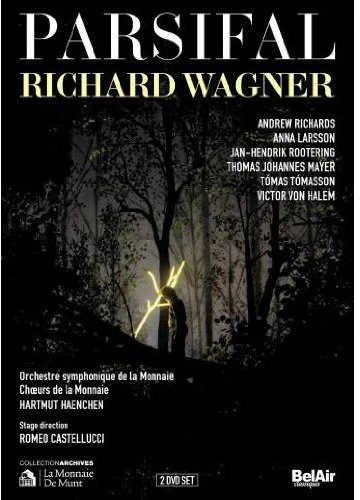
Wagner: Parsifal / Haenchen, Richards, Larsson, Rootering, Mayer, Tomasso
A mythical performance from la Monnaie - Bruxelles.
Parsifal is a strange and enigmatic work. At the end of his life, did Wagner wish to celebrate asceticism, which he himself had never practised? Did he fall upon his knees before the Cross, as claimed by Nietzsche? And what does the secret society of knights based on pure blood signify, desperately waiting for the saviour to regenerate it? What is the true nature of the opposition between the worlds of Klingsor and the Grail? What can Parsifal tell us today? In his artistic will and testament, Wagner condenses his moral idea of the world and returns to the roots of love and religion - to the very heart of art according to him.
With the participation of conductor Hartmut Haenchen who is passionated by the score, Italian stage director Romeo Castellucci proposes an original reading of this brilliant work and explores the essence of Wagnerian ‘Kunstreligion’ in a different light.
“Thanks to the telling contributions of Mr. Castellucci and Mr. Haenchen, the Monnaie’s ‘Parsifal’ casts new light on a difficult opera.” NY TIMES
Parsifal: Andrew Richards
Kundry: Anna Larsson
Gurnemanz: Jan-Hendrik Rootering
Amfortas: Thomas Johannes Mayer
Klingsor: Tómas Tómasson
Titurel: Victor von Halem
Orchestre symphonique de la Monnaie
Hartmut Haenchen
Stage direction: Romeo Castellucci
Choreography: Cindy Van Acker
Set & costume designs, lighting: Romeo Castellucci
Dramaturgy: Piersandra di Matteo
Recording: La Monnaie / De Munt, Bruxelles - 20/02/2011
R E V I E W:3763560.az_WAGNER_Parsifal_Hartmut_Haenchen.html
WAGNER Parsifal • Hartmut Haenchen, cond; Andrew Richards (Parsifal); Anna Larsson (Kundry); Jan-Hendrick Rootering (Gurnemanz); Thomas Johannes Mayer (Amfortas); Tómas Tómasson (Klingsor); Victor von Halem (Titurel); O symphonique de la Monnaie; Ch de la Monnaie; Ch de jeunes de la Monnaie • BELAIR (DVD: 239:00) Live: Brussels 2/20/2011
The Parisian daily Le Monde called this 2011 Le Monnaie production “un Parsifal hallucinaire.” That’s putting it mildly. Wagner’s operas have long inspired “extreme” treatments and this is one of the most extreme I’ve encountered. Some of it works, some of it doesn’t. It’s not for the faint of heart. And I wouldn’t want to be without it.
Parsifal is the first operatic undertaking for the Italian playwright and stage director Romeo Castellucci, well known for his avant-garde tendencies. In the hyperbolic language sometimes employed by men and women devoted to dramaturgy, Castelluci explains his method in the liner notes. “As I approached Parsifal, I tried to forget everything I knew. I put myself in the shoes of someone who knew nothing. I closed my eyes, and I listened once, twenty times, and then a hundred times to the music, this thing. Then I slept. I reworked the whole of Parsifal in a state of amnesia, from the beginning to the end. A work like this needs a vision coming from one’s deepest places … not just an illustrative approach.” OK, that’s a little over the top. But there truly is a dreamlike quality to what you witness here. One remembers images rather than scenes when it’s all over. Act I’s setting is a dense and dark forest in which one can, at first, barely make out the principal singers. (Gurnemanz’s costume covers him from head to toe in leaves, so he fits right in.) Act II is borderline pornographic, as Castelluci dispenses with singing Flowermaidens on stage and, with the vocalists out of sight, has Parsifal tempted by platinum-wigged nude dancers (and, as the credits acknowledge, “Shibari bondage performers” and “contortionists.”) One dancer lies down on a pedestal and aims her external genitalia at the audience for a good 20 minutes. Kundry’s and Amfortas’s act of sexual congress, barely alluded to as a historical event in run-of-the-mill Parsifals, is graphically projected as a hologram. Act III is a complete change of gears, with the chorus joined by a large crowd of non-singing supernumeraries in modern-day dress that, from the Transformation Scene onward, are seen to be slowly striding forward, presumably to a better future world. There are clichés, to be sure—the face paint, Kundry’s application of a few words, graffiti-style, to a blank wall, etc.—and some familiar visual theatrical features are missing: there’s no spear, no non-healing wound, no sign of the Cross when Klingsor’s realm is vanquished. But for contemplative Wagnerians, this will be a very rich experience indeed.
It helps enormously that the musical values are first-rate. Hartmut Haenchen is an experienced and insightful Wagner conductor and, as with his excellent Ring cycle for Etcetera (Fanfare 31:3), he consults the notes of Wagner’s assistants and other artists involved in the first Bayreuth performances. Haenchen definitely eschews the draggy tempos that have become common, but this Parsifal is not the least bit rushed. (For the record, the timing is a half-hour longer than Pierre Boulez’s famously brisk 1970 Bayreuth recording.) Castellucci is not alone in finding Kundry to be the central character in Parsifal—she’s alive and well when the curtain comes down at the close of act III—and Anne Larsson does a terrific job with the wide-ranging dramatic requirements of her role. Jan-Hendrick Rootering is a magisterial Gurnemanz and the American tenor Andrew Richards has a pleasing, well-supported voice well suited to Parsifal. This is Richards’s first Wagner role and, from the sounds of it, Siegmund and Walther, at least, should be on his radar. Thomas Johannes Mayer appears and sounds agonized without scenery chewing. (Remember, he’s got no wound to show off.) Tómas Tómasson is an excellent singer, though perhaps his Klingsor should be a bit less robust to contrast better with the other male characters that still have their “equipment” intact.
Most opera videos released nowadays are carefully planned, with a film director assigned to the project; this video, we are told, is “purely an archive.” No apologies are necessary. The camera work is skillful and editor didn’t feel obliged to always show us who was singing at the moment. (How long can you watch Gurnemanz explaining the back-story, anyway?) The medium was clearly analog film. The sound is good and even though the resolution of Dolby Digital is lower than the stereo PCM option on a DVD, the surround sound program here is sonically very satisfactory. Subtitle choices are English, French, Dutch, and German.
Clearly, this shouldn’t be anyone’s introduction to Parsifal. But for those who want to explore new levels of meaning and emotional power in Wagner’s final work, BelAir’s release deserves the strongest consideration.
FANFARE: Andrew Quint
Parsifal is a strange and enigmatic work. At the end of his life, did Wagner wish to celebrate asceticism, which he himself had never practised? Did he fall upon his knees before the Cross, as claimed by Nietzsche? And what does the secret society of knights based on pure blood signify, desperately waiting for the saviour to regenerate it? What is the true nature of the opposition between the worlds of Klingsor and the Grail? What can Parsifal tell us today? In his artistic will and testament, Wagner condenses his moral idea of the world and returns to the roots of love and religion - to the very heart of art according to him.
With the participation of conductor Hartmut Haenchen who is passionated by the score, Italian stage director Romeo Castellucci proposes an original reading of this brilliant work and explores the essence of Wagnerian ‘Kunstreligion’ in a different light.
“Thanks to the telling contributions of Mr. Castellucci and Mr. Haenchen, the Monnaie’s ‘Parsifal’ casts new light on a difficult opera.” NY TIMES
Parsifal: Andrew Richards
Kundry: Anna Larsson
Gurnemanz: Jan-Hendrik Rootering
Amfortas: Thomas Johannes Mayer
Klingsor: Tómas Tómasson
Titurel: Victor von Halem
Orchestre symphonique de la Monnaie
Hartmut Haenchen
Stage direction: Romeo Castellucci
Choreography: Cindy Van Acker
Set & costume designs, lighting: Romeo Castellucci
Dramaturgy: Piersandra di Matteo
Recording: La Monnaie / De Munt, Bruxelles - 20/02/2011
R E V I E W:
WAGNER Parsifal • Hartmut Haenchen, cond; Andrew Richards (Parsifal); Anna Larsson (Kundry); Jan-Hendrick Rootering (Gurnemanz); Thomas Johannes Mayer (Amfortas); Tómas Tómasson (Klingsor); Victor von Halem (Titurel); O symphonique de la Monnaie; Ch de la Monnaie; Ch de jeunes de la Monnaie • BELAIR (DVD: 239:00) Live: Brussels 2/20/2011
The Parisian daily Le Monde called this 2011 Le Monnaie production “un Parsifal hallucinaire.” That’s putting it mildly. Wagner’s operas have long inspired “extreme” treatments and this is one of the most extreme I’ve encountered. Some of it works, some of it doesn’t. It’s not for the faint of heart. And I wouldn’t want to be without it.
Parsifal is the first operatic undertaking for the Italian playwright and stage director Romeo Castellucci, well known for his avant-garde tendencies. In the hyperbolic language sometimes employed by men and women devoted to dramaturgy, Castelluci explains his method in the liner notes. “As I approached Parsifal, I tried to forget everything I knew. I put myself in the shoes of someone who knew nothing. I closed my eyes, and I listened once, twenty times, and then a hundred times to the music, this thing. Then I slept. I reworked the whole of Parsifal in a state of amnesia, from the beginning to the end. A work like this needs a vision coming from one’s deepest places … not just an illustrative approach.” OK, that’s a little over the top. But there truly is a dreamlike quality to what you witness here. One remembers images rather than scenes when it’s all over. Act I’s setting is a dense and dark forest in which one can, at first, barely make out the principal singers. (Gurnemanz’s costume covers him from head to toe in leaves, so he fits right in.) Act II is borderline pornographic, as Castelluci dispenses with singing Flowermaidens on stage and, with the vocalists out of sight, has Parsifal tempted by platinum-wigged nude dancers (and, as the credits acknowledge, “Shibari bondage performers” and “contortionists.”) One dancer lies down on a pedestal and aims her external genitalia at the audience for a good 20 minutes. Kundry’s and Amfortas’s act of sexual congress, barely alluded to as a historical event in run-of-the-mill Parsifals, is graphically projected as a hologram. Act III is a complete change of gears, with the chorus joined by a large crowd of non-singing supernumeraries in modern-day dress that, from the Transformation Scene onward, are seen to be slowly striding forward, presumably to a better future world. There are clichés, to be sure—the face paint, Kundry’s application of a few words, graffiti-style, to a blank wall, etc.—and some familiar visual theatrical features are missing: there’s no spear, no non-healing wound, no sign of the Cross when Klingsor’s realm is vanquished. But for contemplative Wagnerians, this will be a very rich experience indeed.
It helps enormously that the musical values are first-rate. Hartmut Haenchen is an experienced and insightful Wagner conductor and, as with his excellent Ring cycle for Etcetera (Fanfare 31:3), he consults the notes of Wagner’s assistants and other artists involved in the first Bayreuth performances. Haenchen definitely eschews the draggy tempos that have become common, but this Parsifal is not the least bit rushed. (For the record, the timing is a half-hour longer than Pierre Boulez’s famously brisk 1970 Bayreuth recording.) Castellucci is not alone in finding Kundry to be the central character in Parsifal—she’s alive and well when the curtain comes down at the close of act III—and Anne Larsson does a terrific job with the wide-ranging dramatic requirements of her role. Jan-Hendrick Rootering is a magisterial Gurnemanz and the American tenor Andrew Richards has a pleasing, well-supported voice well suited to Parsifal. This is Richards’s first Wagner role and, from the sounds of it, Siegmund and Walther, at least, should be on his radar. Thomas Johannes Mayer appears and sounds agonized without scenery chewing. (Remember, he’s got no wound to show off.) Tómas Tómasson is an excellent singer, though perhaps his Klingsor should be a bit less robust to contrast better with the other male characters that still have their “equipment” intact.
Most opera videos released nowadays are carefully planned, with a film director assigned to the project; this video, we are told, is “purely an archive.” No apologies are necessary. The camera work is skillful and editor didn’t feel obliged to always show us who was singing at the moment. (How long can you watch Gurnemanz explaining the back-story, anyway?) The medium was clearly analog film. The sound is good and even though the resolution of Dolby Digital is lower than the stereo PCM option on a DVD, the surround sound program here is sonically very satisfactory. Subtitle choices are English, French, Dutch, and German.
Clearly, this shouldn’t be anyone’s introduction to Parsifal. But for those who want to explore new levels of meaning and emotional power in Wagner’s final work, BelAir’s release deserves the strongest consideration.
FANFARE: Andrew Quint
A mythical performance from la Monnaie - Bruxelles.
Parsifal is a strange and enigmatic work. At the end of his life, did Wagner wish to celebrate asceticism, which he himself had never practised? Did he fall upon his knees before the Cross, as claimed by Nietzsche? And what does the secret society of knights based on pure blood signify, desperately waiting for the saviour to regenerate it? What is the true nature of the opposition between the worlds of Klingsor and the Grail? What can Parsifal tell us today? In his artistic will and testament, Wagner condenses his moral idea of the world and returns to the roots of love and religion - to the very heart of art according to him.
With the participation of conductor Hartmut Haenchen who is passionated by the score, Italian stage director Romeo Castellucci proposes an original reading of this brilliant work and explores the essence of Wagnerian ‘Kunstreligion’ in a different light.
“Thanks to the telling contributions of Mr. Castellucci and Mr. Haenchen, the Monnaie’s ‘Parsifal’ casts new light on a difficult opera.” NY TIMES
Parsifal: Andrew Richards
Kundry: Anna Larsson
Gurnemanz: Jan-Hendrik Rootering
Amfortas: Thomas Johannes Mayer
Klingsor: Tómas Tómasson
Titurel: Victor von Halem
Orchestre symphonique de la Monnaie
Hartmut Haenchen
Stage direction: Romeo Castellucci
Choreography: Cindy Van Acker
Set & costume designs, lighting: Romeo Castellucci
Dramaturgy: Piersandra di Matteo
Recording: La Monnaie / De Munt, Bruxelles - 20/02/2011
R E V I E W:3763560.az_WAGNER_Parsifal_Hartmut_Haenchen.html
WAGNER Parsifal • Hartmut Haenchen, cond; Andrew Richards (Parsifal); Anna Larsson (Kundry); Jan-Hendrick Rootering (Gurnemanz); Thomas Johannes Mayer (Amfortas); Tómas Tómasson (Klingsor); Victor von Halem (Titurel); O symphonique de la Monnaie; Ch de la Monnaie; Ch de jeunes de la Monnaie • BELAIR (DVD: 239:00) Live: Brussels 2/20/2011
The Parisian daily Le Monde called this 2011 Le Monnaie production “un Parsifal hallucinaire.” That’s putting it mildly. Wagner’s operas have long inspired “extreme” treatments and this is one of the most extreme I’ve encountered. Some of it works, some of it doesn’t. It’s not for the faint of heart. And I wouldn’t want to be without it.
Parsifal is the first operatic undertaking for the Italian playwright and stage director Romeo Castellucci, well known for his avant-garde tendencies. In the hyperbolic language sometimes employed by men and women devoted to dramaturgy, Castelluci explains his method in the liner notes. “As I approached Parsifal, I tried to forget everything I knew. I put myself in the shoes of someone who knew nothing. I closed my eyes, and I listened once, twenty times, and then a hundred times to the music, this thing. Then I slept. I reworked the whole of Parsifal in a state of amnesia, from the beginning to the end. A work like this needs a vision coming from one’s deepest places … not just an illustrative approach.” OK, that’s a little over the top. But there truly is a dreamlike quality to what you witness here. One remembers images rather than scenes when it’s all over. Act I’s setting is a dense and dark forest in which one can, at first, barely make out the principal singers. (Gurnemanz’s costume covers him from head to toe in leaves, so he fits right in.) Act II is borderline pornographic, as Castelluci dispenses with singing Flowermaidens on stage and, with the vocalists out of sight, has Parsifal tempted by platinum-wigged nude dancers (and, as the credits acknowledge, “Shibari bondage performers” and “contortionists.”) One dancer lies down on a pedestal and aims her external genitalia at the audience for a good 20 minutes. Kundry’s and Amfortas’s act of sexual congress, barely alluded to as a historical event in run-of-the-mill Parsifals, is graphically projected as a hologram. Act III is a complete change of gears, with the chorus joined by a large crowd of non-singing supernumeraries in modern-day dress that, from the Transformation Scene onward, are seen to be slowly striding forward, presumably to a better future world. There are clichés, to be sure—the face paint, Kundry’s application of a few words, graffiti-style, to a blank wall, etc.—and some familiar visual theatrical features are missing: there’s no spear, no non-healing wound, no sign of the Cross when Klingsor’s realm is vanquished. But for contemplative Wagnerians, this will be a very rich experience indeed.
It helps enormously that the musical values are first-rate. Hartmut Haenchen is an experienced and insightful Wagner conductor and, as with his excellent Ring cycle for Etcetera (Fanfare 31:3), he consults the notes of Wagner’s assistants and other artists involved in the first Bayreuth performances. Haenchen definitely eschews the draggy tempos that have become common, but this Parsifal is not the least bit rushed. (For the record, the timing is a half-hour longer than Pierre Boulez’s famously brisk 1970 Bayreuth recording.) Castellucci is not alone in finding Kundry to be the central character in Parsifal—she’s alive and well when the curtain comes down at the close of act III—and Anne Larsson does a terrific job with the wide-ranging dramatic requirements of her role. Jan-Hendrick Rootering is a magisterial Gurnemanz and the American tenor Andrew Richards has a pleasing, well-supported voice well suited to Parsifal. This is Richards’s first Wagner role and, from the sounds of it, Siegmund and Walther, at least, should be on his radar. Thomas Johannes Mayer appears and sounds agonized without scenery chewing. (Remember, he’s got no wound to show off.) Tómas Tómasson is an excellent singer, though perhaps his Klingsor should be a bit less robust to contrast better with the other male characters that still have their “equipment” intact.
Most opera videos released nowadays are carefully planned, with a film director assigned to the project; this video, we are told, is “purely an archive.” No apologies are necessary. The camera work is skillful and editor didn’t feel obliged to always show us who was singing at the moment. (How long can you watch Gurnemanz explaining the back-story, anyway?) The medium was clearly analog film. The sound is good and even though the resolution of Dolby Digital is lower than the stereo PCM option on a DVD, the surround sound program here is sonically very satisfactory. Subtitle choices are English, French, Dutch, and German.
Clearly, this shouldn’t be anyone’s introduction to Parsifal. But for those who want to explore new levels of meaning and emotional power in Wagner’s final work, BelAir’s release deserves the strongest consideration.
FANFARE: Andrew Quint
Parsifal is a strange and enigmatic work. At the end of his life, did Wagner wish to celebrate asceticism, which he himself had never practised? Did he fall upon his knees before the Cross, as claimed by Nietzsche? And what does the secret society of knights based on pure blood signify, desperately waiting for the saviour to regenerate it? What is the true nature of the opposition between the worlds of Klingsor and the Grail? What can Parsifal tell us today? In his artistic will and testament, Wagner condenses his moral idea of the world and returns to the roots of love and religion - to the very heart of art according to him.
With the participation of conductor Hartmut Haenchen who is passionated by the score, Italian stage director Romeo Castellucci proposes an original reading of this brilliant work and explores the essence of Wagnerian ‘Kunstreligion’ in a different light.
“Thanks to the telling contributions of Mr. Castellucci and Mr. Haenchen, the Monnaie’s ‘Parsifal’ casts new light on a difficult opera.” NY TIMES
Parsifal: Andrew Richards
Kundry: Anna Larsson
Gurnemanz: Jan-Hendrik Rootering
Amfortas: Thomas Johannes Mayer
Klingsor: Tómas Tómasson
Titurel: Victor von Halem
Orchestre symphonique de la Monnaie
Hartmut Haenchen
Stage direction: Romeo Castellucci
Choreography: Cindy Van Acker
Set & costume designs, lighting: Romeo Castellucci
Dramaturgy: Piersandra di Matteo
Recording: La Monnaie / De Munt, Bruxelles - 20/02/2011
R E V I E W:
WAGNER Parsifal • Hartmut Haenchen, cond; Andrew Richards (Parsifal); Anna Larsson (Kundry); Jan-Hendrick Rootering (Gurnemanz); Thomas Johannes Mayer (Amfortas); Tómas Tómasson (Klingsor); Victor von Halem (Titurel); O symphonique de la Monnaie; Ch de la Monnaie; Ch de jeunes de la Monnaie • BELAIR (DVD: 239:00) Live: Brussels 2/20/2011
The Parisian daily Le Monde called this 2011 Le Monnaie production “un Parsifal hallucinaire.” That’s putting it mildly. Wagner’s operas have long inspired “extreme” treatments and this is one of the most extreme I’ve encountered. Some of it works, some of it doesn’t. It’s not for the faint of heart. And I wouldn’t want to be without it.
Parsifal is the first operatic undertaking for the Italian playwright and stage director Romeo Castellucci, well known for his avant-garde tendencies. In the hyperbolic language sometimes employed by men and women devoted to dramaturgy, Castelluci explains his method in the liner notes. “As I approached Parsifal, I tried to forget everything I knew. I put myself in the shoes of someone who knew nothing. I closed my eyes, and I listened once, twenty times, and then a hundred times to the music, this thing. Then I slept. I reworked the whole of Parsifal in a state of amnesia, from the beginning to the end. A work like this needs a vision coming from one’s deepest places … not just an illustrative approach.” OK, that’s a little over the top. But there truly is a dreamlike quality to what you witness here. One remembers images rather than scenes when it’s all over. Act I’s setting is a dense and dark forest in which one can, at first, barely make out the principal singers. (Gurnemanz’s costume covers him from head to toe in leaves, so he fits right in.) Act II is borderline pornographic, as Castelluci dispenses with singing Flowermaidens on stage and, with the vocalists out of sight, has Parsifal tempted by platinum-wigged nude dancers (and, as the credits acknowledge, “Shibari bondage performers” and “contortionists.”) One dancer lies down on a pedestal and aims her external genitalia at the audience for a good 20 minutes. Kundry’s and Amfortas’s act of sexual congress, barely alluded to as a historical event in run-of-the-mill Parsifals, is graphically projected as a hologram. Act III is a complete change of gears, with the chorus joined by a large crowd of non-singing supernumeraries in modern-day dress that, from the Transformation Scene onward, are seen to be slowly striding forward, presumably to a better future world. There are clichés, to be sure—the face paint, Kundry’s application of a few words, graffiti-style, to a blank wall, etc.—and some familiar visual theatrical features are missing: there’s no spear, no non-healing wound, no sign of the Cross when Klingsor’s realm is vanquished. But for contemplative Wagnerians, this will be a very rich experience indeed.
It helps enormously that the musical values are first-rate. Hartmut Haenchen is an experienced and insightful Wagner conductor and, as with his excellent Ring cycle for Etcetera (Fanfare 31:3), he consults the notes of Wagner’s assistants and other artists involved in the first Bayreuth performances. Haenchen definitely eschews the draggy tempos that have become common, but this Parsifal is not the least bit rushed. (For the record, the timing is a half-hour longer than Pierre Boulez’s famously brisk 1970 Bayreuth recording.) Castellucci is not alone in finding Kundry to be the central character in Parsifal—she’s alive and well when the curtain comes down at the close of act III—and Anne Larsson does a terrific job with the wide-ranging dramatic requirements of her role. Jan-Hendrick Rootering is a magisterial Gurnemanz and the American tenor Andrew Richards has a pleasing, well-supported voice well suited to Parsifal. This is Richards’s first Wagner role and, from the sounds of it, Siegmund and Walther, at least, should be on his radar. Thomas Johannes Mayer appears and sounds agonized without scenery chewing. (Remember, he’s got no wound to show off.) Tómas Tómasson is an excellent singer, though perhaps his Klingsor should be a bit less robust to contrast better with the other male characters that still have their “equipment” intact.
Most opera videos released nowadays are carefully planned, with a film director assigned to the project; this video, we are told, is “purely an archive.” No apologies are necessary. The camera work is skillful and editor didn’t feel obliged to always show us who was singing at the moment. (How long can you watch Gurnemanz explaining the back-story, anyway?) The medium was clearly analog film. The sound is good and even though the resolution of Dolby Digital is lower than the stereo PCM option on a DVD, the surround sound program here is sonically very satisfactory. Subtitle choices are English, French, Dutch, and German.
Clearly, this shouldn’t be anyone’s introduction to Parsifal. But for those who want to explore new levels of meaning and emotional power in Wagner’s final work, BelAir’s release deserves the strongest consideration.
FANFARE: Andrew Quint
$11.55
Original: $32.99
-65%Wagner: Parsifal / Haenchen, Richards, Larsson, Rootering, Mayer, Tomasso—
$32.99
$11.55Description
A mythical performance from la Monnaie - Bruxelles.
Parsifal is a strange and enigmatic work. At the end of his life, did Wagner wish to celebrate asceticism, which he himself had never practised? Did he fall upon his knees before the Cross, as claimed by Nietzsche? And what does the secret society of knights based on pure blood signify, desperately waiting for the saviour to regenerate it? What is the true nature of the opposition between the worlds of Klingsor and the Grail? What can Parsifal tell us today? In his artistic will and testament, Wagner condenses his moral idea of the world and returns to the roots of love and religion - to the very heart of art according to him.
With the participation of conductor Hartmut Haenchen who is passionated by the score, Italian stage director Romeo Castellucci proposes an original reading of this brilliant work and explores the essence of Wagnerian ‘Kunstreligion’ in a different light.
“Thanks to the telling contributions of Mr. Castellucci and Mr. Haenchen, the Monnaie’s ‘Parsifal’ casts new light on a difficult opera.” NY TIMES
Parsifal: Andrew Richards
Kundry: Anna Larsson
Gurnemanz: Jan-Hendrik Rootering
Amfortas: Thomas Johannes Mayer
Klingsor: Tómas Tómasson
Titurel: Victor von Halem
Orchestre symphonique de la Monnaie
Hartmut Haenchen
Stage direction: Romeo Castellucci
Choreography: Cindy Van Acker
Set & costume designs, lighting: Romeo Castellucci
Dramaturgy: Piersandra di Matteo
Recording: La Monnaie / De Munt, Bruxelles - 20/02/2011
R E V I E W:3763560.az_WAGNER_Parsifal_Hartmut_Haenchen.html
WAGNER Parsifal • Hartmut Haenchen, cond; Andrew Richards (Parsifal); Anna Larsson (Kundry); Jan-Hendrick Rootering (Gurnemanz); Thomas Johannes Mayer (Amfortas); Tómas Tómasson (Klingsor); Victor von Halem (Titurel); O symphonique de la Monnaie; Ch de la Monnaie; Ch de jeunes de la Monnaie • BELAIR (DVD: 239:00) Live: Brussels 2/20/2011
The Parisian daily Le Monde called this 2011 Le Monnaie production “un Parsifal hallucinaire.” That’s putting it mildly. Wagner’s operas have long inspired “extreme” treatments and this is one of the most extreme I’ve encountered. Some of it works, some of it doesn’t. It’s not for the faint of heart. And I wouldn’t want to be without it.
Parsifal is the first operatic undertaking for the Italian playwright and stage director Romeo Castellucci, well known for his avant-garde tendencies. In the hyperbolic language sometimes employed by men and women devoted to dramaturgy, Castelluci explains his method in the liner notes. “As I approached Parsifal, I tried to forget everything I knew. I put myself in the shoes of someone who knew nothing. I closed my eyes, and I listened once, twenty times, and then a hundred times to the music, this thing. Then I slept. I reworked the whole of Parsifal in a state of amnesia, from the beginning to the end. A work like this needs a vision coming from one’s deepest places … not just an illustrative approach.” OK, that’s a little over the top. But there truly is a dreamlike quality to what you witness here. One remembers images rather than scenes when it’s all over. Act I’s setting is a dense and dark forest in which one can, at first, barely make out the principal singers. (Gurnemanz’s costume covers him from head to toe in leaves, so he fits right in.) Act II is borderline pornographic, as Castelluci dispenses with singing Flowermaidens on stage and, with the vocalists out of sight, has Parsifal tempted by platinum-wigged nude dancers (and, as the credits acknowledge, “Shibari bondage performers” and “contortionists.”) One dancer lies down on a pedestal and aims her external genitalia at the audience for a good 20 minutes. Kundry’s and Amfortas’s act of sexual congress, barely alluded to as a historical event in run-of-the-mill Parsifals, is graphically projected as a hologram. Act III is a complete change of gears, with the chorus joined by a large crowd of non-singing supernumeraries in modern-day dress that, from the Transformation Scene onward, are seen to be slowly striding forward, presumably to a better future world. There are clichés, to be sure—the face paint, Kundry’s application of a few words, graffiti-style, to a blank wall, etc.—and some familiar visual theatrical features are missing: there’s no spear, no non-healing wound, no sign of the Cross when Klingsor’s realm is vanquished. But for contemplative Wagnerians, this will be a very rich experience indeed.
It helps enormously that the musical values are first-rate. Hartmut Haenchen is an experienced and insightful Wagner conductor and, as with his excellent Ring cycle for Etcetera (Fanfare 31:3), he consults the notes of Wagner’s assistants and other artists involved in the first Bayreuth performances. Haenchen definitely eschews the draggy tempos that have become common, but this Parsifal is not the least bit rushed. (For the record, the timing is a half-hour longer than Pierre Boulez’s famously brisk 1970 Bayreuth recording.) Castellucci is not alone in finding Kundry to be the central character in Parsifal—she’s alive and well when the curtain comes down at the close of act III—and Anne Larsson does a terrific job with the wide-ranging dramatic requirements of her role. Jan-Hendrick Rootering is a magisterial Gurnemanz and the American tenor Andrew Richards has a pleasing, well-supported voice well suited to Parsifal. This is Richards’s first Wagner role and, from the sounds of it, Siegmund and Walther, at least, should be on his radar. Thomas Johannes Mayer appears and sounds agonized without scenery chewing. (Remember, he’s got no wound to show off.) Tómas Tómasson is an excellent singer, though perhaps his Klingsor should be a bit less robust to contrast better with the other male characters that still have their “equipment” intact.
Most opera videos released nowadays are carefully planned, with a film director assigned to the project; this video, we are told, is “purely an archive.” No apologies are necessary. The camera work is skillful and editor didn’t feel obliged to always show us who was singing at the moment. (How long can you watch Gurnemanz explaining the back-story, anyway?) The medium was clearly analog film. The sound is good and even though the resolution of Dolby Digital is lower than the stereo PCM option on a DVD, the surround sound program here is sonically very satisfactory. Subtitle choices are English, French, Dutch, and German.
Clearly, this shouldn’t be anyone’s introduction to Parsifal. But for those who want to explore new levels of meaning and emotional power in Wagner’s final work, BelAir’s release deserves the strongest consideration.
FANFARE: Andrew Quint
Parsifal is a strange and enigmatic work. At the end of his life, did Wagner wish to celebrate asceticism, which he himself had never practised? Did he fall upon his knees before the Cross, as claimed by Nietzsche? And what does the secret society of knights based on pure blood signify, desperately waiting for the saviour to regenerate it? What is the true nature of the opposition between the worlds of Klingsor and the Grail? What can Parsifal tell us today? In his artistic will and testament, Wagner condenses his moral idea of the world and returns to the roots of love and religion - to the very heart of art according to him.
With the participation of conductor Hartmut Haenchen who is passionated by the score, Italian stage director Romeo Castellucci proposes an original reading of this brilliant work and explores the essence of Wagnerian ‘Kunstreligion’ in a different light.
“Thanks to the telling contributions of Mr. Castellucci and Mr. Haenchen, the Monnaie’s ‘Parsifal’ casts new light on a difficult opera.” NY TIMES
Parsifal: Andrew Richards
Kundry: Anna Larsson
Gurnemanz: Jan-Hendrik Rootering
Amfortas: Thomas Johannes Mayer
Klingsor: Tómas Tómasson
Titurel: Victor von Halem
Orchestre symphonique de la Monnaie
Hartmut Haenchen
Stage direction: Romeo Castellucci
Choreography: Cindy Van Acker
Set & costume designs, lighting: Romeo Castellucci
Dramaturgy: Piersandra di Matteo
Recording: La Monnaie / De Munt, Bruxelles - 20/02/2011
R E V I E W:
WAGNER Parsifal • Hartmut Haenchen, cond; Andrew Richards (Parsifal); Anna Larsson (Kundry); Jan-Hendrick Rootering (Gurnemanz); Thomas Johannes Mayer (Amfortas); Tómas Tómasson (Klingsor); Victor von Halem (Titurel); O symphonique de la Monnaie; Ch de la Monnaie; Ch de jeunes de la Monnaie • BELAIR (DVD: 239:00) Live: Brussels 2/20/2011
The Parisian daily Le Monde called this 2011 Le Monnaie production “un Parsifal hallucinaire.” That’s putting it mildly. Wagner’s operas have long inspired “extreme” treatments and this is one of the most extreme I’ve encountered. Some of it works, some of it doesn’t. It’s not for the faint of heart. And I wouldn’t want to be without it.
Parsifal is the first operatic undertaking for the Italian playwright and stage director Romeo Castellucci, well known for his avant-garde tendencies. In the hyperbolic language sometimes employed by men and women devoted to dramaturgy, Castelluci explains his method in the liner notes. “As I approached Parsifal, I tried to forget everything I knew. I put myself in the shoes of someone who knew nothing. I closed my eyes, and I listened once, twenty times, and then a hundred times to the music, this thing. Then I slept. I reworked the whole of Parsifal in a state of amnesia, from the beginning to the end. A work like this needs a vision coming from one’s deepest places … not just an illustrative approach.” OK, that’s a little over the top. But there truly is a dreamlike quality to what you witness here. One remembers images rather than scenes when it’s all over. Act I’s setting is a dense and dark forest in which one can, at first, barely make out the principal singers. (Gurnemanz’s costume covers him from head to toe in leaves, so he fits right in.) Act II is borderline pornographic, as Castelluci dispenses with singing Flowermaidens on stage and, with the vocalists out of sight, has Parsifal tempted by platinum-wigged nude dancers (and, as the credits acknowledge, “Shibari bondage performers” and “contortionists.”) One dancer lies down on a pedestal and aims her external genitalia at the audience for a good 20 minutes. Kundry’s and Amfortas’s act of sexual congress, barely alluded to as a historical event in run-of-the-mill Parsifals, is graphically projected as a hologram. Act III is a complete change of gears, with the chorus joined by a large crowd of non-singing supernumeraries in modern-day dress that, from the Transformation Scene onward, are seen to be slowly striding forward, presumably to a better future world. There are clichés, to be sure—the face paint, Kundry’s application of a few words, graffiti-style, to a blank wall, etc.—and some familiar visual theatrical features are missing: there’s no spear, no non-healing wound, no sign of the Cross when Klingsor’s realm is vanquished. But for contemplative Wagnerians, this will be a very rich experience indeed.
It helps enormously that the musical values are first-rate. Hartmut Haenchen is an experienced and insightful Wagner conductor and, as with his excellent Ring cycle for Etcetera (Fanfare 31:3), he consults the notes of Wagner’s assistants and other artists involved in the first Bayreuth performances. Haenchen definitely eschews the draggy tempos that have become common, but this Parsifal is not the least bit rushed. (For the record, the timing is a half-hour longer than Pierre Boulez’s famously brisk 1970 Bayreuth recording.) Castellucci is not alone in finding Kundry to be the central character in Parsifal—she’s alive and well when the curtain comes down at the close of act III—and Anne Larsson does a terrific job with the wide-ranging dramatic requirements of her role. Jan-Hendrick Rootering is a magisterial Gurnemanz and the American tenor Andrew Richards has a pleasing, well-supported voice well suited to Parsifal. This is Richards’s first Wagner role and, from the sounds of it, Siegmund and Walther, at least, should be on his radar. Thomas Johannes Mayer appears and sounds agonized without scenery chewing. (Remember, he’s got no wound to show off.) Tómas Tómasson is an excellent singer, though perhaps his Klingsor should be a bit less robust to contrast better with the other male characters that still have their “equipment” intact.
Most opera videos released nowadays are carefully planned, with a film director assigned to the project; this video, we are told, is “purely an archive.” No apologies are necessary. The camera work is skillful and editor didn’t feel obliged to always show us who was singing at the moment. (How long can you watch Gurnemanz explaining the back-story, anyway?) The medium was clearly analog film. The sound is good and even though the resolution of Dolby Digital is lower than the stereo PCM option on a DVD, the surround sound program here is sonically very satisfactory. Subtitle choices are English, French, Dutch, and German.
Clearly, this shouldn’t be anyone’s introduction to Parsifal. But for those who want to explore new levels of meaning and emotional power in Wagner’s final work, BelAir’s release deserves the strongest consideration.
FANFARE: Andrew Quint