🎉 Up to 70% Off Selected ItemsShop Sale

1 / 2
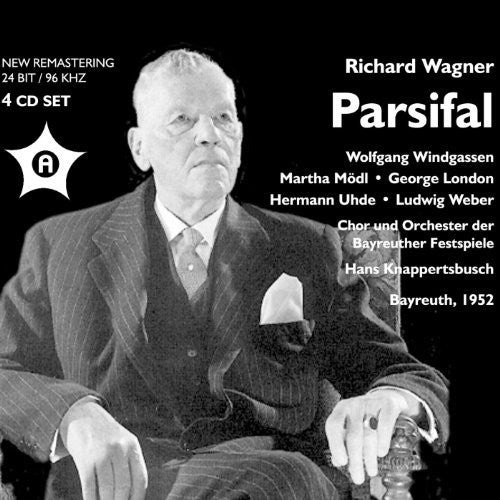
Wagner: Parsifal / Knappertsbusch, Modl, Windgassen, London
WAGNER Parsifal • Hans Knappertsbusch, cond; Wolfgang Windgassen ( Parsifal ); Martha Mödl ( Kundry ); George London ( Amfortas ); Herman Uhde ( Klingsor ); Ludwig Weber ( Gurnemanz ); Kurt Böhme ( Titurel ); Rita Streich, Erika Zimmermann, Hanna Ludwig, Hertha Töpper, Ruth Siewert ( Flower Maidens ); Karl Terkal, Werner Faulhaber ( Grail Knights ); Bayreuth Festival Ch & O • ANDROMEDA 5161, mono (4 CDs: 262:37) Live: Bayreuth 8/1/1952
Once again we have an historic Bayreuth recording from the early Wieland Wagner era, in this case Parsifal under the baton of its once-high priest Knappertsbusch. Possibly due to the overall quieter music, the harsh orchestral sound quality heard on the 1954 Tannhäuser (see my review below) is absent, and if anything the beautiful Bayreuth “sound” permeates this entire performance. Unlike the Tannhäuser, which had formerly appeared on LPs as far back as 1961 and came out on several CD incarnations, this particular Parsifal has only been available (according to the highly reputable web site Opera Discography) on three previous issues, all CD: Melodram, Archipel, and Cantus Classics.
With all due respect to those who enjoy Knappertsbusch’s early-1960s performances (the commercial recording on Philips or the “pirate” version with Jon Vickers), this one simply has more tension and a greater orchestral “sheen” despite the mono sound. And, for me, this cast is simply outstanding in every way. In addition, because of the better orchestral sound, I prefer it to Kna’s 1951 commercially released Decca-London performance from back in the LP days with almost the same principals (except that Arnold van Mill sang Titurel). The one big question mark I had in mind prior to hearing it was Ludwig Weber, a bass who never quite impressed me as both a great voice and a great singing-actor, yet his Gurnemanz in this performance is absolutely first-rate in every respect. The other role I worried about, not vocally but histrionically, was that of the title character, knowing full well that for all his virtues in virtually the entire Wagner canon otherwise, Wolfgang Windgassen was never noted as the most lively or interesting of vocal or stage actors, but he, too, is better than I expected. I suspect that Knappertsbusch’s superb guidance was the answer. Of course, insofar as this conductor and this opera go, they were a perfect artistic match regardless of era (yes, even the 1962 studio recording is good), but to be honest I find his conducting less mannered here, more direct and just as eloquent.
As for the other principals, they are, to my ears, the best in their roles (though I came to appreciate Parsifal rather late, I’ve indeed become a convert and have caught up by listening to several performances through the decades). Mödl’s value always was as much, if not more, as an actress than purely as a singer, and I have admired her ever since Furtwängler’s RAI Ring came out on Seraphim LPs many moons ago. Of modern Kundrys I especially love Waltraud Meier, and purely from a vocal angle her Kundry is better, but Mödl almost gives you the character in 3D. No passive, subservient Kundry she! Mödl’s Kundry, in fact, almost sounds confrontational in the first act, as if she is tired of being treated as a pariah by Gurnemanz and isn’t going to take it any more, and in the second she is pleading with Parsifal rather than just trying to be seductive. And, of course, Amfortas was one of George London’s great roles, so overall we have about as solid a cast (vocally as well as histrionically) as you could hope for. As much as I admire Hans Hotter as a vocal actor, he was simply past his vocal prime after 1957 or so, therefore as much as I like his acting, his singing in the 1962 recording is no match for Weber’s.
And then there is the Bayreuth “sound.” As much as I can like other performances and recordings of Wagner’s music dramas, by and large I am drawn to those that emanated from the Green Hill because of its unusual two-second “decay,” which always seems to add something to the music. Between that aspect of the recording and the magnificent performances, one may wish for the visual element but it isn’t necessary. Somehow or other, Kna manages to conjure up the visuals in your mind as you listen, and even in ancient mono you seem to get a sense of “space” in the sonics that just doesn’t exist in others’ performances, no matter how good—and I, for one, was really blown away by the Metropolitan Opera’s 2012–13 production of this opera when it was broadcast, especially by Jonas Kaufmann’s stellar interpretation of the title role. That one may yet supplant this in my mind (and collection) if and when it comes out on DVD, but in the meantime I could easily live with this recording to the end of my days.
FANFARE: Lynn René Bayley
WAGNER Parsifal • Hans Knappertsbusch, cond; Wolfgang Windgassen ( Parsifal ); Martha Mödl ( Kundry ); George London ( Amfortas ); Herman Uhde ( Klingsor ); Ludwig Weber ( Gurnemanz ); Kurt Böhme ( Titurel ); Rita Streich, Erika Zimmermann, Hanna Ludwig, Hertha Töpper, Ruth Siewert ( Flower Maidens ); Karl Terkal, Werner Faulhaber ( Grail Knights ); Bayreuth Festival Ch & O • ANDROMEDA 5161, mono (4 CDs: 262:37) Live: Bayreuth 8/1/1952
Once again we have an historic Bayreuth recording from the early Wieland Wagner era, in this case Parsifal under the baton of its once-high priest Knappertsbusch. Possibly due to the overall quieter music, the harsh orchestral sound quality heard on the 1954 Tannhäuser (see my review below) is absent, and if anything the beautiful Bayreuth “sound” permeates this entire performance. Unlike the Tannhäuser, which had formerly appeared on LPs as far back as 1961 and came out on several CD incarnations, this particular Parsifal has only been available (according to the highly reputable web site Opera Discography) on three previous issues, all CD: Melodram, Archipel, and Cantus Classics.
With all due respect to those who enjoy Knappertsbusch’s early-1960s performances (the commercial recording on Philips or the “pirate” version with Jon Vickers), this one simply has more tension and a greater orchestral “sheen” despite the mono sound. And, for me, this cast is simply outstanding in every way. In addition, because of the better orchestral sound, I prefer it to Kna’s 1951 commercially released Decca-London performance from back in the LP days with almost the same principals (except that Arnold van Mill sang Titurel). The one big question mark I had in mind prior to hearing it was Ludwig Weber, a bass who never quite impressed me as both a great voice and a great singing-actor, yet his Gurnemanz in this performance is absolutely first-rate in every respect. The other role I worried about, not vocally but histrionically, was that of the title character, knowing full well that for all his virtues in virtually the entire Wagner canon otherwise, Wolfgang Windgassen was never noted as the most lively or interesting of vocal or stage actors, but he, too, is better than I expected. I suspect that Knappertsbusch’s superb guidance was the answer. Of course, insofar as this conductor and this opera go, they were a perfect artistic match regardless of era (yes, even the 1962 studio recording is good), but to be honest I find his conducting less mannered here, more direct and just as eloquent.
As for the other principals, they are, to my ears, the best in their roles (though I came to appreciate Parsifal rather late, I’ve indeed become a convert and have caught up by listening to several performances through the decades). Mödl’s value always was as much, if not more, as an actress than purely as a singer, and I have admired her ever since Furtwängler’s RAI Ring came out on Seraphim LPs many moons ago. Of modern Kundrys I especially love Waltraud Meier, and purely from a vocal angle her Kundry is better, but Mödl almost gives you the character in 3D. No passive, subservient Kundry she! Mödl’s Kundry, in fact, almost sounds confrontational in the first act, as if she is tired of being treated as a pariah by Gurnemanz and isn’t going to take it any more, and in the second she is pleading with Parsifal rather than just trying to be seductive. And, of course, Amfortas was one of George London’s great roles, so overall we have about as solid a cast (vocally as well as histrionically) as you could hope for. As much as I admire Hans Hotter as a vocal actor, he was simply past his vocal prime after 1957 or so, therefore as much as I like his acting, his singing in the 1962 recording is no match for Weber’s.
And then there is the Bayreuth “sound.” As much as I can like other performances and recordings of Wagner’s music dramas, by and large I am drawn to those that emanated from the Green Hill because of its unusual two-second “decay,” which always seems to add something to the music. Between that aspect of the recording and the magnificent performances, one may wish for the visual element but it isn’t necessary. Somehow or other, Kna manages to conjure up the visuals in your mind as you listen, and even in ancient mono you seem to get a sense of “space” in the sonics that just doesn’t exist in others’ performances, no matter how good—and I, for one, was really blown away by the Metropolitan Opera’s 2012–13 production of this opera when it was broadcast, especially by Jonas Kaufmann’s stellar interpretation of the title role. That one may yet supplant this in my mind (and collection) if and when it comes out on DVD, but in the meantime I could easily live with this recording to the end of my days.
FANFARE: Lynn René Bayley
$9.45
Original: $26.99
-65%Wagner: Parsifal / Knappertsbusch, Modl, Windgassen, London—
$26.99
$9.45Description
WAGNER Parsifal • Hans Knappertsbusch, cond; Wolfgang Windgassen ( Parsifal ); Martha Mödl ( Kundry ); George London ( Amfortas ); Herman Uhde ( Klingsor ); Ludwig Weber ( Gurnemanz ); Kurt Böhme ( Titurel ); Rita Streich, Erika Zimmermann, Hanna Ludwig, Hertha Töpper, Ruth Siewert ( Flower Maidens ); Karl Terkal, Werner Faulhaber ( Grail Knights ); Bayreuth Festival Ch & O • ANDROMEDA 5161, mono (4 CDs: 262:37) Live: Bayreuth 8/1/1952
Once again we have an historic Bayreuth recording from the early Wieland Wagner era, in this case Parsifal under the baton of its once-high priest Knappertsbusch. Possibly due to the overall quieter music, the harsh orchestral sound quality heard on the 1954 Tannhäuser (see my review below) is absent, and if anything the beautiful Bayreuth “sound” permeates this entire performance. Unlike the Tannhäuser, which had formerly appeared on LPs as far back as 1961 and came out on several CD incarnations, this particular Parsifal has only been available (according to the highly reputable web site Opera Discography) on three previous issues, all CD: Melodram, Archipel, and Cantus Classics.
With all due respect to those who enjoy Knappertsbusch’s early-1960s performances (the commercial recording on Philips or the “pirate” version with Jon Vickers), this one simply has more tension and a greater orchestral “sheen” despite the mono sound. And, for me, this cast is simply outstanding in every way. In addition, because of the better orchestral sound, I prefer it to Kna’s 1951 commercially released Decca-London performance from back in the LP days with almost the same principals (except that Arnold van Mill sang Titurel). The one big question mark I had in mind prior to hearing it was Ludwig Weber, a bass who never quite impressed me as both a great voice and a great singing-actor, yet his Gurnemanz in this performance is absolutely first-rate in every respect. The other role I worried about, not vocally but histrionically, was that of the title character, knowing full well that for all his virtues in virtually the entire Wagner canon otherwise, Wolfgang Windgassen was never noted as the most lively or interesting of vocal or stage actors, but he, too, is better than I expected. I suspect that Knappertsbusch’s superb guidance was the answer. Of course, insofar as this conductor and this opera go, they were a perfect artistic match regardless of era (yes, even the 1962 studio recording is good), but to be honest I find his conducting less mannered here, more direct and just as eloquent.
As for the other principals, they are, to my ears, the best in their roles (though I came to appreciate Parsifal rather late, I’ve indeed become a convert and have caught up by listening to several performances through the decades). Mödl’s value always was as much, if not more, as an actress than purely as a singer, and I have admired her ever since Furtwängler’s RAI Ring came out on Seraphim LPs many moons ago. Of modern Kundrys I especially love Waltraud Meier, and purely from a vocal angle her Kundry is better, but Mödl almost gives you the character in 3D. No passive, subservient Kundry she! Mödl’s Kundry, in fact, almost sounds confrontational in the first act, as if she is tired of being treated as a pariah by Gurnemanz and isn’t going to take it any more, and in the second she is pleading with Parsifal rather than just trying to be seductive. And, of course, Amfortas was one of George London’s great roles, so overall we have about as solid a cast (vocally as well as histrionically) as you could hope for. As much as I admire Hans Hotter as a vocal actor, he was simply past his vocal prime after 1957 or so, therefore as much as I like his acting, his singing in the 1962 recording is no match for Weber’s.
And then there is the Bayreuth “sound.” As much as I can like other performances and recordings of Wagner’s music dramas, by and large I am drawn to those that emanated from the Green Hill because of its unusual two-second “decay,” which always seems to add something to the music. Between that aspect of the recording and the magnificent performances, one may wish for the visual element but it isn’t necessary. Somehow or other, Kna manages to conjure up the visuals in your mind as you listen, and even in ancient mono you seem to get a sense of “space” in the sonics that just doesn’t exist in others’ performances, no matter how good—and I, for one, was really blown away by the Metropolitan Opera’s 2012–13 production of this opera when it was broadcast, especially by Jonas Kaufmann’s stellar interpretation of the title role. That one may yet supplant this in my mind (and collection) if and when it comes out on DVD, but in the meantime I could easily live with this recording to the end of my days.
FANFARE: Lynn René Bayley