🎉 Up to 70% Off Selected ItemsShop Sale

1 / 2
Wagner: Siegfried / Weigle, Ryan, Marsh, Stensvold, Schmeckenbecher
A year or so ago Oehms released a CD version of this opera from the same source that was recorded in 2011; this video version was made the following year. I was impressed with the earlier CDs, and this performance has much to recommend it as well. The added visual element is a definite plus–it’s a fascinating production.
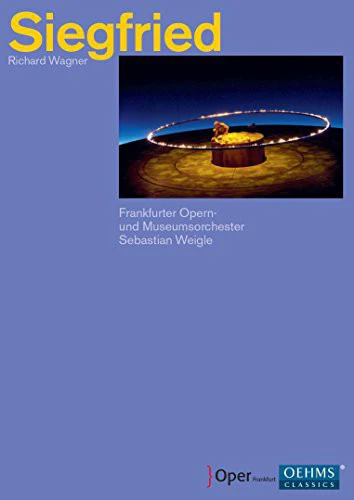
Jens Kilian is the set designer and Vera Nemirova is the director. Yes, it is Regie, but there’s neither an overturned chair nor a Nazi to be found. The set is a huge, tilted circle; within it, like the rings of an old tree, are other, smaller circles that rise and fall. Some characters live and work on the lower levels (Mime and Erda), and some above; others travel between. The circle can open into smaller chambers for one-on-one moments–the Wanderer and Mime are chatting comfortably at times in a “comfortable” space. When Brünnhilde is placed on her rock–dead center of the huge ring–it rises to form a pillar, and the fire (real fire, by the way), the circumference of a larger ring, rises to protect her, like a nimbus. Aside from swords, spears, and a forge, there are no props. A most remarkable decision of Nemirova’s is to make the Forest Bird a lithe dancer (Alan Barnes, here) with long, feathery talons, who moves and flaps silently, and also moves appropriately when the off-stage voice of the bird (Robin Johannsen, quite lovely) sings.
Mime, wearing thick glasses, is dirty-looking and clumsy; Siegfried, blonde hair flowing, is in leather and a bear skin at the start (the stage direction, “enter, chasing bear”, has been altered to “enter, wearing a bear”), and later in what looks like a collection of wolf skins. The Wanderer goes from elegant dress pants to long, leather coat, but he’s always natty. In other words, due to the set and costume design, this Ring is universal; it takes place neither then nor now; it weds the phantasmagoric with the literal. Somehow, it all works.
Moreover, the characterizations are vivid. Siegfried may be an insensitive dolt, but he’s genuinely curious about baby animals looking like their parents, touched emotionally by the green around him during the Forest Murmurs, stumped and jumpy when he discovers that Brünnhilde is not a man, and almost maniacally happy at the opera’s close. Wotan is a tough guy in Act 1 with Mime, but is all too human in his confrontations with both Erda and Siegfried. And Brünnhilde’s transformation from goddess to woman is subtle and rings true.
Musically, there is much to marvel at, as there was with the audio-only CDs. Sebastian Weigle, while not holding back, gets a chamber-like effect from the orchestra, and the series of duets that make up the opera have an informality about them that practically turn some scenes into a drawing room comedy or drama. Siegfried and Mime banter irritatingly and Mime and the Wanderer play off one another. Mime’s commentary during the Forging Song is deliciously wicked (diction is impeccable from all singers throughout).
Casting a true Heldenbariton, rather than a bass Wanderer, is one of the keys. I was unfamiliar with Terje Stensvold and assumed him a relatively new find; in fact, he is 68 years old and has been singing for decades, with no deterioration of the voice’s core. As suggested above, his Wotan can be playful and grave by turns, godlike and ready to give up his godhood. It is a wonderful performance.
Similarly, Lance Ryan as Siegfried is more in the Windgassen than the bari-tenor mode (he studied with Gianni Raimondi and Carlo Bergonzi). His tone is bright and forward and his high notes are amazingly big and solid–he even articulates the high C at the end of his entrance laughter. The Forging Song sounds joyous. He’s tireless until the last 20 minutes, where at this point his tone becomes leathery, with pitch issues as well. But he’s exciting, good to watch, and one of the more “complete” Siegfrieds I’ve ever seen.
Susan Bullock’s Brünnhilde is matronly–she actually does look like Siegfried’s aunt–but she acts up a storm and almost makes up for it. She’s in better vocal condition than on the CDs, with the voice solidly produced, a real trill, her enunciation perfect. The voice may not be pretty but she inhabits the role, and the high notes ring out as well. As the pair acknowledges their love, Brünnhilde’s pedestal lowers–they’re finally on the same level. A nice touch, again.
Peter Marsh’s Mime is just right, a slime-ball who thinks he’s smarter than he is, with a voice that’s laser-focused. Jochen Schmeckenbecher’s Alberich, in somewhat regular, modern dress, is not as dark-toned as we’re accustomed to (Neidlinger, Kelemann), but his nastiness is never in doubt. Magnus Baldvinsson’s Fafner, not amplified and hardly a huge sound, becomes all too human, wonderfully curious about the boy who kills him. Meredith Arwady’s Erda, assisted by crucial stillness from Weigle’s baton, makes the best of her scene, albeit with a far-too-wide vibrato.
Conductor Sebastian Weigle has no fear of pulling out all the stops, but he never drowns out the singers; inner voices are audible but not awkwardly underlined. His chosen tinta–lighter than the Furtwängler, Knappertsbusch, Levine crowd–is abetted by the surprisingly brilliant playing by the Frankfurt forces, whose brass is shiny and whose strings shimmer, but also by two other factors: the spotless recording, in which the harps and triangle can be heard even when up against the full complement of strings and winds.
The unhelpful booklet has only a synopsis in German and English; those are the subtitle choices as well. There are only three tracks per act–a really dumb, inconvenient choice. There is wild applause, and plenty of it, after each act. This is a good option for a non-traditional (i.e: the opposite of the Met’s literal set on DG) Siegfried, along with Barenboim’s on Warner Classics, in the Harry Kupfer, Bayreuth production.
-- Robert Levine, ClassicsToday.com
Jens Kilian is the set designer and Vera Nemirova is the director. Yes, it is Regie, but there’s neither an overturned chair nor a Nazi to be found. The set is a huge, tilted circle; within it, like the rings of an old tree, are other, smaller circles that rise and fall. Some characters live and work on the lower levels (Mime and Erda), and some above; others travel between. The circle can open into smaller chambers for one-on-one moments–the Wanderer and Mime are chatting comfortably at times in a “comfortable” space. When Brünnhilde is placed on her rock–dead center of the huge ring–it rises to form a pillar, and the fire (real fire, by the way), the circumference of a larger ring, rises to protect her, like a nimbus. Aside from swords, spears, and a forge, there are no props. A most remarkable decision of Nemirova’s is to make the Forest Bird a lithe dancer (Alan Barnes, here) with long, feathery talons, who moves and flaps silently, and also moves appropriately when the off-stage voice of the bird (Robin Johannsen, quite lovely) sings.
Mime, wearing thick glasses, is dirty-looking and clumsy; Siegfried, blonde hair flowing, is in leather and a bear skin at the start (the stage direction, “enter, chasing bear”, has been altered to “enter, wearing a bear”), and later in what looks like a collection of wolf skins. The Wanderer goes from elegant dress pants to long, leather coat, but he’s always natty. In other words, due to the set and costume design, this Ring is universal; it takes place neither then nor now; it weds the phantasmagoric with the literal. Somehow, it all works.
Moreover, the characterizations are vivid. Siegfried may be an insensitive dolt, but he’s genuinely curious about baby animals looking like their parents, touched emotionally by the green around him during the Forest Murmurs, stumped and jumpy when he discovers that Brünnhilde is not a man, and almost maniacally happy at the opera’s close. Wotan is a tough guy in Act 1 with Mime, but is all too human in his confrontations with both Erda and Siegfried. And Brünnhilde’s transformation from goddess to woman is subtle and rings true.
Musically, there is much to marvel at, as there was with the audio-only CDs. Sebastian Weigle, while not holding back, gets a chamber-like effect from the orchestra, and the series of duets that make up the opera have an informality about them that practically turn some scenes into a drawing room comedy or drama. Siegfried and Mime banter irritatingly and Mime and the Wanderer play off one another. Mime’s commentary during the Forging Song is deliciously wicked (diction is impeccable from all singers throughout).
Casting a true Heldenbariton, rather than a bass Wanderer, is one of the keys. I was unfamiliar with Terje Stensvold and assumed him a relatively new find; in fact, he is 68 years old and has been singing for decades, with no deterioration of the voice’s core. As suggested above, his Wotan can be playful and grave by turns, godlike and ready to give up his godhood. It is a wonderful performance.
Similarly, Lance Ryan as Siegfried is more in the Windgassen than the bari-tenor mode (he studied with Gianni Raimondi and Carlo Bergonzi). His tone is bright and forward and his high notes are amazingly big and solid–he even articulates the high C at the end of his entrance laughter. The Forging Song sounds joyous. He’s tireless until the last 20 minutes, where at this point his tone becomes leathery, with pitch issues as well. But he’s exciting, good to watch, and one of the more “complete” Siegfrieds I’ve ever seen.
Susan Bullock’s Brünnhilde is matronly–she actually does look like Siegfried’s aunt–but she acts up a storm and almost makes up for it. She’s in better vocal condition than on the CDs, with the voice solidly produced, a real trill, her enunciation perfect. The voice may not be pretty but she inhabits the role, and the high notes ring out as well. As the pair acknowledges their love, Brünnhilde’s pedestal lowers–they’re finally on the same level. A nice touch, again.
Peter Marsh’s Mime is just right, a slime-ball who thinks he’s smarter than he is, with a voice that’s laser-focused. Jochen Schmeckenbecher’s Alberich, in somewhat regular, modern dress, is not as dark-toned as we’re accustomed to (Neidlinger, Kelemann), but his nastiness is never in doubt. Magnus Baldvinsson’s Fafner, not amplified and hardly a huge sound, becomes all too human, wonderfully curious about the boy who kills him. Meredith Arwady’s Erda, assisted by crucial stillness from Weigle’s baton, makes the best of her scene, albeit with a far-too-wide vibrato.
Conductor Sebastian Weigle has no fear of pulling out all the stops, but he never drowns out the singers; inner voices are audible but not awkwardly underlined. His chosen tinta–lighter than the Furtwängler, Knappertsbusch, Levine crowd–is abetted by the surprisingly brilliant playing by the Frankfurt forces, whose brass is shiny and whose strings shimmer, but also by two other factors: the spotless recording, in which the harps and triangle can be heard even when up against the full complement of strings and winds.
The unhelpful booklet has only a synopsis in German and English; those are the subtitle choices as well. There are only three tracks per act–a really dumb, inconvenient choice. There is wild applause, and plenty of it, after each act. This is a good option for a non-traditional (i.e: the opposite of the Met’s literal set on DG) Siegfried, along with Barenboim’s on Warner Classics, in the Harry Kupfer, Bayreuth production.
-- Robert Levine, ClassicsToday.com
A year or so ago Oehms released a CD version of this opera from the same source that was recorded in 2011; this video version was made the following year. I was impressed with the earlier CDs, and this performance has much to recommend it as well. The added visual element is a definite plus–it’s a fascinating production.
Jens Kilian is the set designer and Vera Nemirova is the director. Yes, it is Regie, but there’s neither an overturned chair nor a Nazi to be found. The set is a huge, tilted circle; within it, like the rings of an old tree, are other, smaller circles that rise and fall. Some characters live and work on the lower levels (Mime and Erda), and some above; others travel between. The circle can open into smaller chambers for one-on-one moments–the Wanderer and Mime are chatting comfortably at times in a “comfortable” space. When Brünnhilde is placed on her rock–dead center of the huge ring–it rises to form a pillar, and the fire (real fire, by the way), the circumference of a larger ring, rises to protect her, like a nimbus. Aside from swords, spears, and a forge, there are no props. A most remarkable decision of Nemirova’s is to make the Forest Bird a lithe dancer (Alan Barnes, here) with long, feathery talons, who moves and flaps silently, and also moves appropriately when the off-stage voice of the bird (Robin Johannsen, quite lovely) sings.
Mime, wearing thick glasses, is dirty-looking and clumsy; Siegfried, blonde hair flowing, is in leather and a bear skin at the start (the stage direction, “enter, chasing bear”, has been altered to “enter, wearing a bear”), and later in what looks like a collection of wolf skins. The Wanderer goes from elegant dress pants to long, leather coat, but he’s always natty. In other words, due to the set and costume design, this Ring is universal; it takes place neither then nor now; it weds the phantasmagoric with the literal. Somehow, it all works.
Moreover, the characterizations are vivid. Siegfried may be an insensitive dolt, but he’s genuinely curious about baby animals looking like their parents, touched emotionally by the green around him during the Forest Murmurs, stumped and jumpy when he discovers that Brünnhilde is not a man, and almost maniacally happy at the opera’s close. Wotan is a tough guy in Act 1 with Mime, but is all too human in his confrontations with both Erda and Siegfried. And Brünnhilde’s transformation from goddess to woman is subtle and rings true.
Musically, there is much to marvel at, as there was with the audio-only CDs. Sebastian Weigle, while not holding back, gets a chamber-like effect from the orchestra, and the series of duets that make up the opera have an informality about them that practically turn some scenes into a drawing room comedy or drama. Siegfried and Mime banter irritatingly and Mime and the Wanderer play off one another. Mime’s commentary during the Forging Song is deliciously wicked (diction is impeccable from all singers throughout).
Casting a true Heldenbariton, rather than a bass Wanderer, is one of the keys. I was unfamiliar with Terje Stensvold and assumed him a relatively new find; in fact, he is 68 years old and has been singing for decades, with no deterioration of the voice’s core. As suggested above, his Wotan can be playful and grave by turns, godlike and ready to give up his godhood. It is a wonderful performance.
Similarly, Lance Ryan as Siegfried is more in the Windgassen than the bari-tenor mode (he studied with Gianni Raimondi and Carlo Bergonzi). His tone is bright and forward and his high notes are amazingly big and solid–he even articulates the high C at the end of his entrance laughter. The Forging Song sounds joyous. He’s tireless until the last 20 minutes, where at this point his tone becomes leathery, with pitch issues as well. But he’s exciting, good to watch, and one of the more “complete” Siegfrieds I’ve ever seen.
Susan Bullock’s Brünnhilde is matronly–she actually does look like Siegfried’s aunt–but she acts up a storm and almost makes up for it. She’s in better vocal condition than on the CDs, with the voice solidly produced, a real trill, her enunciation perfect. The voice may not be pretty but she inhabits the role, and the high notes ring out as well. As the pair acknowledges their love, Brünnhilde’s pedestal lowers–they’re finally on the same level. A nice touch, again.
Peter Marsh’s Mime is just right, a slime-ball who thinks he’s smarter than he is, with a voice that’s laser-focused. Jochen Schmeckenbecher’s Alberich, in somewhat regular, modern dress, is not as dark-toned as we’re accustomed to (Neidlinger, Kelemann), but his nastiness is never in doubt. Magnus Baldvinsson’s Fafner, not amplified and hardly a huge sound, becomes all too human, wonderfully curious about the boy who kills him. Meredith Arwady’s Erda, assisted by crucial stillness from Weigle’s baton, makes the best of her scene, albeit with a far-too-wide vibrato.
Conductor Sebastian Weigle has no fear of pulling out all the stops, but he never drowns out the singers; inner voices are audible but not awkwardly underlined. His chosen tinta–lighter than the Furtwängler, Knappertsbusch, Levine crowd–is abetted by the surprisingly brilliant playing by the Frankfurt forces, whose brass is shiny and whose strings shimmer, but also by two other factors: the spotless recording, in which the harps and triangle can be heard even when up against the full complement of strings and winds.
The unhelpful booklet has only a synopsis in German and English; those are the subtitle choices as well. There are only three tracks per act–a really dumb, inconvenient choice. There is wild applause, and plenty of it, after each act. This is a good option for a non-traditional (i.e: the opposite of the Met’s literal set on DG) Siegfried, along with Barenboim’s on Warner Classics, in the Harry Kupfer, Bayreuth production.
-- Robert Levine, ClassicsToday.com
Jens Kilian is the set designer and Vera Nemirova is the director. Yes, it is Regie, but there’s neither an overturned chair nor a Nazi to be found. The set is a huge, tilted circle; within it, like the rings of an old tree, are other, smaller circles that rise and fall. Some characters live and work on the lower levels (Mime and Erda), and some above; others travel between. The circle can open into smaller chambers for one-on-one moments–the Wanderer and Mime are chatting comfortably at times in a “comfortable” space. When Brünnhilde is placed on her rock–dead center of the huge ring–it rises to form a pillar, and the fire (real fire, by the way), the circumference of a larger ring, rises to protect her, like a nimbus. Aside from swords, spears, and a forge, there are no props. A most remarkable decision of Nemirova’s is to make the Forest Bird a lithe dancer (Alan Barnes, here) with long, feathery talons, who moves and flaps silently, and also moves appropriately when the off-stage voice of the bird (Robin Johannsen, quite lovely) sings.
Mime, wearing thick glasses, is dirty-looking and clumsy; Siegfried, blonde hair flowing, is in leather and a bear skin at the start (the stage direction, “enter, chasing bear”, has been altered to “enter, wearing a bear”), and later in what looks like a collection of wolf skins. The Wanderer goes from elegant dress pants to long, leather coat, but he’s always natty. In other words, due to the set and costume design, this Ring is universal; it takes place neither then nor now; it weds the phantasmagoric with the literal. Somehow, it all works.
Moreover, the characterizations are vivid. Siegfried may be an insensitive dolt, but he’s genuinely curious about baby animals looking like their parents, touched emotionally by the green around him during the Forest Murmurs, stumped and jumpy when he discovers that Brünnhilde is not a man, and almost maniacally happy at the opera’s close. Wotan is a tough guy in Act 1 with Mime, but is all too human in his confrontations with both Erda and Siegfried. And Brünnhilde’s transformation from goddess to woman is subtle and rings true.
Musically, there is much to marvel at, as there was with the audio-only CDs. Sebastian Weigle, while not holding back, gets a chamber-like effect from the orchestra, and the series of duets that make up the opera have an informality about them that practically turn some scenes into a drawing room comedy or drama. Siegfried and Mime banter irritatingly and Mime and the Wanderer play off one another. Mime’s commentary during the Forging Song is deliciously wicked (diction is impeccable from all singers throughout).
Casting a true Heldenbariton, rather than a bass Wanderer, is one of the keys. I was unfamiliar with Terje Stensvold and assumed him a relatively new find; in fact, he is 68 years old and has been singing for decades, with no deterioration of the voice’s core. As suggested above, his Wotan can be playful and grave by turns, godlike and ready to give up his godhood. It is a wonderful performance.
Similarly, Lance Ryan as Siegfried is more in the Windgassen than the bari-tenor mode (he studied with Gianni Raimondi and Carlo Bergonzi). His tone is bright and forward and his high notes are amazingly big and solid–he even articulates the high C at the end of his entrance laughter. The Forging Song sounds joyous. He’s tireless until the last 20 minutes, where at this point his tone becomes leathery, with pitch issues as well. But he’s exciting, good to watch, and one of the more “complete” Siegfrieds I’ve ever seen.
Susan Bullock’s Brünnhilde is matronly–she actually does look like Siegfried’s aunt–but she acts up a storm and almost makes up for it. She’s in better vocal condition than on the CDs, with the voice solidly produced, a real trill, her enunciation perfect. The voice may not be pretty but she inhabits the role, and the high notes ring out as well. As the pair acknowledges their love, Brünnhilde’s pedestal lowers–they’re finally on the same level. A nice touch, again.
Peter Marsh’s Mime is just right, a slime-ball who thinks he’s smarter than he is, with a voice that’s laser-focused. Jochen Schmeckenbecher’s Alberich, in somewhat regular, modern dress, is not as dark-toned as we’re accustomed to (Neidlinger, Kelemann), but his nastiness is never in doubt. Magnus Baldvinsson’s Fafner, not amplified and hardly a huge sound, becomes all too human, wonderfully curious about the boy who kills him. Meredith Arwady’s Erda, assisted by crucial stillness from Weigle’s baton, makes the best of her scene, albeit with a far-too-wide vibrato.
Conductor Sebastian Weigle has no fear of pulling out all the stops, but he never drowns out the singers; inner voices are audible but not awkwardly underlined. His chosen tinta–lighter than the Furtwängler, Knappertsbusch, Levine crowd–is abetted by the surprisingly brilliant playing by the Frankfurt forces, whose brass is shiny and whose strings shimmer, but also by two other factors: the spotless recording, in which the harps and triangle can be heard even when up against the full complement of strings and winds.
The unhelpful booklet has only a synopsis in German and English; those are the subtitle choices as well. There are only three tracks per act–a really dumb, inconvenient choice. There is wild applause, and plenty of it, after each act. This is a good option for a non-traditional (i.e: the opposite of the Met’s literal set on DG) Siegfried, along with Barenboim’s on Warner Classics, in the Harry Kupfer, Bayreuth production.
-- Robert Levine, ClassicsToday.com
$8.40
Original: $23.99
-65%Wagner: Siegfried / Weigle, Ryan, Marsh, Stensvold, Schmeckenbecher—
$23.99
$8.40Description
A year or so ago Oehms released a CD version of this opera from the same source that was recorded in 2011; this video version was made the following year. I was impressed with the earlier CDs, and this performance has much to recommend it as well. The added visual element is a definite plus–it’s a fascinating production.
Jens Kilian is the set designer and Vera Nemirova is the director. Yes, it is Regie, but there’s neither an overturned chair nor a Nazi to be found. The set is a huge, tilted circle; within it, like the rings of an old tree, are other, smaller circles that rise and fall. Some characters live and work on the lower levels (Mime and Erda), and some above; others travel between. The circle can open into smaller chambers for one-on-one moments–the Wanderer and Mime are chatting comfortably at times in a “comfortable” space. When Brünnhilde is placed on her rock–dead center of the huge ring–it rises to form a pillar, and the fire (real fire, by the way), the circumference of a larger ring, rises to protect her, like a nimbus. Aside from swords, spears, and a forge, there are no props. A most remarkable decision of Nemirova’s is to make the Forest Bird a lithe dancer (Alan Barnes, here) with long, feathery talons, who moves and flaps silently, and also moves appropriately when the off-stage voice of the bird (Robin Johannsen, quite lovely) sings.
Mime, wearing thick glasses, is dirty-looking and clumsy; Siegfried, blonde hair flowing, is in leather and a bear skin at the start (the stage direction, “enter, chasing bear”, has been altered to “enter, wearing a bear”), and later in what looks like a collection of wolf skins. The Wanderer goes from elegant dress pants to long, leather coat, but he’s always natty. In other words, due to the set and costume design, this Ring is universal; it takes place neither then nor now; it weds the phantasmagoric with the literal. Somehow, it all works.
Moreover, the characterizations are vivid. Siegfried may be an insensitive dolt, but he’s genuinely curious about baby animals looking like their parents, touched emotionally by the green around him during the Forest Murmurs, stumped and jumpy when he discovers that Brünnhilde is not a man, and almost maniacally happy at the opera’s close. Wotan is a tough guy in Act 1 with Mime, but is all too human in his confrontations with both Erda and Siegfried. And Brünnhilde’s transformation from goddess to woman is subtle and rings true.
Musically, there is much to marvel at, as there was with the audio-only CDs. Sebastian Weigle, while not holding back, gets a chamber-like effect from the orchestra, and the series of duets that make up the opera have an informality about them that practically turn some scenes into a drawing room comedy or drama. Siegfried and Mime banter irritatingly and Mime and the Wanderer play off one another. Mime’s commentary during the Forging Song is deliciously wicked (diction is impeccable from all singers throughout).
Casting a true Heldenbariton, rather than a bass Wanderer, is one of the keys. I was unfamiliar with Terje Stensvold and assumed him a relatively new find; in fact, he is 68 years old and has been singing for decades, with no deterioration of the voice’s core. As suggested above, his Wotan can be playful and grave by turns, godlike and ready to give up his godhood. It is a wonderful performance.
Similarly, Lance Ryan as Siegfried is more in the Windgassen than the bari-tenor mode (he studied with Gianni Raimondi and Carlo Bergonzi). His tone is bright and forward and his high notes are amazingly big and solid–he even articulates the high C at the end of his entrance laughter. The Forging Song sounds joyous. He’s tireless until the last 20 minutes, where at this point his tone becomes leathery, with pitch issues as well. But he’s exciting, good to watch, and one of the more “complete” Siegfrieds I’ve ever seen.
Susan Bullock’s Brünnhilde is matronly–she actually does look like Siegfried’s aunt–but she acts up a storm and almost makes up for it. She’s in better vocal condition than on the CDs, with the voice solidly produced, a real trill, her enunciation perfect. The voice may not be pretty but she inhabits the role, and the high notes ring out as well. As the pair acknowledges their love, Brünnhilde’s pedestal lowers–they’re finally on the same level. A nice touch, again.
Peter Marsh’s Mime is just right, a slime-ball who thinks he’s smarter than he is, with a voice that’s laser-focused. Jochen Schmeckenbecher’s Alberich, in somewhat regular, modern dress, is not as dark-toned as we’re accustomed to (Neidlinger, Kelemann), but his nastiness is never in doubt. Magnus Baldvinsson’s Fafner, not amplified and hardly a huge sound, becomes all too human, wonderfully curious about the boy who kills him. Meredith Arwady’s Erda, assisted by crucial stillness from Weigle’s baton, makes the best of her scene, albeit with a far-too-wide vibrato.
Conductor Sebastian Weigle has no fear of pulling out all the stops, but he never drowns out the singers; inner voices are audible but not awkwardly underlined. His chosen tinta–lighter than the Furtwängler, Knappertsbusch, Levine crowd–is abetted by the surprisingly brilliant playing by the Frankfurt forces, whose brass is shiny and whose strings shimmer, but also by two other factors: the spotless recording, in which the harps and triangle can be heard even when up against the full complement of strings and winds.
The unhelpful booklet has only a synopsis in German and English; those are the subtitle choices as well. There are only three tracks per act–a really dumb, inconvenient choice. There is wild applause, and plenty of it, after each act. This is a good option for a non-traditional (i.e: the opposite of the Met’s literal set on DG) Siegfried, along with Barenboim’s on Warner Classics, in the Harry Kupfer, Bayreuth production.
-- Robert Levine, ClassicsToday.com
Jens Kilian is the set designer and Vera Nemirova is the director. Yes, it is Regie, but there’s neither an overturned chair nor a Nazi to be found. The set is a huge, tilted circle; within it, like the rings of an old tree, are other, smaller circles that rise and fall. Some characters live and work on the lower levels (Mime and Erda), and some above; others travel between. The circle can open into smaller chambers for one-on-one moments–the Wanderer and Mime are chatting comfortably at times in a “comfortable” space. When Brünnhilde is placed on her rock–dead center of the huge ring–it rises to form a pillar, and the fire (real fire, by the way), the circumference of a larger ring, rises to protect her, like a nimbus. Aside from swords, spears, and a forge, there are no props. A most remarkable decision of Nemirova’s is to make the Forest Bird a lithe dancer (Alan Barnes, here) with long, feathery talons, who moves and flaps silently, and also moves appropriately when the off-stage voice of the bird (Robin Johannsen, quite lovely) sings.
Mime, wearing thick glasses, is dirty-looking and clumsy; Siegfried, blonde hair flowing, is in leather and a bear skin at the start (the stage direction, “enter, chasing bear”, has been altered to “enter, wearing a bear”), and later in what looks like a collection of wolf skins. The Wanderer goes from elegant dress pants to long, leather coat, but he’s always natty. In other words, due to the set and costume design, this Ring is universal; it takes place neither then nor now; it weds the phantasmagoric with the literal. Somehow, it all works.
Moreover, the characterizations are vivid. Siegfried may be an insensitive dolt, but he’s genuinely curious about baby animals looking like their parents, touched emotionally by the green around him during the Forest Murmurs, stumped and jumpy when he discovers that Brünnhilde is not a man, and almost maniacally happy at the opera’s close. Wotan is a tough guy in Act 1 with Mime, but is all too human in his confrontations with both Erda and Siegfried. And Brünnhilde’s transformation from goddess to woman is subtle and rings true.
Musically, there is much to marvel at, as there was with the audio-only CDs. Sebastian Weigle, while not holding back, gets a chamber-like effect from the orchestra, and the series of duets that make up the opera have an informality about them that practically turn some scenes into a drawing room comedy or drama. Siegfried and Mime banter irritatingly and Mime and the Wanderer play off one another. Mime’s commentary during the Forging Song is deliciously wicked (diction is impeccable from all singers throughout).
Casting a true Heldenbariton, rather than a bass Wanderer, is one of the keys. I was unfamiliar with Terje Stensvold and assumed him a relatively new find; in fact, he is 68 years old and has been singing for decades, with no deterioration of the voice’s core. As suggested above, his Wotan can be playful and grave by turns, godlike and ready to give up his godhood. It is a wonderful performance.
Similarly, Lance Ryan as Siegfried is more in the Windgassen than the bari-tenor mode (he studied with Gianni Raimondi and Carlo Bergonzi). His tone is bright and forward and his high notes are amazingly big and solid–he even articulates the high C at the end of his entrance laughter. The Forging Song sounds joyous. He’s tireless until the last 20 minutes, where at this point his tone becomes leathery, with pitch issues as well. But he’s exciting, good to watch, and one of the more “complete” Siegfrieds I’ve ever seen.
Susan Bullock’s Brünnhilde is matronly–she actually does look like Siegfried’s aunt–but she acts up a storm and almost makes up for it. She’s in better vocal condition than on the CDs, with the voice solidly produced, a real trill, her enunciation perfect. The voice may not be pretty but she inhabits the role, and the high notes ring out as well. As the pair acknowledges their love, Brünnhilde’s pedestal lowers–they’re finally on the same level. A nice touch, again.
Peter Marsh’s Mime is just right, a slime-ball who thinks he’s smarter than he is, with a voice that’s laser-focused. Jochen Schmeckenbecher’s Alberich, in somewhat regular, modern dress, is not as dark-toned as we’re accustomed to (Neidlinger, Kelemann), but his nastiness is never in doubt. Magnus Baldvinsson’s Fafner, not amplified and hardly a huge sound, becomes all too human, wonderfully curious about the boy who kills him. Meredith Arwady’s Erda, assisted by crucial stillness from Weigle’s baton, makes the best of her scene, albeit with a far-too-wide vibrato.
Conductor Sebastian Weigle has no fear of pulling out all the stops, but he never drowns out the singers; inner voices are audible but not awkwardly underlined. His chosen tinta–lighter than the Furtwängler, Knappertsbusch, Levine crowd–is abetted by the surprisingly brilliant playing by the Frankfurt forces, whose brass is shiny and whose strings shimmer, but also by two other factors: the spotless recording, in which the harps and triangle can be heard even when up against the full complement of strings and winds.
The unhelpful booklet has only a synopsis in German and English; those are the subtitle choices as well. There are only three tracks per act–a really dumb, inconvenient choice. There is wild applause, and plenty of it, after each act. This is a good option for a non-traditional (i.e: the opposite of the Met’s literal set on DG) Siegfried, along with Barenboim’s on Warner Classics, in the Harry Kupfer, Bayreuth production.
-- Robert Levine, ClassicsToday.com