🎉 Up to 70% Off Selected ItemsShop Sale

1 / 2
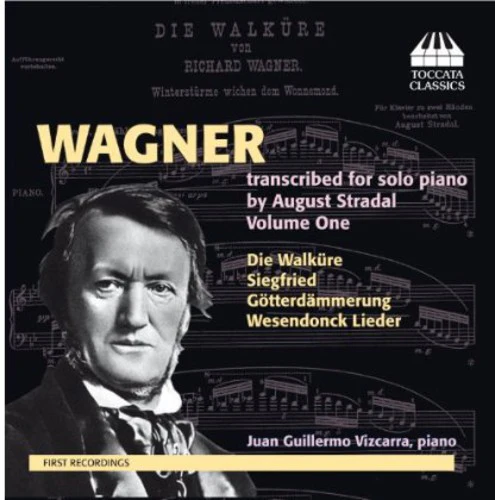
Wagner: Transcribed Solo Piano By August Stradel, Vol. 1
While I was thoroughly enjoying myself listening to this disc an analogy sprang to mind regarding 19 th Century war-horse piano transcriptions. It struck me that – from a 'modern' perspective – they are rather like a great steam locomotive, totally redundant and outmoded but actually rather inspiring and a triumph of engineering!
I have written before that I have an enduring pleasure in hearing a good transcription of something utterly preposterous ... and what could be more preposterous than transcribing Wagner’s Ring for solo piano? The key to raising both the transcription and indeed the performance of it hangs on several far less absurd considerations. These are as follows. How well does the transcriber retain the essence of the work in question? How successfully does the transcriber satisfy the twin musical imperatives of writing a work pleasing as both a virtuoso piano piece and as ‘simple’ music? Lastly, how well is the performer able to surmount the vast technical hurdles implied by the genre whilst producing a performance of real musical value? The reason for my pleasure in this disc is that on every count I would have to say: very well indeed.
To start with the composer/transcriber; August Stradal was yet another of those acolytes of Liszt who seem to have spent a good part of their creative careers trying to out-arrange their master. One can imagine an unspoken conflict between Liszt’s many disciples each trying desperately to produce piano music of ever greater complexity and virtuosity. Along the way Stradal had Bruckner as a teacher and in later life provided important biographical information on both those masters. He also transcribed Bruckner’s Symphonies 1-2 and 5-8 for piano … now there’s a project for Toccata to consider! For those interested the Bruckner transcriptions as well as the 2 Liszt Symphonies, Brandenburg No.3 and other works too can be viewed and downloaded from the IMSLP website – unfortunately none of the works recorded here can be so viewed.
I quite enjoy playing a little game when listening to transcriptions such as this – it’s called “count the imaginary fingers”. The closer you get to twenty the better. Pianist Juan Guillermo Vizcarra makes a staggeringly powerful case for these transcriptions and he is no mean interpreter of Wagner either. The six excerpts from the Ring are grouped sensibly together in chronological order. Hence the disc opens with three selections from Die Walküre. The first two are rather dwarfed by an extended transcription of its closing pages. Siegmund’s Love-song comes first and shows Stradal’s skill at retaining the original voicing of the opera with the hero ‘singing’ in the middle register of the keyboard and the ‘orchestra’ fully represented above and below. Vizcarra is especially skilled at layering the dynamics within these complex textures ensuring that the ear is guided to primary and secondary material. He is a very dynamic player – his performance had me thinking back to the days of LPs and Michael Ponti’s trail-blazing discs on Vox-Turnabout of various Opera paraphrases. Occasionally I did wonder if Vizcarra was overly-muscular which, allied to a quite close and dynamic recording, does risk ‘virtuosity-awareness-fatigue-syndrome’. Conversely, this is music that should overwhelm one in whatever format it is performed. Vizcarra goes on to prove that he is by no means ‘just’ a virtuoso. Indeed I found his pacing of the seventeen minute selection from the end of Die Walküre very impressive. Likewise the single excerpt from Siegfried – Forest Murmurs – is beautifully paced. I say this even if just occasionally the leading melodic line feels a fraction heavy in comparison to the accompanying material but I do feel rather mean-spirited mentioning this.
Malcolm MacDonald in his predictably fascinating and insightful liner cites the two Götterdämmerung excerpts as representing the apogee of Stradal’s art with regard to Wagner. Certainly the sheer complexity of textures that he is able to retain from the original version of Siegfried’s Rhine Journey is astonishing. Again I find Vizcarra’s pacing of the closing pages which then lead with seamless skill into Siegfried’s Funeral March wholly convincing. Given that so much of the orchestral texture in this extraordinarily valedictory passage is built on long-held chords building crescendi this is the one time a piano struggles to maintain the illusion of the original. This is for the simple and obvious fact that a piano cannot play a crescendo without repeating a note or chord. That aside Vizcarra is a very impressive interpreter and Stradal’s transcription builds to a remarkably powerful climax replete with little sky-bursts of keyboard flurries and virtuoso gestures.
Sensibly, the final third of the disc is devoted to a far less rhetorical and grandly dramatic transcription of the five Wesendonck Lieder. These do already exist in the original version for piano and voice. MacDonald explains that Stradal stays essentially faithful to Wagner’s original except in two respects; he changes the order of the songs and moves the vocal line into the middle register again whilst at the same time moving Wagner’s right-hand piano part up the octave. This has the twin effect of making that element of the accompaniment sound immediately more ‘brilliant’ whilst keeping the now inner vocal line clear of conflicting part-writing. Vizcarra is beautifully poetic throughout the cycle although again I occasionally wondered if he strove too hard to give the inner/vocal line prominence. Especially since the placing of this line in a tenor/baritone register changes the feel quite significantly from their mezzo-soprano original. Again this seems like minor carping when one has been given the opportunity to hear such startlingly effective transcriptions in such convincing performances.
Toccata Classics is one of my favourite labels with the questing and quirky nature of the repertoire they offer very much a reflection on the tastes and passions their founder and executive producer Martin Anderson. This disc is another excellent example of his sure-fire sense of rare and unknown music well worth restoring and exploring. More Wagner please but a set of the Bruckner transcriptions really would be something.
-- Nick Barnard, MusicWeb International
I have written before that I have an enduring pleasure in hearing a good transcription of something utterly preposterous ... and what could be more preposterous than transcribing Wagner’s Ring for solo piano? The key to raising both the transcription and indeed the performance of it hangs on several far less absurd considerations. These are as follows. How well does the transcriber retain the essence of the work in question? How successfully does the transcriber satisfy the twin musical imperatives of writing a work pleasing as both a virtuoso piano piece and as ‘simple’ music? Lastly, how well is the performer able to surmount the vast technical hurdles implied by the genre whilst producing a performance of real musical value? The reason for my pleasure in this disc is that on every count I would have to say: very well indeed.
To start with the composer/transcriber; August Stradal was yet another of those acolytes of Liszt who seem to have spent a good part of their creative careers trying to out-arrange their master. One can imagine an unspoken conflict between Liszt’s many disciples each trying desperately to produce piano music of ever greater complexity and virtuosity. Along the way Stradal had Bruckner as a teacher and in later life provided important biographical information on both those masters. He also transcribed Bruckner’s Symphonies 1-2 and 5-8 for piano … now there’s a project for Toccata to consider! For those interested the Bruckner transcriptions as well as the 2 Liszt Symphonies, Brandenburg No.3 and other works too can be viewed and downloaded from the IMSLP website – unfortunately none of the works recorded here can be so viewed.
I quite enjoy playing a little game when listening to transcriptions such as this – it’s called “count the imaginary fingers”. The closer you get to twenty the better. Pianist Juan Guillermo Vizcarra makes a staggeringly powerful case for these transcriptions and he is no mean interpreter of Wagner either. The six excerpts from the Ring are grouped sensibly together in chronological order. Hence the disc opens with three selections from Die Walküre. The first two are rather dwarfed by an extended transcription of its closing pages. Siegmund’s Love-song comes first and shows Stradal’s skill at retaining the original voicing of the opera with the hero ‘singing’ in the middle register of the keyboard and the ‘orchestra’ fully represented above and below. Vizcarra is especially skilled at layering the dynamics within these complex textures ensuring that the ear is guided to primary and secondary material. He is a very dynamic player – his performance had me thinking back to the days of LPs and Michael Ponti’s trail-blazing discs on Vox-Turnabout of various Opera paraphrases. Occasionally I did wonder if Vizcarra was overly-muscular which, allied to a quite close and dynamic recording, does risk ‘virtuosity-awareness-fatigue-syndrome’. Conversely, this is music that should overwhelm one in whatever format it is performed. Vizcarra goes on to prove that he is by no means ‘just’ a virtuoso. Indeed I found his pacing of the seventeen minute selection from the end of Die Walküre very impressive. Likewise the single excerpt from Siegfried – Forest Murmurs – is beautifully paced. I say this even if just occasionally the leading melodic line feels a fraction heavy in comparison to the accompanying material but I do feel rather mean-spirited mentioning this.
Malcolm MacDonald in his predictably fascinating and insightful liner cites the two Götterdämmerung excerpts as representing the apogee of Stradal’s art with regard to Wagner. Certainly the sheer complexity of textures that he is able to retain from the original version of Siegfried’s Rhine Journey is astonishing. Again I find Vizcarra’s pacing of the closing pages which then lead with seamless skill into Siegfried’s Funeral March wholly convincing. Given that so much of the orchestral texture in this extraordinarily valedictory passage is built on long-held chords building crescendi this is the one time a piano struggles to maintain the illusion of the original. This is for the simple and obvious fact that a piano cannot play a crescendo without repeating a note or chord. That aside Vizcarra is a very impressive interpreter and Stradal’s transcription builds to a remarkably powerful climax replete with little sky-bursts of keyboard flurries and virtuoso gestures.
Sensibly, the final third of the disc is devoted to a far less rhetorical and grandly dramatic transcription of the five Wesendonck Lieder. These do already exist in the original version for piano and voice. MacDonald explains that Stradal stays essentially faithful to Wagner’s original except in two respects; he changes the order of the songs and moves the vocal line into the middle register again whilst at the same time moving Wagner’s right-hand piano part up the octave. This has the twin effect of making that element of the accompaniment sound immediately more ‘brilliant’ whilst keeping the now inner vocal line clear of conflicting part-writing. Vizcarra is beautifully poetic throughout the cycle although again I occasionally wondered if he strove too hard to give the inner/vocal line prominence. Especially since the placing of this line in a tenor/baritone register changes the feel quite significantly from their mezzo-soprano original. Again this seems like minor carping when one has been given the opportunity to hear such startlingly effective transcriptions in such convincing performances.
Toccata Classics is one of my favourite labels with the questing and quirky nature of the repertoire they offer very much a reflection on the tastes and passions their founder and executive producer Martin Anderson. This disc is another excellent example of his sure-fire sense of rare and unknown music well worth restoring and exploring. More Wagner please but a set of the Bruckner transcriptions really would be something.
-- Nick Barnard, MusicWeb International
While I was thoroughly enjoying myself listening to this disc an analogy sprang to mind regarding 19 th Century war-horse piano transcriptions. It struck me that – from a 'modern' perspective – they are rather like a great steam locomotive, totally redundant and outmoded but actually rather inspiring and a triumph of engineering!
I have written before that I have an enduring pleasure in hearing a good transcription of something utterly preposterous ... and what could be more preposterous than transcribing Wagner’s Ring for solo piano? The key to raising both the transcription and indeed the performance of it hangs on several far less absurd considerations. These are as follows. How well does the transcriber retain the essence of the work in question? How successfully does the transcriber satisfy the twin musical imperatives of writing a work pleasing as both a virtuoso piano piece and as ‘simple’ music? Lastly, how well is the performer able to surmount the vast technical hurdles implied by the genre whilst producing a performance of real musical value? The reason for my pleasure in this disc is that on every count I would have to say: very well indeed.
To start with the composer/transcriber; August Stradal was yet another of those acolytes of Liszt who seem to have spent a good part of their creative careers trying to out-arrange their master. One can imagine an unspoken conflict between Liszt’s many disciples each trying desperately to produce piano music of ever greater complexity and virtuosity. Along the way Stradal had Bruckner as a teacher and in later life provided important biographical information on both those masters. He also transcribed Bruckner’s Symphonies 1-2 and 5-8 for piano … now there’s a project for Toccata to consider! For those interested the Bruckner transcriptions as well as the 2 Liszt Symphonies, Brandenburg No.3 and other works too can be viewed and downloaded from the IMSLP website – unfortunately none of the works recorded here can be so viewed.
I quite enjoy playing a little game when listening to transcriptions such as this – it’s called “count the imaginary fingers”. The closer you get to twenty the better. Pianist Juan Guillermo Vizcarra makes a staggeringly powerful case for these transcriptions and he is no mean interpreter of Wagner either. The six excerpts from the Ring are grouped sensibly together in chronological order. Hence the disc opens with three selections from Die Walküre. The first two are rather dwarfed by an extended transcription of its closing pages. Siegmund’s Love-song comes first and shows Stradal’s skill at retaining the original voicing of the opera with the hero ‘singing’ in the middle register of the keyboard and the ‘orchestra’ fully represented above and below. Vizcarra is especially skilled at layering the dynamics within these complex textures ensuring that the ear is guided to primary and secondary material. He is a very dynamic player – his performance had me thinking back to the days of LPs and Michael Ponti’s trail-blazing discs on Vox-Turnabout of various Opera paraphrases. Occasionally I did wonder if Vizcarra was overly-muscular which, allied to a quite close and dynamic recording, does risk ‘virtuosity-awareness-fatigue-syndrome’. Conversely, this is music that should overwhelm one in whatever format it is performed. Vizcarra goes on to prove that he is by no means ‘just’ a virtuoso. Indeed I found his pacing of the seventeen minute selection from the end of Die Walküre very impressive. Likewise the single excerpt from Siegfried – Forest Murmurs – is beautifully paced. I say this even if just occasionally the leading melodic line feels a fraction heavy in comparison to the accompanying material but I do feel rather mean-spirited mentioning this.
Malcolm MacDonald in his predictably fascinating and insightful liner cites the two Götterdämmerung excerpts as representing the apogee of Stradal’s art with regard to Wagner. Certainly the sheer complexity of textures that he is able to retain from the original version of Siegfried’s Rhine Journey is astonishing. Again I find Vizcarra’s pacing of the closing pages which then lead with seamless skill into Siegfried’s Funeral March wholly convincing. Given that so much of the orchestral texture in this extraordinarily valedictory passage is built on long-held chords building crescendi this is the one time a piano struggles to maintain the illusion of the original. This is for the simple and obvious fact that a piano cannot play a crescendo without repeating a note or chord. That aside Vizcarra is a very impressive interpreter and Stradal’s transcription builds to a remarkably powerful climax replete with little sky-bursts of keyboard flurries and virtuoso gestures.
Sensibly, the final third of the disc is devoted to a far less rhetorical and grandly dramatic transcription of the five Wesendonck Lieder. These do already exist in the original version for piano and voice. MacDonald explains that Stradal stays essentially faithful to Wagner’s original except in two respects; he changes the order of the songs and moves the vocal line into the middle register again whilst at the same time moving Wagner’s right-hand piano part up the octave. This has the twin effect of making that element of the accompaniment sound immediately more ‘brilliant’ whilst keeping the now inner vocal line clear of conflicting part-writing. Vizcarra is beautifully poetic throughout the cycle although again I occasionally wondered if he strove too hard to give the inner/vocal line prominence. Especially since the placing of this line in a tenor/baritone register changes the feel quite significantly from their mezzo-soprano original. Again this seems like minor carping when one has been given the opportunity to hear such startlingly effective transcriptions in such convincing performances.
Toccata Classics is one of my favourite labels with the questing and quirky nature of the repertoire they offer very much a reflection on the tastes and passions their founder and executive producer Martin Anderson. This disc is another excellent example of his sure-fire sense of rare and unknown music well worth restoring and exploring. More Wagner please but a set of the Bruckner transcriptions really would be something.
-- Nick Barnard, MusicWeb International
I have written before that I have an enduring pleasure in hearing a good transcription of something utterly preposterous ... and what could be more preposterous than transcribing Wagner’s Ring for solo piano? The key to raising both the transcription and indeed the performance of it hangs on several far less absurd considerations. These are as follows. How well does the transcriber retain the essence of the work in question? How successfully does the transcriber satisfy the twin musical imperatives of writing a work pleasing as both a virtuoso piano piece and as ‘simple’ music? Lastly, how well is the performer able to surmount the vast technical hurdles implied by the genre whilst producing a performance of real musical value? The reason for my pleasure in this disc is that on every count I would have to say: very well indeed.
To start with the composer/transcriber; August Stradal was yet another of those acolytes of Liszt who seem to have spent a good part of their creative careers trying to out-arrange their master. One can imagine an unspoken conflict between Liszt’s many disciples each trying desperately to produce piano music of ever greater complexity and virtuosity. Along the way Stradal had Bruckner as a teacher and in later life provided important biographical information on both those masters. He also transcribed Bruckner’s Symphonies 1-2 and 5-8 for piano … now there’s a project for Toccata to consider! For those interested the Bruckner transcriptions as well as the 2 Liszt Symphonies, Brandenburg No.3 and other works too can be viewed and downloaded from the IMSLP website – unfortunately none of the works recorded here can be so viewed.
I quite enjoy playing a little game when listening to transcriptions such as this – it’s called “count the imaginary fingers”. The closer you get to twenty the better. Pianist Juan Guillermo Vizcarra makes a staggeringly powerful case for these transcriptions and he is no mean interpreter of Wagner either. The six excerpts from the Ring are grouped sensibly together in chronological order. Hence the disc opens with three selections from Die Walküre. The first two are rather dwarfed by an extended transcription of its closing pages. Siegmund’s Love-song comes first and shows Stradal’s skill at retaining the original voicing of the opera with the hero ‘singing’ in the middle register of the keyboard and the ‘orchestra’ fully represented above and below. Vizcarra is especially skilled at layering the dynamics within these complex textures ensuring that the ear is guided to primary and secondary material. He is a very dynamic player – his performance had me thinking back to the days of LPs and Michael Ponti’s trail-blazing discs on Vox-Turnabout of various Opera paraphrases. Occasionally I did wonder if Vizcarra was overly-muscular which, allied to a quite close and dynamic recording, does risk ‘virtuosity-awareness-fatigue-syndrome’. Conversely, this is music that should overwhelm one in whatever format it is performed. Vizcarra goes on to prove that he is by no means ‘just’ a virtuoso. Indeed I found his pacing of the seventeen minute selection from the end of Die Walküre very impressive. Likewise the single excerpt from Siegfried – Forest Murmurs – is beautifully paced. I say this even if just occasionally the leading melodic line feels a fraction heavy in comparison to the accompanying material but I do feel rather mean-spirited mentioning this.
Malcolm MacDonald in his predictably fascinating and insightful liner cites the two Götterdämmerung excerpts as representing the apogee of Stradal’s art with regard to Wagner. Certainly the sheer complexity of textures that he is able to retain from the original version of Siegfried’s Rhine Journey is astonishing. Again I find Vizcarra’s pacing of the closing pages which then lead with seamless skill into Siegfried’s Funeral March wholly convincing. Given that so much of the orchestral texture in this extraordinarily valedictory passage is built on long-held chords building crescendi this is the one time a piano struggles to maintain the illusion of the original. This is for the simple and obvious fact that a piano cannot play a crescendo without repeating a note or chord. That aside Vizcarra is a very impressive interpreter and Stradal’s transcription builds to a remarkably powerful climax replete with little sky-bursts of keyboard flurries and virtuoso gestures.
Sensibly, the final third of the disc is devoted to a far less rhetorical and grandly dramatic transcription of the five Wesendonck Lieder. These do already exist in the original version for piano and voice. MacDonald explains that Stradal stays essentially faithful to Wagner’s original except in two respects; he changes the order of the songs and moves the vocal line into the middle register again whilst at the same time moving Wagner’s right-hand piano part up the octave. This has the twin effect of making that element of the accompaniment sound immediately more ‘brilliant’ whilst keeping the now inner vocal line clear of conflicting part-writing. Vizcarra is beautifully poetic throughout the cycle although again I occasionally wondered if he strove too hard to give the inner/vocal line prominence. Especially since the placing of this line in a tenor/baritone register changes the feel quite significantly from their mezzo-soprano original. Again this seems like minor carping when one has been given the opportunity to hear such startlingly effective transcriptions in such convincing performances.
Toccata Classics is one of my favourite labels with the questing and quirky nature of the repertoire they offer very much a reflection on the tastes and passions their founder and executive producer Martin Anderson. This disc is another excellent example of his sure-fire sense of rare and unknown music well worth restoring and exploring. More Wagner please but a set of the Bruckner transcriptions really would be something.
-- Nick Barnard, MusicWeb International
$20.99
Wagner: Transcribed Solo Piano By August Stradel, Vol. 1—
$20.99
Description
While I was thoroughly enjoying myself listening to this disc an analogy sprang to mind regarding 19 th Century war-horse piano transcriptions. It struck me that – from a 'modern' perspective – they are rather like a great steam locomotive, totally redundant and outmoded but actually rather inspiring and a triumph of engineering!
I have written before that I have an enduring pleasure in hearing a good transcription of something utterly preposterous ... and what could be more preposterous than transcribing Wagner’s Ring for solo piano? The key to raising both the transcription and indeed the performance of it hangs on several far less absurd considerations. These are as follows. How well does the transcriber retain the essence of the work in question? How successfully does the transcriber satisfy the twin musical imperatives of writing a work pleasing as both a virtuoso piano piece and as ‘simple’ music? Lastly, how well is the performer able to surmount the vast technical hurdles implied by the genre whilst producing a performance of real musical value? The reason for my pleasure in this disc is that on every count I would have to say: very well indeed.
To start with the composer/transcriber; August Stradal was yet another of those acolytes of Liszt who seem to have spent a good part of their creative careers trying to out-arrange their master. One can imagine an unspoken conflict between Liszt’s many disciples each trying desperately to produce piano music of ever greater complexity and virtuosity. Along the way Stradal had Bruckner as a teacher and in later life provided important biographical information on both those masters. He also transcribed Bruckner’s Symphonies 1-2 and 5-8 for piano … now there’s a project for Toccata to consider! For those interested the Bruckner transcriptions as well as the 2 Liszt Symphonies, Brandenburg No.3 and other works too can be viewed and downloaded from the IMSLP website – unfortunately none of the works recorded here can be so viewed.
I quite enjoy playing a little game when listening to transcriptions such as this – it’s called “count the imaginary fingers”. The closer you get to twenty the better. Pianist Juan Guillermo Vizcarra makes a staggeringly powerful case for these transcriptions and he is no mean interpreter of Wagner either. The six excerpts from the Ring are grouped sensibly together in chronological order. Hence the disc opens with three selections from Die Walküre. The first two are rather dwarfed by an extended transcription of its closing pages. Siegmund’s Love-song comes first and shows Stradal’s skill at retaining the original voicing of the opera with the hero ‘singing’ in the middle register of the keyboard and the ‘orchestra’ fully represented above and below. Vizcarra is especially skilled at layering the dynamics within these complex textures ensuring that the ear is guided to primary and secondary material. He is a very dynamic player – his performance had me thinking back to the days of LPs and Michael Ponti’s trail-blazing discs on Vox-Turnabout of various Opera paraphrases. Occasionally I did wonder if Vizcarra was overly-muscular which, allied to a quite close and dynamic recording, does risk ‘virtuosity-awareness-fatigue-syndrome’. Conversely, this is music that should overwhelm one in whatever format it is performed. Vizcarra goes on to prove that he is by no means ‘just’ a virtuoso. Indeed I found his pacing of the seventeen minute selection from the end of Die Walküre very impressive. Likewise the single excerpt from Siegfried – Forest Murmurs – is beautifully paced. I say this even if just occasionally the leading melodic line feels a fraction heavy in comparison to the accompanying material but I do feel rather mean-spirited mentioning this.
Malcolm MacDonald in his predictably fascinating and insightful liner cites the two Götterdämmerung excerpts as representing the apogee of Stradal’s art with regard to Wagner. Certainly the sheer complexity of textures that he is able to retain from the original version of Siegfried’s Rhine Journey is astonishing. Again I find Vizcarra’s pacing of the closing pages which then lead with seamless skill into Siegfried’s Funeral March wholly convincing. Given that so much of the orchestral texture in this extraordinarily valedictory passage is built on long-held chords building crescendi this is the one time a piano struggles to maintain the illusion of the original. This is for the simple and obvious fact that a piano cannot play a crescendo without repeating a note or chord. That aside Vizcarra is a very impressive interpreter and Stradal’s transcription builds to a remarkably powerful climax replete with little sky-bursts of keyboard flurries and virtuoso gestures.
Sensibly, the final third of the disc is devoted to a far less rhetorical and grandly dramatic transcription of the five Wesendonck Lieder. These do already exist in the original version for piano and voice. MacDonald explains that Stradal stays essentially faithful to Wagner’s original except in two respects; he changes the order of the songs and moves the vocal line into the middle register again whilst at the same time moving Wagner’s right-hand piano part up the octave. This has the twin effect of making that element of the accompaniment sound immediately more ‘brilliant’ whilst keeping the now inner vocal line clear of conflicting part-writing. Vizcarra is beautifully poetic throughout the cycle although again I occasionally wondered if he strove too hard to give the inner/vocal line prominence. Especially since the placing of this line in a tenor/baritone register changes the feel quite significantly from their mezzo-soprano original. Again this seems like minor carping when one has been given the opportunity to hear such startlingly effective transcriptions in such convincing performances.
Toccata Classics is one of my favourite labels with the questing and quirky nature of the repertoire they offer very much a reflection on the tastes and passions their founder and executive producer Martin Anderson. This disc is another excellent example of his sure-fire sense of rare and unknown music well worth restoring and exploring. More Wagner please but a set of the Bruckner transcriptions really would be something.
-- Nick Barnard, MusicWeb International
I have written before that I have an enduring pleasure in hearing a good transcription of something utterly preposterous ... and what could be more preposterous than transcribing Wagner’s Ring for solo piano? The key to raising both the transcription and indeed the performance of it hangs on several far less absurd considerations. These are as follows. How well does the transcriber retain the essence of the work in question? How successfully does the transcriber satisfy the twin musical imperatives of writing a work pleasing as both a virtuoso piano piece and as ‘simple’ music? Lastly, how well is the performer able to surmount the vast technical hurdles implied by the genre whilst producing a performance of real musical value? The reason for my pleasure in this disc is that on every count I would have to say: very well indeed.
To start with the composer/transcriber; August Stradal was yet another of those acolytes of Liszt who seem to have spent a good part of their creative careers trying to out-arrange their master. One can imagine an unspoken conflict between Liszt’s many disciples each trying desperately to produce piano music of ever greater complexity and virtuosity. Along the way Stradal had Bruckner as a teacher and in later life provided important biographical information on both those masters. He also transcribed Bruckner’s Symphonies 1-2 and 5-8 for piano … now there’s a project for Toccata to consider! For those interested the Bruckner transcriptions as well as the 2 Liszt Symphonies, Brandenburg No.3 and other works too can be viewed and downloaded from the IMSLP website – unfortunately none of the works recorded here can be so viewed.
I quite enjoy playing a little game when listening to transcriptions such as this – it’s called “count the imaginary fingers”. The closer you get to twenty the better. Pianist Juan Guillermo Vizcarra makes a staggeringly powerful case for these transcriptions and he is no mean interpreter of Wagner either. The six excerpts from the Ring are grouped sensibly together in chronological order. Hence the disc opens with three selections from Die Walküre. The first two are rather dwarfed by an extended transcription of its closing pages. Siegmund’s Love-song comes first and shows Stradal’s skill at retaining the original voicing of the opera with the hero ‘singing’ in the middle register of the keyboard and the ‘orchestra’ fully represented above and below. Vizcarra is especially skilled at layering the dynamics within these complex textures ensuring that the ear is guided to primary and secondary material. He is a very dynamic player – his performance had me thinking back to the days of LPs and Michael Ponti’s trail-blazing discs on Vox-Turnabout of various Opera paraphrases. Occasionally I did wonder if Vizcarra was overly-muscular which, allied to a quite close and dynamic recording, does risk ‘virtuosity-awareness-fatigue-syndrome’. Conversely, this is music that should overwhelm one in whatever format it is performed. Vizcarra goes on to prove that he is by no means ‘just’ a virtuoso. Indeed I found his pacing of the seventeen minute selection from the end of Die Walküre very impressive. Likewise the single excerpt from Siegfried – Forest Murmurs – is beautifully paced. I say this even if just occasionally the leading melodic line feels a fraction heavy in comparison to the accompanying material but I do feel rather mean-spirited mentioning this.
Malcolm MacDonald in his predictably fascinating and insightful liner cites the two Götterdämmerung excerpts as representing the apogee of Stradal’s art with regard to Wagner. Certainly the sheer complexity of textures that he is able to retain from the original version of Siegfried’s Rhine Journey is astonishing. Again I find Vizcarra’s pacing of the closing pages which then lead with seamless skill into Siegfried’s Funeral March wholly convincing. Given that so much of the orchestral texture in this extraordinarily valedictory passage is built on long-held chords building crescendi this is the one time a piano struggles to maintain the illusion of the original. This is for the simple and obvious fact that a piano cannot play a crescendo without repeating a note or chord. That aside Vizcarra is a very impressive interpreter and Stradal’s transcription builds to a remarkably powerful climax replete with little sky-bursts of keyboard flurries and virtuoso gestures.
Sensibly, the final third of the disc is devoted to a far less rhetorical and grandly dramatic transcription of the five Wesendonck Lieder. These do already exist in the original version for piano and voice. MacDonald explains that Stradal stays essentially faithful to Wagner’s original except in two respects; he changes the order of the songs and moves the vocal line into the middle register again whilst at the same time moving Wagner’s right-hand piano part up the octave. This has the twin effect of making that element of the accompaniment sound immediately more ‘brilliant’ whilst keeping the now inner vocal line clear of conflicting part-writing. Vizcarra is beautifully poetic throughout the cycle although again I occasionally wondered if he strove too hard to give the inner/vocal line prominence. Especially since the placing of this line in a tenor/baritone register changes the feel quite significantly from their mezzo-soprano original. Again this seems like minor carping when one has been given the opportunity to hear such startlingly effective transcriptions in such convincing performances.
Toccata Classics is one of my favourite labels with the questing and quirky nature of the repertoire they offer very much a reflection on the tastes and passions their founder and executive producer Martin Anderson. This disc is another excellent example of his sure-fire sense of rare and unknown music well worth restoring and exploring. More Wagner please but a set of the Bruckner transcriptions really would be something.
-- Nick Barnard, MusicWeb International