🎉 Up to 70% Off Selected ItemsShop Sale

1 / 2
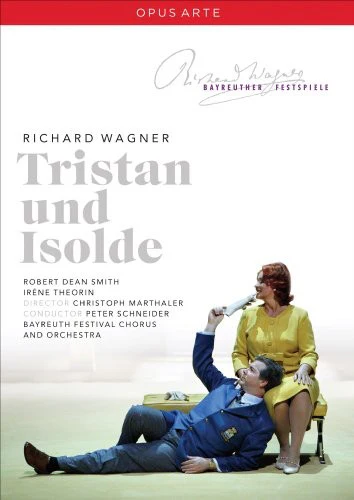
Wagner: Tristan Und Isolde / Smith, Theorin
Tristan: Robert Dean Smith
Marke: Robert Holl
Isolde: Iréne Theorin
Kurwenal: Jukka Rasilainen
Melot: Ralf Lukas
Brangäne: Michelle Breedt
Junger Seemann: Clemens Bieber
Ein Hirt: Arnold Bezuyen
Ein Steuermann: Martin Snell
Bayreuther Festspiele Chorus/Eberhard Friedrich
Bayreuther Festspiele Orchestra/Peter Schneider
Stage Director: Christoph Marthaler
rec. live, Bayreuth Festival, 9 August 2009.
Special Features: include ‘Kinder, macht was Neues!’ The making of Tristan und Isolde.
Video Tracks: 16:9
Audio Tracks: 5.1 DTS Surround, PCM Stereo
Subtitle Tracks: English, French, German, Spanish
OPUS ARTE OA 1033 D [3DVDs: 292:00]
As I reported last year this performance of Tristan und Isolde was chosen for only the second live relay from the ‘Green Hill’ following Die Meistersinger in 2008. Katharina Wagner who now controls Bayreuth alongside her half-sister Eva Wagner-Pasquier, wishes to open up the Festival to a much wider audience. So again the Bayreuth Festival joined forces with the city of Bayreuth and a leading German engineering company, Siemens, to present the Siemens Festival Night. This allowed several thousand people the opportunity of a free event at the Bayreuth Festplatz. In addition, the opera, like last year’s, was available on the Internet.
As I look back on what I wrote last August as the reviewer of this performance I was in no danger (in mid-January) of bright sun shining on my TV screen and creating the problems I had initially with the outdoor showing. I had reported on Christoph Marthaler’s 2005 anti-romantic staging of Tristan und Isolde from the theatre in 2008 and most of what I wrote both then and again last year stands without much significant alteration. The Prelude introduces us to the circles of light that are the light bulbs and the recurring imagery for the ocean liner in which the ‘action’ is set. Katharina Wagner has called Marthaler ‘a master when it comes to staging boredom, standstill and desperation’ though whether this is damning him with faint praise I cannot tell. In his metaphysical interpretation there is little eye contact — or any contact for that matter — between the characters. It must not be forgotten that Katharina had little — if anything — to do with this production as, at the time it was planned, the Festival was solidly in the hands of her father, Wolfgang, and late mother, Gudrun.
As revived here by Anna Sophie-Mahler little does happen in this Tristan und Isolde but Michael Beyer’s direction for TV puts our attention directly onto the faces of the singers and the truth they showed holds the viewer’s attention. In the opera house you are distanced from the facial expression of the singers but here we can focus on crucial small moments to mostly good effect. Iréne Theorin as Isolde is revealed to be quite a stunning actress and her best moment remains near the end of Act I when she is quite deranged at ‘Nun lass uns Sühne trinken!’ Here having drunk the ‘wrong’ potion she is beginning to feel the effect of passion and not her death; she very subtlety undoes her top button and then takes her pulse. Robert Dean Smith, as Tristan, also benefits from the close-ups particularly in his Act III ravings. As before, the other highlights include Michelle Breedt’s concerned Brangäne trying to snatch back the Todestrank from Isolde in Act I, King Marke’s pain at being deceived being etched so clearly on Robert Holl’s craggy features and the passing of the knife that fatally wounds Tristan from Marke on to Melot then Tristan and back to Melot and finally returned into Marke’s hands. Then significantly there is Tristan staring straight at Kurwenal (Jukka Rasilainen) convincing me that his coming back to life in Act III is all in his faithful retainer’s mind. Much of this might be missed if – as a member of the theatre audience – you were looking elsewhere.
The walls of the hold where Tristan is shown ‘lying in state’ look even more mildewed and graffiti-covered in the final Act here on DVD than on the night of the relay. Some moments also still look ridiculous such as Tristan and Kurwenal’s Act I hand gesturing when the latter sings about Lord Morold, though this is not now blown up on a huge 90m² screen.
The sound from my DVD player was reasonably faithful to the live transmission though arguably more vivid than before because of the work of the engineers. The voices sound mostly very even and the orchestra under Peter Schneider’s experience baton seems faultless and perfectly balanced though, as outdoors in August, it still seems a little louder than you would get in the Festspielhaus.
As an extra there is a short backstage self-congratulatory feature entitled ‘Kinder, macht was Neues!’ Sadly this urge by Richard Wagner to future generations to ‘do something new’ has often been taken too literally. Here we get rehearsal footage, comments and a justification for the production by those involved and even a plug for the sponsors, Siemens.
Katharina has stated that she aims to ‘make the Festival accessible to a wide public’ and for ‘a strategy of transparency while setting artistic standards for future interpretations of Wagner and winning new opera fans’. With the long wait for Bayreuth tickets it is now more possible to keep up-to-date with what is going on than ever before. It is no good some critics complaining that things are not what they were at Bayreuth without the Wagnerian, as well as the general opera-loving public, having the evidence to discuss the work going on there. At least the recent two DVD releases, along with the Ring CDs conducted by Thielemann, can only help promote the debate that I am sure Katharina and Eva surely welcome from those distanced from — what the blurb on this Tristan calls — ‘the spiritual home of Wagner’s work’.
This imbues this DVD with an historical importance but it is recommended for so much more — and even though the supporting singers are not the same quality — there are still world-class performances from Iréne Theorin’s committed, radiant Isolde and Robert Dean Smith’s lyrical, inexhaustible Tristan. It is also extremely well conducted by the Bayreuth veteran, Peter Schneider and, together with the two central performances; it is often possible to be transported to a realm far away from the drabness of the stage designs.
— Jim Pritchard, MusicWeb International
Marke: Robert Holl
Isolde: Iréne Theorin
Kurwenal: Jukka Rasilainen
Melot: Ralf Lukas
Brangäne: Michelle Breedt
Junger Seemann: Clemens Bieber
Ein Hirt: Arnold Bezuyen
Ein Steuermann: Martin Snell
Bayreuther Festspiele Chorus/Eberhard Friedrich
Bayreuther Festspiele Orchestra/Peter Schneider
Stage Director: Christoph Marthaler
rec. live, Bayreuth Festival, 9 August 2009.
Special Features: include ‘Kinder, macht was Neues!’ The making of Tristan und Isolde.
Video Tracks: 16:9
Audio Tracks: 5.1 DTS Surround, PCM Stereo
Subtitle Tracks: English, French, German, Spanish
OPUS ARTE OA 1033 D [3DVDs: 292:00]
As I reported last year this performance of Tristan und Isolde was chosen for only the second live relay from the ‘Green Hill’ following Die Meistersinger in 2008. Katharina Wagner who now controls Bayreuth alongside her half-sister Eva Wagner-Pasquier, wishes to open up the Festival to a much wider audience. So again the Bayreuth Festival joined forces with the city of Bayreuth and a leading German engineering company, Siemens, to present the Siemens Festival Night. This allowed several thousand people the opportunity of a free event at the Bayreuth Festplatz. In addition, the opera, like last year’s, was available on the Internet.
As I look back on what I wrote last August as the reviewer of this performance I was in no danger (in mid-January) of bright sun shining on my TV screen and creating the problems I had initially with the outdoor showing. I had reported on Christoph Marthaler’s 2005 anti-romantic staging of Tristan und Isolde from the theatre in 2008 and most of what I wrote both then and again last year stands without much significant alteration. The Prelude introduces us to the circles of light that are the light bulbs and the recurring imagery for the ocean liner in which the ‘action’ is set. Katharina Wagner has called Marthaler ‘a master when it comes to staging boredom, standstill and desperation’ though whether this is damning him with faint praise I cannot tell. In his metaphysical interpretation there is little eye contact — or any contact for that matter — between the characters. It must not be forgotten that Katharina had little — if anything — to do with this production as, at the time it was planned, the Festival was solidly in the hands of her father, Wolfgang, and late mother, Gudrun.
As revived here by Anna Sophie-Mahler little does happen in this Tristan und Isolde but Michael Beyer’s direction for TV puts our attention directly onto the faces of the singers and the truth they showed holds the viewer’s attention. In the opera house you are distanced from the facial expression of the singers but here we can focus on crucial small moments to mostly good effect. Iréne Theorin as Isolde is revealed to be quite a stunning actress and her best moment remains near the end of Act I when she is quite deranged at ‘Nun lass uns Sühne trinken!’ Here having drunk the ‘wrong’ potion she is beginning to feel the effect of passion and not her death; she very subtlety undoes her top button and then takes her pulse. Robert Dean Smith, as Tristan, also benefits from the close-ups particularly in his Act III ravings. As before, the other highlights include Michelle Breedt’s concerned Brangäne trying to snatch back the Todestrank from Isolde in Act I, King Marke’s pain at being deceived being etched so clearly on Robert Holl’s craggy features and the passing of the knife that fatally wounds Tristan from Marke on to Melot then Tristan and back to Melot and finally returned into Marke’s hands. Then significantly there is Tristan staring straight at Kurwenal (Jukka Rasilainen) convincing me that his coming back to life in Act III is all in his faithful retainer’s mind. Much of this might be missed if – as a member of the theatre audience – you were looking elsewhere.
The walls of the hold where Tristan is shown ‘lying in state’ look even more mildewed and graffiti-covered in the final Act here on DVD than on the night of the relay. Some moments also still look ridiculous such as Tristan and Kurwenal’s Act I hand gesturing when the latter sings about Lord Morold, though this is not now blown up on a huge 90m² screen.
The sound from my DVD player was reasonably faithful to the live transmission though arguably more vivid than before because of the work of the engineers. The voices sound mostly very even and the orchestra under Peter Schneider’s experience baton seems faultless and perfectly balanced though, as outdoors in August, it still seems a little louder than you would get in the Festspielhaus.
As an extra there is a short backstage self-congratulatory feature entitled ‘Kinder, macht was Neues!’ Sadly this urge by Richard Wagner to future generations to ‘do something new’ has often been taken too literally. Here we get rehearsal footage, comments and a justification for the production by those involved and even a plug for the sponsors, Siemens.
Katharina has stated that she aims to ‘make the Festival accessible to a wide public’ and for ‘a strategy of transparency while setting artistic standards for future interpretations of Wagner and winning new opera fans’. With the long wait for Bayreuth tickets it is now more possible to keep up-to-date with what is going on than ever before. It is no good some critics complaining that things are not what they were at Bayreuth without the Wagnerian, as well as the general opera-loving public, having the evidence to discuss the work going on there. At least the recent two DVD releases, along with the Ring CDs conducted by Thielemann, can only help promote the debate that I am sure Katharina and Eva surely welcome from those distanced from — what the blurb on this Tristan calls — ‘the spiritual home of Wagner’s work’.
This imbues this DVD with an historical importance but it is recommended for so much more — and even though the supporting singers are not the same quality — there are still world-class performances from Iréne Theorin’s committed, radiant Isolde and Robert Dean Smith’s lyrical, inexhaustible Tristan. It is also extremely well conducted by the Bayreuth veteran, Peter Schneider and, together with the two central performances; it is often possible to be transported to a realm far away from the drabness of the stage designs.
— Jim Pritchard, MusicWeb International
Tristan: Robert Dean Smith
Marke: Robert Holl
Isolde: Iréne Theorin
Kurwenal: Jukka Rasilainen
Melot: Ralf Lukas
Brangäne: Michelle Breedt
Junger Seemann: Clemens Bieber
Ein Hirt: Arnold Bezuyen
Ein Steuermann: Martin Snell
Bayreuther Festspiele Chorus/Eberhard Friedrich
Bayreuther Festspiele Orchestra/Peter Schneider
Stage Director: Christoph Marthaler
rec. live, Bayreuth Festival, 9 August 2009.
Special Features: include ‘Kinder, macht was Neues!’ The making of Tristan und Isolde.
Video Tracks: 16:9
Audio Tracks: 5.1 DTS Surround, PCM Stereo
Subtitle Tracks: English, French, German, Spanish
OPUS ARTE OA 1033 D [3DVDs: 292:00]
As I reported last year this performance of Tristan und Isolde was chosen for only the second live relay from the ‘Green Hill’ following Die Meistersinger in 2008. Katharina Wagner who now controls Bayreuth alongside her half-sister Eva Wagner-Pasquier, wishes to open up the Festival to a much wider audience. So again the Bayreuth Festival joined forces with the city of Bayreuth and a leading German engineering company, Siemens, to present the Siemens Festival Night. This allowed several thousand people the opportunity of a free event at the Bayreuth Festplatz. In addition, the opera, like last year’s, was available on the Internet.
As I look back on what I wrote last August as the reviewer of this performance I was in no danger (in mid-January) of bright sun shining on my TV screen and creating the problems I had initially with the outdoor showing. I had reported on Christoph Marthaler’s 2005 anti-romantic staging of Tristan und Isolde from the theatre in 2008 and most of what I wrote both then and again last year stands without much significant alteration. The Prelude introduces us to the circles of light that are the light bulbs and the recurring imagery for the ocean liner in which the ‘action’ is set. Katharina Wagner has called Marthaler ‘a master when it comes to staging boredom, standstill and desperation’ though whether this is damning him with faint praise I cannot tell. In his metaphysical interpretation there is little eye contact — or any contact for that matter — between the characters. It must not be forgotten that Katharina had little — if anything — to do with this production as, at the time it was planned, the Festival was solidly in the hands of her father, Wolfgang, and late mother, Gudrun.
As revived here by Anna Sophie-Mahler little does happen in this Tristan und Isolde but Michael Beyer’s direction for TV puts our attention directly onto the faces of the singers and the truth they showed holds the viewer’s attention. In the opera house you are distanced from the facial expression of the singers but here we can focus on crucial small moments to mostly good effect. Iréne Theorin as Isolde is revealed to be quite a stunning actress and her best moment remains near the end of Act I when she is quite deranged at ‘Nun lass uns Sühne trinken!’ Here having drunk the ‘wrong’ potion she is beginning to feel the effect of passion and not her death; she very subtlety undoes her top button and then takes her pulse. Robert Dean Smith, as Tristan, also benefits from the close-ups particularly in his Act III ravings. As before, the other highlights include Michelle Breedt’s concerned Brangäne trying to snatch back the Todestrank from Isolde in Act I, King Marke’s pain at being deceived being etched so clearly on Robert Holl’s craggy features and the passing of the knife that fatally wounds Tristan from Marke on to Melot then Tristan and back to Melot and finally returned into Marke’s hands. Then significantly there is Tristan staring straight at Kurwenal (Jukka Rasilainen) convincing me that his coming back to life in Act III is all in his faithful retainer’s mind. Much of this might be missed if – as a member of the theatre audience – you were looking elsewhere.
The walls of the hold where Tristan is shown ‘lying in state’ look even more mildewed and graffiti-covered in the final Act here on DVD than on the night of the relay. Some moments also still look ridiculous such as Tristan and Kurwenal’s Act I hand gesturing when the latter sings about Lord Morold, though this is not now blown up on a huge 90m² screen.
The sound from my DVD player was reasonably faithful to the live transmission though arguably more vivid than before because of the work of the engineers. The voices sound mostly very even and the orchestra under Peter Schneider’s experience baton seems faultless and perfectly balanced though, as outdoors in August, it still seems a little louder than you would get in the Festspielhaus.
As an extra there is a short backstage self-congratulatory feature entitled ‘Kinder, macht was Neues!’ Sadly this urge by Richard Wagner to future generations to ‘do something new’ has often been taken too literally. Here we get rehearsal footage, comments and a justification for the production by those involved and even a plug for the sponsors, Siemens.
Katharina has stated that she aims to ‘make the Festival accessible to a wide public’ and for ‘a strategy of transparency while setting artistic standards for future interpretations of Wagner and winning new opera fans’. With the long wait for Bayreuth tickets it is now more possible to keep up-to-date with what is going on than ever before. It is no good some critics complaining that things are not what they were at Bayreuth without the Wagnerian, as well as the general opera-loving public, having the evidence to discuss the work going on there. At least the recent two DVD releases, along with the Ring CDs conducted by Thielemann, can only help promote the debate that I am sure Katharina and Eva surely welcome from those distanced from — what the blurb on this Tristan calls — ‘the spiritual home of Wagner’s work’.
This imbues this DVD with an historical importance but it is recommended for so much more — and even though the supporting singers are not the same quality — there are still world-class performances from Iréne Theorin’s committed, radiant Isolde and Robert Dean Smith’s lyrical, inexhaustible Tristan. It is also extremely well conducted by the Bayreuth veteran, Peter Schneider and, together with the two central performances; it is often possible to be transported to a realm far away from the drabness of the stage designs.
— Jim Pritchard, MusicWeb International
Marke: Robert Holl
Isolde: Iréne Theorin
Kurwenal: Jukka Rasilainen
Melot: Ralf Lukas
Brangäne: Michelle Breedt
Junger Seemann: Clemens Bieber
Ein Hirt: Arnold Bezuyen
Ein Steuermann: Martin Snell
Bayreuther Festspiele Chorus/Eberhard Friedrich
Bayreuther Festspiele Orchestra/Peter Schneider
Stage Director: Christoph Marthaler
rec. live, Bayreuth Festival, 9 August 2009.
Special Features: include ‘Kinder, macht was Neues!’ The making of Tristan und Isolde.
Video Tracks: 16:9
Audio Tracks: 5.1 DTS Surround, PCM Stereo
Subtitle Tracks: English, French, German, Spanish
OPUS ARTE OA 1033 D [3DVDs: 292:00]
As I reported last year this performance of Tristan und Isolde was chosen for only the second live relay from the ‘Green Hill’ following Die Meistersinger in 2008. Katharina Wagner who now controls Bayreuth alongside her half-sister Eva Wagner-Pasquier, wishes to open up the Festival to a much wider audience. So again the Bayreuth Festival joined forces with the city of Bayreuth and a leading German engineering company, Siemens, to present the Siemens Festival Night. This allowed several thousand people the opportunity of a free event at the Bayreuth Festplatz. In addition, the opera, like last year’s, was available on the Internet.
As I look back on what I wrote last August as the reviewer of this performance I was in no danger (in mid-January) of bright sun shining on my TV screen and creating the problems I had initially with the outdoor showing. I had reported on Christoph Marthaler’s 2005 anti-romantic staging of Tristan und Isolde from the theatre in 2008 and most of what I wrote both then and again last year stands without much significant alteration. The Prelude introduces us to the circles of light that are the light bulbs and the recurring imagery for the ocean liner in which the ‘action’ is set. Katharina Wagner has called Marthaler ‘a master when it comes to staging boredom, standstill and desperation’ though whether this is damning him with faint praise I cannot tell. In his metaphysical interpretation there is little eye contact — or any contact for that matter — between the characters. It must not be forgotten that Katharina had little — if anything — to do with this production as, at the time it was planned, the Festival was solidly in the hands of her father, Wolfgang, and late mother, Gudrun.
As revived here by Anna Sophie-Mahler little does happen in this Tristan und Isolde but Michael Beyer’s direction for TV puts our attention directly onto the faces of the singers and the truth they showed holds the viewer’s attention. In the opera house you are distanced from the facial expression of the singers but here we can focus on crucial small moments to mostly good effect. Iréne Theorin as Isolde is revealed to be quite a stunning actress and her best moment remains near the end of Act I when she is quite deranged at ‘Nun lass uns Sühne trinken!’ Here having drunk the ‘wrong’ potion she is beginning to feel the effect of passion and not her death; she very subtlety undoes her top button and then takes her pulse. Robert Dean Smith, as Tristan, also benefits from the close-ups particularly in his Act III ravings. As before, the other highlights include Michelle Breedt’s concerned Brangäne trying to snatch back the Todestrank from Isolde in Act I, King Marke’s pain at being deceived being etched so clearly on Robert Holl’s craggy features and the passing of the knife that fatally wounds Tristan from Marke on to Melot then Tristan and back to Melot and finally returned into Marke’s hands. Then significantly there is Tristan staring straight at Kurwenal (Jukka Rasilainen) convincing me that his coming back to life in Act III is all in his faithful retainer’s mind. Much of this might be missed if – as a member of the theatre audience – you were looking elsewhere.
The walls of the hold where Tristan is shown ‘lying in state’ look even more mildewed and graffiti-covered in the final Act here on DVD than on the night of the relay. Some moments also still look ridiculous such as Tristan and Kurwenal’s Act I hand gesturing when the latter sings about Lord Morold, though this is not now blown up on a huge 90m² screen.
The sound from my DVD player was reasonably faithful to the live transmission though arguably more vivid than before because of the work of the engineers. The voices sound mostly very even and the orchestra under Peter Schneider’s experience baton seems faultless and perfectly balanced though, as outdoors in August, it still seems a little louder than you would get in the Festspielhaus.
As an extra there is a short backstage self-congratulatory feature entitled ‘Kinder, macht was Neues!’ Sadly this urge by Richard Wagner to future generations to ‘do something new’ has often been taken too literally. Here we get rehearsal footage, comments and a justification for the production by those involved and even a plug for the sponsors, Siemens.
Katharina has stated that she aims to ‘make the Festival accessible to a wide public’ and for ‘a strategy of transparency while setting artistic standards for future interpretations of Wagner and winning new opera fans’. With the long wait for Bayreuth tickets it is now more possible to keep up-to-date with what is going on than ever before. It is no good some critics complaining that things are not what they were at Bayreuth without the Wagnerian, as well as the general opera-loving public, having the evidence to discuss the work going on there. At least the recent two DVD releases, along with the Ring CDs conducted by Thielemann, can only help promote the debate that I am sure Katharina and Eva surely welcome from those distanced from — what the blurb on this Tristan calls — ‘the spiritual home of Wagner’s work’.
This imbues this DVD with an historical importance but it is recommended for so much more — and even though the supporting singers are not the same quality — there are still world-class performances from Iréne Theorin’s committed, radiant Isolde and Robert Dean Smith’s lyrical, inexhaustible Tristan. It is also extremely well conducted by the Bayreuth veteran, Peter Schneider and, together with the two central performances; it is often possible to be transported to a realm far away from the drabness of the stage designs.
— Jim Pritchard, MusicWeb International
$10.50
Original: $29.99
-65%Wagner: Tristan Und Isolde / Smith, Theorin—
$29.99
$10.50Description
Tristan: Robert Dean Smith
Marke: Robert Holl
Isolde: Iréne Theorin
Kurwenal: Jukka Rasilainen
Melot: Ralf Lukas
Brangäne: Michelle Breedt
Junger Seemann: Clemens Bieber
Ein Hirt: Arnold Bezuyen
Ein Steuermann: Martin Snell
Bayreuther Festspiele Chorus/Eberhard Friedrich
Bayreuther Festspiele Orchestra/Peter Schneider
Stage Director: Christoph Marthaler
rec. live, Bayreuth Festival, 9 August 2009.
Special Features: include ‘Kinder, macht was Neues!’ The making of Tristan und Isolde.
Video Tracks: 16:9
Audio Tracks: 5.1 DTS Surround, PCM Stereo
Subtitle Tracks: English, French, German, Spanish
OPUS ARTE OA 1033 D [3DVDs: 292:00]
As I reported last year this performance of Tristan und Isolde was chosen for only the second live relay from the ‘Green Hill’ following Die Meistersinger in 2008. Katharina Wagner who now controls Bayreuth alongside her half-sister Eva Wagner-Pasquier, wishes to open up the Festival to a much wider audience. So again the Bayreuth Festival joined forces with the city of Bayreuth and a leading German engineering company, Siemens, to present the Siemens Festival Night. This allowed several thousand people the opportunity of a free event at the Bayreuth Festplatz. In addition, the opera, like last year’s, was available on the Internet.
As I look back on what I wrote last August as the reviewer of this performance I was in no danger (in mid-January) of bright sun shining on my TV screen and creating the problems I had initially with the outdoor showing. I had reported on Christoph Marthaler’s 2005 anti-romantic staging of Tristan und Isolde from the theatre in 2008 and most of what I wrote both then and again last year stands without much significant alteration. The Prelude introduces us to the circles of light that are the light bulbs and the recurring imagery for the ocean liner in which the ‘action’ is set. Katharina Wagner has called Marthaler ‘a master when it comes to staging boredom, standstill and desperation’ though whether this is damning him with faint praise I cannot tell. In his metaphysical interpretation there is little eye contact — or any contact for that matter — between the characters. It must not be forgotten that Katharina had little — if anything — to do with this production as, at the time it was planned, the Festival was solidly in the hands of her father, Wolfgang, and late mother, Gudrun.
As revived here by Anna Sophie-Mahler little does happen in this Tristan und Isolde but Michael Beyer’s direction for TV puts our attention directly onto the faces of the singers and the truth they showed holds the viewer’s attention. In the opera house you are distanced from the facial expression of the singers but here we can focus on crucial small moments to mostly good effect. Iréne Theorin as Isolde is revealed to be quite a stunning actress and her best moment remains near the end of Act I when she is quite deranged at ‘Nun lass uns Sühne trinken!’ Here having drunk the ‘wrong’ potion she is beginning to feel the effect of passion and not her death; she very subtlety undoes her top button and then takes her pulse. Robert Dean Smith, as Tristan, also benefits from the close-ups particularly in his Act III ravings. As before, the other highlights include Michelle Breedt’s concerned Brangäne trying to snatch back the Todestrank from Isolde in Act I, King Marke’s pain at being deceived being etched so clearly on Robert Holl’s craggy features and the passing of the knife that fatally wounds Tristan from Marke on to Melot then Tristan and back to Melot and finally returned into Marke’s hands. Then significantly there is Tristan staring straight at Kurwenal (Jukka Rasilainen) convincing me that his coming back to life in Act III is all in his faithful retainer’s mind. Much of this might be missed if – as a member of the theatre audience – you were looking elsewhere.
The walls of the hold where Tristan is shown ‘lying in state’ look even more mildewed and graffiti-covered in the final Act here on DVD than on the night of the relay. Some moments also still look ridiculous such as Tristan and Kurwenal’s Act I hand gesturing when the latter sings about Lord Morold, though this is not now blown up on a huge 90m² screen.
The sound from my DVD player was reasonably faithful to the live transmission though arguably more vivid than before because of the work of the engineers. The voices sound mostly very even and the orchestra under Peter Schneider’s experience baton seems faultless and perfectly balanced though, as outdoors in August, it still seems a little louder than you would get in the Festspielhaus.
As an extra there is a short backstage self-congratulatory feature entitled ‘Kinder, macht was Neues!’ Sadly this urge by Richard Wagner to future generations to ‘do something new’ has often been taken too literally. Here we get rehearsal footage, comments and a justification for the production by those involved and even a plug for the sponsors, Siemens.
Katharina has stated that she aims to ‘make the Festival accessible to a wide public’ and for ‘a strategy of transparency while setting artistic standards for future interpretations of Wagner and winning new opera fans’. With the long wait for Bayreuth tickets it is now more possible to keep up-to-date with what is going on than ever before. It is no good some critics complaining that things are not what they were at Bayreuth without the Wagnerian, as well as the general opera-loving public, having the evidence to discuss the work going on there. At least the recent two DVD releases, along with the Ring CDs conducted by Thielemann, can only help promote the debate that I am sure Katharina and Eva surely welcome from those distanced from — what the blurb on this Tristan calls — ‘the spiritual home of Wagner’s work’.
This imbues this DVD with an historical importance but it is recommended for so much more — and even though the supporting singers are not the same quality — there are still world-class performances from Iréne Theorin’s committed, radiant Isolde and Robert Dean Smith’s lyrical, inexhaustible Tristan. It is also extremely well conducted by the Bayreuth veteran, Peter Schneider and, together with the two central performances; it is often possible to be transported to a realm far away from the drabness of the stage designs.
— Jim Pritchard, MusicWeb International
Marke: Robert Holl
Isolde: Iréne Theorin
Kurwenal: Jukka Rasilainen
Melot: Ralf Lukas
Brangäne: Michelle Breedt
Junger Seemann: Clemens Bieber
Ein Hirt: Arnold Bezuyen
Ein Steuermann: Martin Snell
Bayreuther Festspiele Chorus/Eberhard Friedrich
Bayreuther Festspiele Orchestra/Peter Schneider
Stage Director: Christoph Marthaler
rec. live, Bayreuth Festival, 9 August 2009.
Special Features: include ‘Kinder, macht was Neues!’ The making of Tristan und Isolde.
Video Tracks: 16:9
Audio Tracks: 5.1 DTS Surround, PCM Stereo
Subtitle Tracks: English, French, German, Spanish
OPUS ARTE OA 1033 D [3DVDs: 292:00]
As I reported last year this performance of Tristan und Isolde was chosen for only the second live relay from the ‘Green Hill’ following Die Meistersinger in 2008. Katharina Wagner who now controls Bayreuth alongside her half-sister Eva Wagner-Pasquier, wishes to open up the Festival to a much wider audience. So again the Bayreuth Festival joined forces with the city of Bayreuth and a leading German engineering company, Siemens, to present the Siemens Festival Night. This allowed several thousand people the opportunity of a free event at the Bayreuth Festplatz. In addition, the opera, like last year’s, was available on the Internet.
As I look back on what I wrote last August as the reviewer of this performance I was in no danger (in mid-January) of bright sun shining on my TV screen and creating the problems I had initially with the outdoor showing. I had reported on Christoph Marthaler’s 2005 anti-romantic staging of Tristan und Isolde from the theatre in 2008 and most of what I wrote both then and again last year stands without much significant alteration. The Prelude introduces us to the circles of light that are the light bulbs and the recurring imagery for the ocean liner in which the ‘action’ is set. Katharina Wagner has called Marthaler ‘a master when it comes to staging boredom, standstill and desperation’ though whether this is damning him with faint praise I cannot tell. In his metaphysical interpretation there is little eye contact — or any contact for that matter — between the characters. It must not be forgotten that Katharina had little — if anything — to do with this production as, at the time it was planned, the Festival was solidly in the hands of her father, Wolfgang, and late mother, Gudrun.
As revived here by Anna Sophie-Mahler little does happen in this Tristan und Isolde but Michael Beyer’s direction for TV puts our attention directly onto the faces of the singers and the truth they showed holds the viewer’s attention. In the opera house you are distanced from the facial expression of the singers but here we can focus on crucial small moments to mostly good effect. Iréne Theorin as Isolde is revealed to be quite a stunning actress and her best moment remains near the end of Act I when she is quite deranged at ‘Nun lass uns Sühne trinken!’ Here having drunk the ‘wrong’ potion she is beginning to feel the effect of passion and not her death; she very subtlety undoes her top button and then takes her pulse. Robert Dean Smith, as Tristan, also benefits from the close-ups particularly in his Act III ravings. As before, the other highlights include Michelle Breedt’s concerned Brangäne trying to snatch back the Todestrank from Isolde in Act I, King Marke’s pain at being deceived being etched so clearly on Robert Holl’s craggy features and the passing of the knife that fatally wounds Tristan from Marke on to Melot then Tristan and back to Melot and finally returned into Marke’s hands. Then significantly there is Tristan staring straight at Kurwenal (Jukka Rasilainen) convincing me that his coming back to life in Act III is all in his faithful retainer’s mind. Much of this might be missed if – as a member of the theatre audience – you were looking elsewhere.
The walls of the hold where Tristan is shown ‘lying in state’ look even more mildewed and graffiti-covered in the final Act here on DVD than on the night of the relay. Some moments also still look ridiculous such as Tristan and Kurwenal’s Act I hand gesturing when the latter sings about Lord Morold, though this is not now blown up on a huge 90m² screen.
The sound from my DVD player was reasonably faithful to the live transmission though arguably more vivid than before because of the work of the engineers. The voices sound mostly very even and the orchestra under Peter Schneider’s experience baton seems faultless and perfectly balanced though, as outdoors in August, it still seems a little louder than you would get in the Festspielhaus.
As an extra there is a short backstage self-congratulatory feature entitled ‘Kinder, macht was Neues!’ Sadly this urge by Richard Wagner to future generations to ‘do something new’ has often been taken too literally. Here we get rehearsal footage, comments and a justification for the production by those involved and even a plug for the sponsors, Siemens.
Katharina has stated that she aims to ‘make the Festival accessible to a wide public’ and for ‘a strategy of transparency while setting artistic standards for future interpretations of Wagner and winning new opera fans’. With the long wait for Bayreuth tickets it is now more possible to keep up-to-date with what is going on than ever before. It is no good some critics complaining that things are not what they were at Bayreuth without the Wagnerian, as well as the general opera-loving public, having the evidence to discuss the work going on there. At least the recent two DVD releases, along with the Ring CDs conducted by Thielemann, can only help promote the debate that I am sure Katharina and Eva surely welcome from those distanced from — what the blurb on this Tristan calls — ‘the spiritual home of Wagner’s work’.
This imbues this DVD with an historical importance but it is recommended for so much more — and even though the supporting singers are not the same quality — there are still world-class performances from Iréne Theorin’s committed, radiant Isolde and Robert Dean Smith’s lyrical, inexhaustible Tristan. It is also extremely well conducted by the Bayreuth veteran, Peter Schneider and, together with the two central performances; it is often possible to be transported to a realm far away from the drabness of the stage designs.
— Jim Pritchard, MusicWeb International