🎉 Up to 70% Off Selected ItemsShop Sale

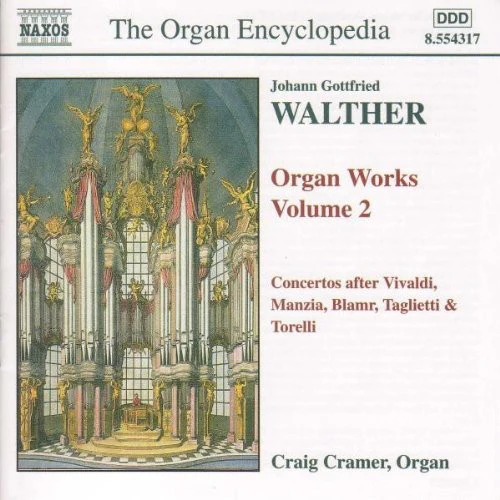
Walther: Organ Works Vol 2 / Craig Cramer
This is rather terrific. It is an example of the transcriber's art as high as Bach's and a whole CD of it, full of Italian concertos we never hear, as well as ones we do. What we have here is a kind of super-abundant version of Bach's arrangements of Vivaldi and others. These are 'concertos after' and reflect the transcriber's skill who has turned them into organ sonatas with some degree of freedom. There was a Vol. 1 of transcribed (Albinoni, Gregori, Telemann, Gentili) and original works which I've not yet heard. Walther was a year older than his distant relative, J. S. Bach. The two became friends when Bach spent time in Weimar. Walther was acknowledged as one of the great organists of his day, playing not only his own compositions but, as Vol. 2 shows, collecting those of other composers.
Born in Erfurt he received tuition from Johann Bernhard Bach. Organist at his home city's St Thomas he formed a friendship, based on much travelling, with Werckmeister, studied with Pachelbel's son, Wilhelm Hieronymus, then studied philosophy back at Erfurt university. As often happens to musical philosophy students in Germany around this time, he finally devoted his energy to music from thenceforth, and was organist at St. Paul's Weimar from 1707, joining the court orchestra by invitation of Duke Wilhelm Ernst, around the time Bach was leaving after the death of his wife.
Walther's own chorale preludes are represented, and 'Mache, dich' with its tinkling effects rather like some of Krebs's later efforts, recall one of the occasional stops no longer used in the organ vocabulary. They're very fine pieces and deserve to be better known. Walther's own modesty and low profile as a composer is the key to their comparative neglect. The transcriptions are suitable for the Italian or Italianate originals, the Vivaldi similar to Bach's and the Manzia unexpected in its use of flute stops. The Blamr is gentle, not quite bland, an attractive composition by someone hardly known to us. The Taglietti is full of panache and the three Torelli concerti that close the volume full of a graciousness one doesn't expect. The single movement d minor is full of questing for the home key, reflective and quasi-churchy. The B flat blows this away in brilliant ceremonials. The a minor is full of bright gothic gloom.
A really enjoyable disc, a true addition, beautifully recorded and played.
-- Simon Jenner, MusicWeb International
Born in Erfurt he received tuition from Johann Bernhard Bach. Organist at his home city's St Thomas he formed a friendship, based on much travelling, with Werckmeister, studied with Pachelbel's son, Wilhelm Hieronymus, then studied philosophy back at Erfurt university. As often happens to musical philosophy students in Germany around this time, he finally devoted his energy to music from thenceforth, and was organist at St. Paul's Weimar from 1707, joining the court orchestra by invitation of Duke Wilhelm Ernst, around the time Bach was leaving after the death of his wife.
Walther's own chorale preludes are represented, and 'Mache, dich' with its tinkling effects rather like some of Krebs's later efforts, recall one of the occasional stops no longer used in the organ vocabulary. They're very fine pieces and deserve to be better known. Walther's own modesty and low profile as a composer is the key to their comparative neglect. The transcriptions are suitable for the Italian or Italianate originals, the Vivaldi similar to Bach's and the Manzia unexpected in its use of flute stops. The Blamr is gentle, not quite bland, an attractive composition by someone hardly known to us. The Taglietti is full of panache and the three Torelli concerti that close the volume full of a graciousness one doesn't expect. The single movement d minor is full of questing for the home key, reflective and quasi-churchy. The B flat blows this away in brilliant ceremonials. The a minor is full of bright gothic gloom.
A really enjoyable disc, a true addition, beautifully recorded and played.
-- Simon Jenner, MusicWeb International
This is rather terrific. It is an example of the transcriber's art as high as Bach's and a whole CD of it, full of Italian concertos we never hear, as well as ones we do. What we have here is a kind of super-abundant version of Bach's arrangements of Vivaldi and others. These are 'concertos after' and reflect the transcriber's skill who has turned them into organ sonatas with some degree of freedom. There was a Vol. 1 of transcribed (Albinoni, Gregori, Telemann, Gentili) and original works which I've not yet heard. Walther was a year older than his distant relative, J. S. Bach. The two became friends when Bach spent time in Weimar. Walther was acknowledged as one of the great organists of his day, playing not only his own compositions but, as Vol. 2 shows, collecting those of other composers.
Born in Erfurt he received tuition from Johann Bernhard Bach. Organist at his home city's St Thomas he formed a friendship, based on much travelling, with Werckmeister, studied with Pachelbel's son, Wilhelm Hieronymus, then studied philosophy back at Erfurt university. As often happens to musical philosophy students in Germany around this time, he finally devoted his energy to music from thenceforth, and was organist at St. Paul's Weimar from 1707, joining the court orchestra by invitation of Duke Wilhelm Ernst, around the time Bach was leaving after the death of his wife.
Walther's own chorale preludes are represented, and 'Mache, dich' with its tinkling effects rather like some of Krebs's later efforts, recall one of the occasional stops no longer used in the organ vocabulary. They're very fine pieces and deserve to be better known. Walther's own modesty and low profile as a composer is the key to their comparative neglect. The transcriptions are suitable for the Italian or Italianate originals, the Vivaldi similar to Bach's and the Manzia unexpected in its use of flute stops. The Blamr is gentle, not quite bland, an attractive composition by someone hardly known to us. The Taglietti is full of panache and the three Torelli concerti that close the volume full of a graciousness one doesn't expect. The single movement d minor is full of questing for the home key, reflective and quasi-churchy. The B flat blows this away in brilliant ceremonials. The a minor is full of bright gothic gloom.
A really enjoyable disc, a true addition, beautifully recorded and played.
-- Simon Jenner, MusicWeb International
Born in Erfurt he received tuition from Johann Bernhard Bach. Organist at his home city's St Thomas he formed a friendship, based on much travelling, with Werckmeister, studied with Pachelbel's son, Wilhelm Hieronymus, then studied philosophy back at Erfurt university. As often happens to musical philosophy students in Germany around this time, he finally devoted his energy to music from thenceforth, and was organist at St. Paul's Weimar from 1707, joining the court orchestra by invitation of Duke Wilhelm Ernst, around the time Bach was leaving after the death of his wife.
Walther's own chorale preludes are represented, and 'Mache, dich' with its tinkling effects rather like some of Krebs's later efforts, recall one of the occasional stops no longer used in the organ vocabulary. They're very fine pieces and deserve to be better known. Walther's own modesty and low profile as a composer is the key to their comparative neglect. The transcriptions are suitable for the Italian or Italianate originals, the Vivaldi similar to Bach's and the Manzia unexpected in its use of flute stops. The Blamr is gentle, not quite bland, an attractive composition by someone hardly known to us. The Taglietti is full of panache and the three Torelli concerti that close the volume full of a graciousness one doesn't expect. The single movement d minor is full of questing for the home key, reflective and quasi-churchy. The B flat blows this away in brilliant ceremonials. The a minor is full of bright gothic gloom.
A really enjoyable disc, a true addition, beautifully recorded and played.
-- Simon Jenner, MusicWeb International
$19.99
Walther: Organ Works Vol 2 / Craig Cramer—
$19.99
Description
This is rather terrific. It is an example of the transcriber's art as high as Bach's and a whole CD of it, full of Italian concertos we never hear, as well as ones we do. What we have here is a kind of super-abundant version of Bach's arrangements of Vivaldi and others. These are 'concertos after' and reflect the transcriber's skill who has turned them into organ sonatas with some degree of freedom. There was a Vol. 1 of transcribed (Albinoni, Gregori, Telemann, Gentili) and original works which I've not yet heard. Walther was a year older than his distant relative, J. S. Bach. The two became friends when Bach spent time in Weimar. Walther was acknowledged as one of the great organists of his day, playing not only his own compositions but, as Vol. 2 shows, collecting those of other composers.
Born in Erfurt he received tuition from Johann Bernhard Bach. Organist at his home city's St Thomas he formed a friendship, based on much travelling, with Werckmeister, studied with Pachelbel's son, Wilhelm Hieronymus, then studied philosophy back at Erfurt university. As often happens to musical philosophy students in Germany around this time, he finally devoted his energy to music from thenceforth, and was organist at St. Paul's Weimar from 1707, joining the court orchestra by invitation of Duke Wilhelm Ernst, around the time Bach was leaving after the death of his wife.
Walther's own chorale preludes are represented, and 'Mache, dich' with its tinkling effects rather like some of Krebs's later efforts, recall one of the occasional stops no longer used in the organ vocabulary. They're very fine pieces and deserve to be better known. Walther's own modesty and low profile as a composer is the key to their comparative neglect. The transcriptions are suitable for the Italian or Italianate originals, the Vivaldi similar to Bach's and the Manzia unexpected in its use of flute stops. The Blamr is gentle, not quite bland, an attractive composition by someone hardly known to us. The Taglietti is full of panache and the three Torelli concerti that close the volume full of a graciousness one doesn't expect. The single movement d minor is full of questing for the home key, reflective and quasi-churchy. The B flat blows this away in brilliant ceremonials. The a minor is full of bright gothic gloom.
A really enjoyable disc, a true addition, beautifully recorded and played.
-- Simon Jenner, MusicWeb International
Born in Erfurt he received tuition from Johann Bernhard Bach. Organist at his home city's St Thomas he formed a friendship, based on much travelling, with Werckmeister, studied with Pachelbel's son, Wilhelm Hieronymus, then studied philosophy back at Erfurt university. As often happens to musical philosophy students in Germany around this time, he finally devoted his energy to music from thenceforth, and was organist at St. Paul's Weimar from 1707, joining the court orchestra by invitation of Duke Wilhelm Ernst, around the time Bach was leaving after the death of his wife.
Walther's own chorale preludes are represented, and 'Mache, dich' with its tinkling effects rather like some of Krebs's later efforts, recall one of the occasional stops no longer used in the organ vocabulary. They're very fine pieces and deserve to be better known. Walther's own modesty and low profile as a composer is the key to their comparative neglect. The transcriptions are suitable for the Italian or Italianate originals, the Vivaldi similar to Bach's and the Manzia unexpected in its use of flute stops. The Blamr is gentle, not quite bland, an attractive composition by someone hardly known to us. The Taglietti is full of panache and the three Torelli concerti that close the volume full of a graciousness one doesn't expect. The single movement d minor is full of questing for the home key, reflective and quasi-churchy. The B flat blows this away in brilliant ceremonials. The a minor is full of bright gothic gloom.
A really enjoyable disc, a true addition, beautifully recorded and played.
-- Simon Jenner, MusicWeb International