🎉 Up to 70% Off Selected ItemsShop Sale

1 / 2
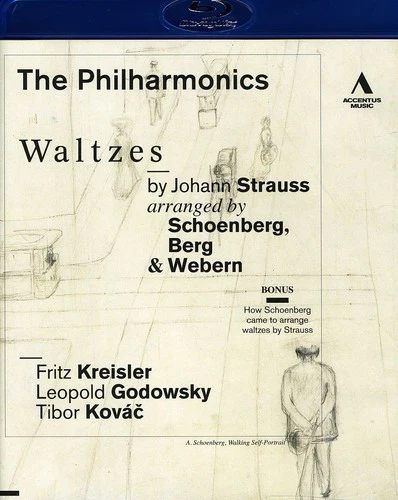
Waltzes By Johann Strauss Arranged By Schoenberg, Berg & Webern / The Philharmonics [blu-ray]
Note: This Blu-ray Disc is only playable on Blu-ray Disc players and not compatible with standard DVD players.
br />
Also available on standard DVD
The Philharmonics:
Tibor Ková? first violin, Shkëlzen Doli second violin, Thilo Fechner viola, Stephan Koncz cello, Ödön Rácz double bass, Daniel Ottensamer clarinet, František Jánoška piano
Guests: Walter Auer flute, Christoph Traxler harmonium
The Philharmonics, the ensemble founded by members of the Vienna Philharmonic Orchestra, fill the Café Sperl with some of the most authentically Viennese sounds imaginable – the Strauss waltzes that Schoenberg, Berg and Webern arranged and performed in May 1921 to raise funds for their pioneering “Society for Private Musical Performances”. This is music the players have in their blood, and they maintain the echt atmosphere with Godowsky’s tribute to the city, “Alt-Wien” and a clutch of Kreisler gems, rounding the programme off with a new piece by the ensemble’s leader Tibor Ková?, based on traditional Jewish melodies and Mahler themes, “Yiddische Mame”.
Recorded live at Café Sperl in Vienna, 9 March 2011
BONUS: How Schoenberg came to arrange waltzes by Strauss
Picture format: 1080i Full-HD
Sound format: PCM Stereo / DTS-HD Master Audio
Region code: 0 (worldwide)
Subtitles (Bonus): English, French
Running time: 64 mins (concert) + 10 mins (bonus)
No. of Discs: 1 (BD 25)
R E V I E W:
3553350.az_J_STRAUSS_II_Emperor.html
J. STRAUSS II Emperor Waltz. Roses from the South. A Night in Venice: Lagunenwalzer. Wine, Women, and Song. The Gypsy Baron: Treasure Waltz. KREISLER Marche miniature viennoise. Schön Rosmarin. Caprice viennois. KOVÁC Yiddische Mame. GODOWSKY Alt-Wien • The Philharmonics • ACCENTUS ACC 10228 (Blu-ray: 64:20) Live: Vienna 3/9/2011
In 1921, as a fund-raiser for the Society for Private Musical Performances, Schoenberg and his two most famous disciples arranged four Strauss waltzes for piano, harmonium, and string quartet. Four years later, Schoenberg returned to the source, adapting the Emperor Waltz for a similar ensemble, with the harmonium replaced by flute and clarinet. (Richard Burke, in Fanfare 22:4, suggests that it was “supposedly for use as an encore” after Pierrot Lunaire .) I’d love to have been at the first performance of the original four, featuring Berg on harmonium, Schoenberg on second violin, and Webern on cello (not to mention Eduard Steuermann on piano and Rodolf Kolisch on first violin), but removed from that star-studded context, the arrangements don’t hold up especially well. In his review of a recording featuring the Berlin String Quartet and friends (one that, like many forays into this repertoire, left out the low-inspiration Lagunenwalzer ), James H. North insisted that the “awkward arrangements” were “of little interest.” And while Richard Burke found more to admire, I can’t agree with him that the distinctive personalities of the three arrangers can be heard in these workaday adaptations. Certainly, there’s nothing here to match the quirkiness of Webern’s take on the six-voice Ricerar from The Musical Offering —nor the full-throated romanticism surging through Schoenberg’s arrangements of Bach’s organ music or Brahms First Piano Quartet. Nor, despite the Second Vienna School’s supposed affection for the Waltz King, is there anything here as delectable as the fantasies and transcriptions penned by such turn-of-the-century piano virtuosos as Godowsky, Rosenthal, and Rachmaninoff.
Still, as background music, this repertoire has its virtues—and this Blu-ray, featuring The Philharmonics (an ensemble made up of members of the Vienna Philharmonic), treats it precisely in that manner, offering up whipped-cream live performances from Vienna’s Café Sperl, with an audience numbering a dozen or so people, most of whom are more involved in their books, magazines, gossip, and flirtations than in the music. Certainly, this low-key approach makes more sense than the cleaner, more modernist (but also stiffer) manner favored by the members of the Boston Symphony on what is probably the most familiar recording of this material (see 26:2).
The Philharmonics interleave the Strauss waltzes with other popular Viennese confections—as well as first violinist Tibor Ková?’s medley that mixes Mahler with familiar Jewish songs. They’re all played with the same congenial spirit. As for the production: The notes are confusing—especially with respect to responsibility for the Kreisler and Godowsky arrangements; the bonus track, a discussion by Dr. Christian Meyer, director of the Schoenberg Center, is illuminating, but completely disorganized; sound and video are clean, although you’re apt to wonder why you’d want to watch an event that even the original audience wasn’t paying much visual attention to. Still, if you’ve got a Blu-ray player in the right part of your house, this is a fine accompaniment to your Sunday brunch.
FANFARE: Peter J. Rabinowitz
br />
Also available on standard DVD
The Philharmonics:
Tibor Ková? first violin, Shkëlzen Doli second violin, Thilo Fechner viola, Stephan Koncz cello, Ödön Rácz double bass, Daniel Ottensamer clarinet, František Jánoška piano
Guests: Walter Auer flute, Christoph Traxler harmonium
The Philharmonics, the ensemble founded by members of the Vienna Philharmonic Orchestra, fill the Café Sperl with some of the most authentically Viennese sounds imaginable – the Strauss waltzes that Schoenberg, Berg and Webern arranged and performed in May 1921 to raise funds for their pioneering “Society for Private Musical Performances”. This is music the players have in their blood, and they maintain the echt atmosphere with Godowsky’s tribute to the city, “Alt-Wien” and a clutch of Kreisler gems, rounding the programme off with a new piece by the ensemble’s leader Tibor Ková?, based on traditional Jewish melodies and Mahler themes, “Yiddische Mame”.
Recorded live at Café Sperl in Vienna, 9 March 2011
BONUS: How Schoenberg came to arrange waltzes by Strauss
Picture format: 1080i Full-HD
Sound format: PCM Stereo / DTS-HD Master Audio
Region code: 0 (worldwide)
Subtitles (Bonus): English, French
Running time: 64 mins (concert) + 10 mins (bonus)
No. of Discs: 1 (BD 25)
R E V I E W:
J. STRAUSS II Emperor Waltz. Roses from the South. A Night in Venice: Lagunenwalzer. Wine, Women, and Song. The Gypsy Baron: Treasure Waltz. KREISLER Marche miniature viennoise. Schön Rosmarin. Caprice viennois. KOVÁC Yiddische Mame. GODOWSKY Alt-Wien • The Philharmonics • ACCENTUS ACC 10228 (Blu-ray: 64:20) Live: Vienna 3/9/2011
In 1921, as a fund-raiser for the Society for Private Musical Performances, Schoenberg and his two most famous disciples arranged four Strauss waltzes for piano, harmonium, and string quartet. Four years later, Schoenberg returned to the source, adapting the Emperor Waltz for a similar ensemble, with the harmonium replaced by flute and clarinet. (Richard Burke, in Fanfare 22:4, suggests that it was “supposedly for use as an encore” after Pierrot Lunaire .) I’d love to have been at the first performance of the original four, featuring Berg on harmonium, Schoenberg on second violin, and Webern on cello (not to mention Eduard Steuermann on piano and Rodolf Kolisch on first violin), but removed from that star-studded context, the arrangements don’t hold up especially well. In his review of a recording featuring the Berlin String Quartet and friends (one that, like many forays into this repertoire, left out the low-inspiration Lagunenwalzer ), James H. North insisted that the “awkward arrangements” were “of little interest.” And while Richard Burke found more to admire, I can’t agree with him that the distinctive personalities of the three arrangers can be heard in these workaday adaptations. Certainly, there’s nothing here to match the quirkiness of Webern’s take on the six-voice Ricerar from The Musical Offering —nor the full-throated romanticism surging through Schoenberg’s arrangements of Bach’s organ music or Brahms First Piano Quartet. Nor, despite the Second Vienna School’s supposed affection for the Waltz King, is there anything here as delectable as the fantasies and transcriptions penned by such turn-of-the-century piano virtuosos as Godowsky, Rosenthal, and Rachmaninoff.
Still, as background music, this repertoire has its virtues—and this Blu-ray, featuring The Philharmonics (an ensemble made up of members of the Vienna Philharmonic), treats it precisely in that manner, offering up whipped-cream live performances from Vienna’s Café Sperl, with an audience numbering a dozen or so people, most of whom are more involved in their books, magazines, gossip, and flirtations than in the music. Certainly, this low-key approach makes more sense than the cleaner, more modernist (but also stiffer) manner favored by the members of the Boston Symphony on what is probably the most familiar recording of this material (see 26:2).
The Philharmonics interleave the Strauss waltzes with other popular Viennese confections—as well as first violinist Tibor Ková?’s medley that mixes Mahler with familiar Jewish songs. They’re all played with the same congenial spirit. As for the production: The notes are confusing—especially with respect to responsibility for the Kreisler and Godowsky arrangements; the bonus track, a discussion by Dr. Christian Meyer, director of the Schoenberg Center, is illuminating, but completely disorganized; sound and video are clean, although you’re apt to wonder why you’d want to watch an event that even the original audience wasn’t paying much visual attention to. Still, if you’ve got a Blu-ray player in the right part of your house, this is a fine accompaniment to your Sunday brunch.
FANFARE: Peter J. Rabinowitz
Note: This Blu-ray Disc is only playable on Blu-ray Disc players and not compatible with standard DVD players.
br />
Also available on standard DVD
The Philharmonics:
Tibor Ková? first violin, Shkëlzen Doli second violin, Thilo Fechner viola, Stephan Koncz cello, Ödön Rácz double bass, Daniel Ottensamer clarinet, František Jánoška piano
Guests: Walter Auer flute, Christoph Traxler harmonium
The Philharmonics, the ensemble founded by members of the Vienna Philharmonic Orchestra, fill the Café Sperl with some of the most authentically Viennese sounds imaginable – the Strauss waltzes that Schoenberg, Berg and Webern arranged and performed in May 1921 to raise funds for their pioneering “Society for Private Musical Performances”. This is music the players have in their blood, and they maintain the echt atmosphere with Godowsky’s tribute to the city, “Alt-Wien” and a clutch of Kreisler gems, rounding the programme off with a new piece by the ensemble’s leader Tibor Ková?, based on traditional Jewish melodies and Mahler themes, “Yiddische Mame”.
Recorded live at Café Sperl in Vienna, 9 March 2011
BONUS: How Schoenberg came to arrange waltzes by Strauss
Picture format: 1080i Full-HD
Sound format: PCM Stereo / DTS-HD Master Audio
Region code: 0 (worldwide)
Subtitles (Bonus): English, French
Running time: 64 mins (concert) + 10 mins (bonus)
No. of Discs: 1 (BD 25)
R E V I E W:
3553350.az_J_STRAUSS_II_Emperor.html
J. STRAUSS II Emperor Waltz. Roses from the South. A Night in Venice: Lagunenwalzer. Wine, Women, and Song. The Gypsy Baron: Treasure Waltz. KREISLER Marche miniature viennoise. Schön Rosmarin. Caprice viennois. KOVÁC Yiddische Mame. GODOWSKY Alt-Wien • The Philharmonics • ACCENTUS ACC 10228 (Blu-ray: 64:20) Live: Vienna 3/9/2011
In 1921, as a fund-raiser for the Society for Private Musical Performances, Schoenberg and his two most famous disciples arranged four Strauss waltzes for piano, harmonium, and string quartet. Four years later, Schoenberg returned to the source, adapting the Emperor Waltz for a similar ensemble, with the harmonium replaced by flute and clarinet. (Richard Burke, in Fanfare 22:4, suggests that it was “supposedly for use as an encore” after Pierrot Lunaire .) I’d love to have been at the first performance of the original four, featuring Berg on harmonium, Schoenberg on second violin, and Webern on cello (not to mention Eduard Steuermann on piano and Rodolf Kolisch on first violin), but removed from that star-studded context, the arrangements don’t hold up especially well. In his review of a recording featuring the Berlin String Quartet and friends (one that, like many forays into this repertoire, left out the low-inspiration Lagunenwalzer ), James H. North insisted that the “awkward arrangements” were “of little interest.” And while Richard Burke found more to admire, I can’t agree with him that the distinctive personalities of the three arrangers can be heard in these workaday adaptations. Certainly, there’s nothing here to match the quirkiness of Webern’s take on the six-voice Ricerar from The Musical Offering —nor the full-throated romanticism surging through Schoenberg’s arrangements of Bach’s organ music or Brahms First Piano Quartet. Nor, despite the Second Vienna School’s supposed affection for the Waltz King, is there anything here as delectable as the fantasies and transcriptions penned by such turn-of-the-century piano virtuosos as Godowsky, Rosenthal, and Rachmaninoff.
Still, as background music, this repertoire has its virtues—and this Blu-ray, featuring The Philharmonics (an ensemble made up of members of the Vienna Philharmonic), treats it precisely in that manner, offering up whipped-cream live performances from Vienna’s Café Sperl, with an audience numbering a dozen or so people, most of whom are more involved in their books, magazines, gossip, and flirtations than in the music. Certainly, this low-key approach makes more sense than the cleaner, more modernist (but also stiffer) manner favored by the members of the Boston Symphony on what is probably the most familiar recording of this material (see 26:2).
The Philharmonics interleave the Strauss waltzes with other popular Viennese confections—as well as first violinist Tibor Ková?’s medley that mixes Mahler with familiar Jewish songs. They’re all played with the same congenial spirit. As for the production: The notes are confusing—especially with respect to responsibility for the Kreisler and Godowsky arrangements; the bonus track, a discussion by Dr. Christian Meyer, director of the Schoenberg Center, is illuminating, but completely disorganized; sound and video are clean, although you’re apt to wonder why you’d want to watch an event that even the original audience wasn’t paying much visual attention to. Still, if you’ve got a Blu-ray player in the right part of your house, this is a fine accompaniment to your Sunday brunch.
FANFARE: Peter J. Rabinowitz
br />
Also available on standard DVD
The Philharmonics:
Tibor Ková? first violin, Shkëlzen Doli second violin, Thilo Fechner viola, Stephan Koncz cello, Ödön Rácz double bass, Daniel Ottensamer clarinet, František Jánoška piano
Guests: Walter Auer flute, Christoph Traxler harmonium
The Philharmonics, the ensemble founded by members of the Vienna Philharmonic Orchestra, fill the Café Sperl with some of the most authentically Viennese sounds imaginable – the Strauss waltzes that Schoenberg, Berg and Webern arranged and performed in May 1921 to raise funds for their pioneering “Society for Private Musical Performances”. This is music the players have in their blood, and they maintain the echt atmosphere with Godowsky’s tribute to the city, “Alt-Wien” and a clutch of Kreisler gems, rounding the programme off with a new piece by the ensemble’s leader Tibor Ková?, based on traditional Jewish melodies and Mahler themes, “Yiddische Mame”.
Recorded live at Café Sperl in Vienna, 9 March 2011
BONUS: How Schoenberg came to arrange waltzes by Strauss
Picture format: 1080i Full-HD
Sound format: PCM Stereo / DTS-HD Master Audio
Region code: 0 (worldwide)
Subtitles (Bonus): English, French
Running time: 64 mins (concert) + 10 mins (bonus)
No. of Discs: 1 (BD 25)
R E V I E W:
J. STRAUSS II Emperor Waltz. Roses from the South. A Night in Venice: Lagunenwalzer. Wine, Women, and Song. The Gypsy Baron: Treasure Waltz. KREISLER Marche miniature viennoise. Schön Rosmarin. Caprice viennois. KOVÁC Yiddische Mame. GODOWSKY Alt-Wien • The Philharmonics • ACCENTUS ACC 10228 (Blu-ray: 64:20) Live: Vienna 3/9/2011
In 1921, as a fund-raiser for the Society for Private Musical Performances, Schoenberg and his two most famous disciples arranged four Strauss waltzes for piano, harmonium, and string quartet. Four years later, Schoenberg returned to the source, adapting the Emperor Waltz for a similar ensemble, with the harmonium replaced by flute and clarinet. (Richard Burke, in Fanfare 22:4, suggests that it was “supposedly for use as an encore” after Pierrot Lunaire .) I’d love to have been at the first performance of the original four, featuring Berg on harmonium, Schoenberg on second violin, and Webern on cello (not to mention Eduard Steuermann on piano and Rodolf Kolisch on first violin), but removed from that star-studded context, the arrangements don’t hold up especially well. In his review of a recording featuring the Berlin String Quartet and friends (one that, like many forays into this repertoire, left out the low-inspiration Lagunenwalzer ), James H. North insisted that the “awkward arrangements” were “of little interest.” And while Richard Burke found more to admire, I can’t agree with him that the distinctive personalities of the three arrangers can be heard in these workaday adaptations. Certainly, there’s nothing here to match the quirkiness of Webern’s take on the six-voice Ricerar from The Musical Offering —nor the full-throated romanticism surging through Schoenberg’s arrangements of Bach’s organ music or Brahms First Piano Quartet. Nor, despite the Second Vienna School’s supposed affection for the Waltz King, is there anything here as delectable as the fantasies and transcriptions penned by such turn-of-the-century piano virtuosos as Godowsky, Rosenthal, and Rachmaninoff.
Still, as background music, this repertoire has its virtues—and this Blu-ray, featuring The Philharmonics (an ensemble made up of members of the Vienna Philharmonic), treats it precisely in that manner, offering up whipped-cream live performances from Vienna’s Café Sperl, with an audience numbering a dozen or so people, most of whom are more involved in their books, magazines, gossip, and flirtations than in the music. Certainly, this low-key approach makes more sense than the cleaner, more modernist (but also stiffer) manner favored by the members of the Boston Symphony on what is probably the most familiar recording of this material (see 26:2).
The Philharmonics interleave the Strauss waltzes with other popular Viennese confections—as well as first violinist Tibor Ková?’s medley that mixes Mahler with familiar Jewish songs. They’re all played with the same congenial spirit. As for the production: The notes are confusing—especially with respect to responsibility for the Kreisler and Godowsky arrangements; the bonus track, a discussion by Dr. Christian Meyer, director of the Schoenberg Center, is illuminating, but completely disorganized; sound and video are clean, although you’re apt to wonder why you’d want to watch an event that even the original audience wasn’t paying much visual attention to. Still, if you’ve got a Blu-ray player in the right part of your house, this is a fine accompaniment to your Sunday brunch.
FANFARE: Peter J. Rabinowitz
$28.99
Waltzes By Johann Strauss Arranged By Schoenberg, Berg & Webern / The Philharmonics [blu-ray]—
$28.99
Description
Note: This Blu-ray Disc is only playable on Blu-ray Disc players and not compatible with standard DVD players.
br />
Also available on standard DVD
The Philharmonics:
Tibor Ková? first violin, Shkëlzen Doli second violin, Thilo Fechner viola, Stephan Koncz cello, Ödön Rácz double bass, Daniel Ottensamer clarinet, František Jánoška piano
Guests: Walter Auer flute, Christoph Traxler harmonium
The Philharmonics, the ensemble founded by members of the Vienna Philharmonic Orchestra, fill the Café Sperl with some of the most authentically Viennese sounds imaginable – the Strauss waltzes that Schoenberg, Berg and Webern arranged and performed in May 1921 to raise funds for their pioneering “Society for Private Musical Performances”. This is music the players have in their blood, and they maintain the echt atmosphere with Godowsky’s tribute to the city, “Alt-Wien” and a clutch of Kreisler gems, rounding the programme off with a new piece by the ensemble’s leader Tibor Ková?, based on traditional Jewish melodies and Mahler themes, “Yiddische Mame”.
Recorded live at Café Sperl in Vienna, 9 March 2011
BONUS: How Schoenberg came to arrange waltzes by Strauss
Picture format: 1080i Full-HD
Sound format: PCM Stereo / DTS-HD Master Audio
Region code: 0 (worldwide)
Subtitles (Bonus): English, French
Running time: 64 mins (concert) + 10 mins (bonus)
No. of Discs: 1 (BD 25)
R E V I E W:
3553350.az_J_STRAUSS_II_Emperor.html
J. STRAUSS II Emperor Waltz. Roses from the South. A Night in Venice: Lagunenwalzer. Wine, Women, and Song. The Gypsy Baron: Treasure Waltz. KREISLER Marche miniature viennoise. Schön Rosmarin. Caprice viennois. KOVÁC Yiddische Mame. GODOWSKY Alt-Wien • The Philharmonics • ACCENTUS ACC 10228 (Blu-ray: 64:20) Live: Vienna 3/9/2011
In 1921, as a fund-raiser for the Society for Private Musical Performances, Schoenberg and his two most famous disciples arranged four Strauss waltzes for piano, harmonium, and string quartet. Four years later, Schoenberg returned to the source, adapting the Emperor Waltz for a similar ensemble, with the harmonium replaced by flute and clarinet. (Richard Burke, in Fanfare 22:4, suggests that it was “supposedly for use as an encore” after Pierrot Lunaire .) I’d love to have been at the first performance of the original four, featuring Berg on harmonium, Schoenberg on second violin, and Webern on cello (not to mention Eduard Steuermann on piano and Rodolf Kolisch on first violin), but removed from that star-studded context, the arrangements don’t hold up especially well. In his review of a recording featuring the Berlin String Quartet and friends (one that, like many forays into this repertoire, left out the low-inspiration Lagunenwalzer ), James H. North insisted that the “awkward arrangements” were “of little interest.” And while Richard Burke found more to admire, I can’t agree with him that the distinctive personalities of the three arrangers can be heard in these workaday adaptations. Certainly, there’s nothing here to match the quirkiness of Webern’s take on the six-voice Ricerar from The Musical Offering —nor the full-throated romanticism surging through Schoenberg’s arrangements of Bach’s organ music or Brahms First Piano Quartet. Nor, despite the Second Vienna School’s supposed affection for the Waltz King, is there anything here as delectable as the fantasies and transcriptions penned by such turn-of-the-century piano virtuosos as Godowsky, Rosenthal, and Rachmaninoff.
Still, as background music, this repertoire has its virtues—and this Blu-ray, featuring The Philharmonics (an ensemble made up of members of the Vienna Philharmonic), treats it precisely in that manner, offering up whipped-cream live performances from Vienna’s Café Sperl, with an audience numbering a dozen or so people, most of whom are more involved in their books, magazines, gossip, and flirtations than in the music. Certainly, this low-key approach makes more sense than the cleaner, more modernist (but also stiffer) manner favored by the members of the Boston Symphony on what is probably the most familiar recording of this material (see 26:2).
The Philharmonics interleave the Strauss waltzes with other popular Viennese confections—as well as first violinist Tibor Ková?’s medley that mixes Mahler with familiar Jewish songs. They’re all played with the same congenial spirit. As for the production: The notes are confusing—especially with respect to responsibility for the Kreisler and Godowsky arrangements; the bonus track, a discussion by Dr. Christian Meyer, director of the Schoenberg Center, is illuminating, but completely disorganized; sound and video are clean, although you’re apt to wonder why you’d want to watch an event that even the original audience wasn’t paying much visual attention to. Still, if you’ve got a Blu-ray player in the right part of your house, this is a fine accompaniment to your Sunday brunch.
FANFARE: Peter J. Rabinowitz
br />
Also available on standard DVD
The Philharmonics:
Tibor Ková? first violin, Shkëlzen Doli second violin, Thilo Fechner viola, Stephan Koncz cello, Ödön Rácz double bass, Daniel Ottensamer clarinet, František Jánoška piano
Guests: Walter Auer flute, Christoph Traxler harmonium
The Philharmonics, the ensemble founded by members of the Vienna Philharmonic Orchestra, fill the Café Sperl with some of the most authentically Viennese sounds imaginable – the Strauss waltzes that Schoenberg, Berg and Webern arranged and performed in May 1921 to raise funds for their pioneering “Society for Private Musical Performances”. This is music the players have in their blood, and they maintain the echt atmosphere with Godowsky’s tribute to the city, “Alt-Wien” and a clutch of Kreisler gems, rounding the programme off with a new piece by the ensemble’s leader Tibor Ková?, based on traditional Jewish melodies and Mahler themes, “Yiddische Mame”.
Recorded live at Café Sperl in Vienna, 9 March 2011
BONUS: How Schoenberg came to arrange waltzes by Strauss
Picture format: 1080i Full-HD
Sound format: PCM Stereo / DTS-HD Master Audio
Region code: 0 (worldwide)
Subtitles (Bonus): English, French
Running time: 64 mins (concert) + 10 mins (bonus)
No. of Discs: 1 (BD 25)
R E V I E W:
J. STRAUSS II Emperor Waltz. Roses from the South. A Night in Venice: Lagunenwalzer. Wine, Women, and Song. The Gypsy Baron: Treasure Waltz. KREISLER Marche miniature viennoise. Schön Rosmarin. Caprice viennois. KOVÁC Yiddische Mame. GODOWSKY Alt-Wien • The Philharmonics • ACCENTUS ACC 10228 (Blu-ray: 64:20) Live: Vienna 3/9/2011
In 1921, as a fund-raiser for the Society for Private Musical Performances, Schoenberg and his two most famous disciples arranged four Strauss waltzes for piano, harmonium, and string quartet. Four years later, Schoenberg returned to the source, adapting the Emperor Waltz for a similar ensemble, with the harmonium replaced by flute and clarinet. (Richard Burke, in Fanfare 22:4, suggests that it was “supposedly for use as an encore” after Pierrot Lunaire .) I’d love to have been at the first performance of the original four, featuring Berg on harmonium, Schoenberg on second violin, and Webern on cello (not to mention Eduard Steuermann on piano and Rodolf Kolisch on first violin), but removed from that star-studded context, the arrangements don’t hold up especially well. In his review of a recording featuring the Berlin String Quartet and friends (one that, like many forays into this repertoire, left out the low-inspiration Lagunenwalzer ), James H. North insisted that the “awkward arrangements” were “of little interest.” And while Richard Burke found more to admire, I can’t agree with him that the distinctive personalities of the three arrangers can be heard in these workaday adaptations. Certainly, there’s nothing here to match the quirkiness of Webern’s take on the six-voice Ricerar from The Musical Offering —nor the full-throated romanticism surging through Schoenberg’s arrangements of Bach’s organ music or Brahms First Piano Quartet. Nor, despite the Second Vienna School’s supposed affection for the Waltz King, is there anything here as delectable as the fantasies and transcriptions penned by such turn-of-the-century piano virtuosos as Godowsky, Rosenthal, and Rachmaninoff.
Still, as background music, this repertoire has its virtues—and this Blu-ray, featuring The Philharmonics (an ensemble made up of members of the Vienna Philharmonic), treats it precisely in that manner, offering up whipped-cream live performances from Vienna’s Café Sperl, with an audience numbering a dozen or so people, most of whom are more involved in their books, magazines, gossip, and flirtations than in the music. Certainly, this low-key approach makes more sense than the cleaner, more modernist (but also stiffer) manner favored by the members of the Boston Symphony on what is probably the most familiar recording of this material (see 26:2).
The Philharmonics interleave the Strauss waltzes with other popular Viennese confections—as well as first violinist Tibor Ková?’s medley that mixes Mahler with familiar Jewish songs. They’re all played with the same congenial spirit. As for the production: The notes are confusing—especially with respect to responsibility for the Kreisler and Godowsky arrangements; the bonus track, a discussion by Dr. Christian Meyer, director of the Schoenberg Center, is illuminating, but completely disorganized; sound and video are clean, although you’re apt to wonder why you’d want to watch an event that even the original audience wasn’t paying much visual attention to. Still, if you’ve got a Blu-ray player in the right part of your house, this is a fine accompaniment to your Sunday brunch.
FANFARE: Peter J. Rabinowitz