🎉 Up to 70% Off Selected ItemsShop Sale

1 / 2
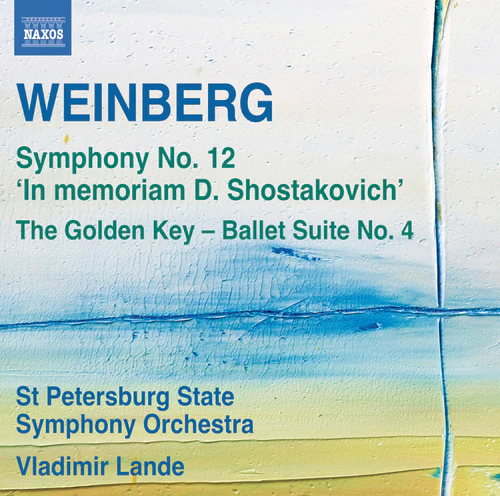
Weinberg: Symphony No 12 "In Memoriam D. Shostakovich" / Lande
WEINBERG Symphony No. 12. The Golden Key: Ballet Suite No. 4 • Vladimir Lande, cond; St. Petersburg St SO • NAXOS 8.573085 (75: 40)
I have been at least mildly enthusiastic about Lande’s previous Weinberg discs for Naxos (Symphony No. 6 on 8.572779 and Symphony No. 19 on 8.572752) and this one is as good, if not better. This is not the first recording of Weinberg’s Symphony No. 12—Maxim Shostakovich had that privilege—but it appears to be the only one available on CD, and the coupling, which is very different in tone, and a nice complement to the symphony, is as enjoyable as it is generous.
Weinberg’s Symphony No. 12 “In Memoriam D. Shostakovich” was composed in 1976, a year after Shostakovich’s death. Many of Weinberg’s works are stylistically similar to Shostakovich’s. This is not surprising, as Shostakovich was a friend and mentor to Weinberg, almost from the time that the latter arrived in the Soviet Union after fleeing his native Poland. This symphony is particularly Shostakovich-like. Although it is “in memoriam,” it is not funereal in tone. In fact, like many of Shostakovich’s works, it displays an emotional ambiguity that encourages a number of interpretations from performers and from listeners alike. Shostakovich’s “Leningrad” Symphony appears to have been an especially strong source of inspiration, but the work’s structure—for example, the epic first movement—is more reminiscent of Shostakovich’s Symphony No. 10. The D-S-C-H (D-E?-C-B) monogram even makes several subtle appearances. The symphony’s themes are distinctive, and Weinberg is a surefooted musical architect. Another similarity with Shostakovich is his ear for unusual scoring, and his always interesting and sometimes grotesque use of wind instruments at the extremes of their register. No one hearing this symphony for the first time will miss its connections with Shostakovich. Weinberg is not an imitator, however, any more than Telemann imitated Bach.
The Golden Key is a ballet from 1955 based on a story by Aleksey Tolstoy. The lead character, Burattino, is a puppet, and the eponymous golden key allows its bearer to enter the country of Happiness. In addition to puppets, there are various animal characters as well. On one level, this is an innocent ballet—even a children’s ballet—but its themes of rebellion and idealism also suggest a deeper and even socio-political interpretation. Shostakovich’s ballet scores have their moments of excellence as well as moments of more workmanlike writing. The Golden Key , from what I have heard of it, is at least on their level. The first three suites were recorded by Mark Ermler with the Bolshoi Theater Orchestra—Olympia OCD 473, if you can find it. That disc also included excerpts from the Fourth Suite. In other words, all four suites have been recorded. Taken together, they add up to about 85 minutes of music, so I am wondering if all of the ballet’s music was used in one of the four suites.
As on the previous CDs, Lande and the St. Petersburg Symphony Orchestra are very satisfactory. Certainly one can imagine more assertive conducting and a richer sounding orchestra, but I don’t think anyone will be unhappy with these performances. In fact, I would say that this is an improvement from the earlier recordings, particularly that of the Symphony No. 6, but that’s one Weinberg symphony in which there was more competition. If you’re interested in Shostakovich, or in music from the Soviet Union in general, there is absolutely no reason not to give this fine new CD a try.
FANFARE: Raymond Tuttle
WEINBERG Symphony No. 12. The Golden Key: Ballet Suite No. 4 • Vladimir Lande, cond; St. Petersburg St SO • NAXOS 8.573085 (75: 40)
I have been at least mildly enthusiastic about Lande’s previous Weinberg discs for Naxos (Symphony No. 6 on 8.572779 and Symphony No. 19 on 8.572752) and this one is as good, if not better. This is not the first recording of Weinberg’s Symphony No. 12—Maxim Shostakovich had that privilege—but it appears to be the only one available on CD, and the coupling, which is very different in tone, and a nice complement to the symphony, is as enjoyable as it is generous.
Weinberg’s Symphony No. 12 “In Memoriam D. Shostakovich” was composed in 1976, a year after Shostakovich’s death. Many of Weinberg’s works are stylistically similar to Shostakovich’s. This is not surprising, as Shostakovich was a friend and mentor to Weinberg, almost from the time that the latter arrived in the Soviet Union after fleeing his native Poland. This symphony is particularly Shostakovich-like. Although it is “in memoriam,” it is not funereal in tone. In fact, like many of Shostakovich’s works, it displays an emotional ambiguity that encourages a number of interpretations from performers and from listeners alike. Shostakovich’s “Leningrad” Symphony appears to have been an especially strong source of inspiration, but the work’s structure—for example, the epic first movement—is more reminiscent of Shostakovich’s Symphony No. 10. The D-S-C-H (D-E?-C-B) monogram even makes several subtle appearances. The symphony’s themes are distinctive, and Weinberg is a surefooted musical architect. Another similarity with Shostakovich is his ear for unusual scoring, and his always interesting and sometimes grotesque use of wind instruments at the extremes of their register. No one hearing this symphony for the first time will miss its connections with Shostakovich. Weinberg is not an imitator, however, any more than Telemann imitated Bach.
The Golden Key is a ballet from 1955 based on a story by Aleksey Tolstoy. The lead character, Burattino, is a puppet, and the eponymous golden key allows its bearer to enter the country of Happiness. In addition to puppets, there are various animal characters as well. On one level, this is an innocent ballet—even a children’s ballet—but its themes of rebellion and idealism also suggest a deeper and even socio-political interpretation. Shostakovich’s ballet scores have their moments of excellence as well as moments of more workmanlike writing. The Golden Key , from what I have heard of it, is at least on their level. The first three suites were recorded by Mark Ermler with the Bolshoi Theater Orchestra—Olympia OCD 473, if you can find it. That disc also included excerpts from the Fourth Suite. In other words, all four suites have been recorded. Taken together, they add up to about 85 minutes of music, so I am wondering if all of the ballet’s music was used in one of the four suites.
As on the previous CDs, Lande and the St. Petersburg Symphony Orchestra are very satisfactory. Certainly one can imagine more assertive conducting and a richer sounding orchestra, but I don’t think anyone will be unhappy with these performances. In fact, I would say that this is an improvement from the earlier recordings, particularly that of the Symphony No. 6, but that’s one Weinberg symphony in which there was more competition. If you’re interested in Shostakovich, or in music from the Soviet Union in general, there is absolutely no reason not to give this fine new CD a try.
FANFARE: Raymond Tuttle
$19.99
Weinberg: Symphony No 12 "In Memoriam D. Shostakovich" / Lande—
$19.99
Description
WEINBERG Symphony No. 12. The Golden Key: Ballet Suite No. 4 • Vladimir Lande, cond; St. Petersburg St SO • NAXOS 8.573085 (75: 40)
I have been at least mildly enthusiastic about Lande’s previous Weinberg discs for Naxos (Symphony No. 6 on 8.572779 and Symphony No. 19 on 8.572752) and this one is as good, if not better. This is not the first recording of Weinberg’s Symphony No. 12—Maxim Shostakovich had that privilege—but it appears to be the only one available on CD, and the coupling, which is very different in tone, and a nice complement to the symphony, is as enjoyable as it is generous.
Weinberg’s Symphony No. 12 “In Memoriam D. Shostakovich” was composed in 1976, a year after Shostakovich’s death. Many of Weinberg’s works are stylistically similar to Shostakovich’s. This is not surprising, as Shostakovich was a friend and mentor to Weinberg, almost from the time that the latter arrived in the Soviet Union after fleeing his native Poland. This symphony is particularly Shostakovich-like. Although it is “in memoriam,” it is not funereal in tone. In fact, like many of Shostakovich’s works, it displays an emotional ambiguity that encourages a number of interpretations from performers and from listeners alike. Shostakovich’s “Leningrad” Symphony appears to have been an especially strong source of inspiration, but the work’s structure—for example, the epic first movement—is more reminiscent of Shostakovich’s Symphony No. 10. The D-S-C-H (D-E?-C-B) monogram even makes several subtle appearances. The symphony’s themes are distinctive, and Weinberg is a surefooted musical architect. Another similarity with Shostakovich is his ear for unusual scoring, and his always interesting and sometimes grotesque use of wind instruments at the extremes of their register. No one hearing this symphony for the first time will miss its connections with Shostakovich. Weinberg is not an imitator, however, any more than Telemann imitated Bach.
The Golden Key is a ballet from 1955 based on a story by Aleksey Tolstoy. The lead character, Burattino, is a puppet, and the eponymous golden key allows its bearer to enter the country of Happiness. In addition to puppets, there are various animal characters as well. On one level, this is an innocent ballet—even a children’s ballet—but its themes of rebellion and idealism also suggest a deeper and even socio-political interpretation. Shostakovich’s ballet scores have their moments of excellence as well as moments of more workmanlike writing. The Golden Key , from what I have heard of it, is at least on their level. The first three suites were recorded by Mark Ermler with the Bolshoi Theater Orchestra—Olympia OCD 473, if you can find it. That disc also included excerpts from the Fourth Suite. In other words, all four suites have been recorded. Taken together, they add up to about 85 minutes of music, so I am wondering if all of the ballet’s music was used in one of the four suites.
As on the previous CDs, Lande and the St. Petersburg Symphony Orchestra are very satisfactory. Certainly one can imagine more assertive conducting and a richer sounding orchestra, but I don’t think anyone will be unhappy with these performances. In fact, I would say that this is an improvement from the earlier recordings, particularly that of the Symphony No. 6, but that’s one Weinberg symphony in which there was more competition. If you’re interested in Shostakovich, or in music from the Soviet Union in general, there is absolutely no reason not to give this fine new CD a try.
FANFARE: Raymond Tuttle






















