🎉 Up to 70% Off Selected ItemsShop Sale

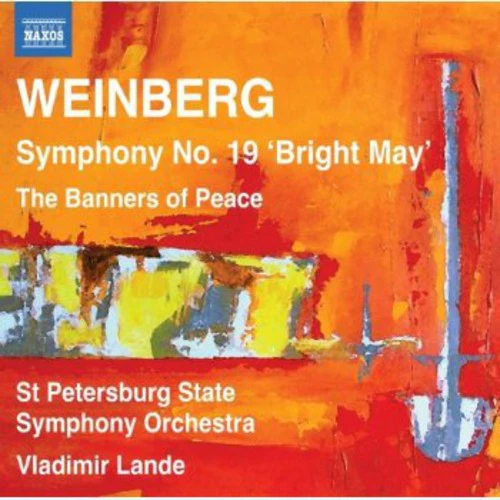
Weinberg: Symphony No. 19, Banners Of Peace / Lande, St. Petersburg Symphony
The subtitle of this symphony Bright May would normally lead one to think that, being written by a Soviet composer, it alluded to 1 May and the workers’ holiday. In this case you would be wrong since it refers to the month the ‘Great Patriotic War’, (the Second World War to most of us) ended. In the first of three linked movements Weinberg describes the devastation left by the war with an overwhelmingly sad introduction. This finally gives way to a calm pastoral episode that continues until disturbed by an insistent and ominous theme heavy with foreboding. This mood finally returns to the pastoral calm. Merging almost seamlessly the second movement opens with a gentle theme that once again is disturbed by a threatening passage leading to a central climax during which percussion and brass dominate before peace returns once more. This leads us into the symphony’s final movement that, like the other two, is a sequence of calm interludes interrupted by ominous passages. The symphony finally ends on a positive note.
It has often been the case that composers horrified either by the looming threat of war or its unleashing, felt compelled to express this horror in music. However, it is unusual for a composer to take a war as a theme for, in Weinberg’s case, a set of three symphonies, so many years after its end. I wondered if the passage of time leads to a better historical view of it musically or whether memory is dulled over the decades. I can’t answer that as I’m not yet acquainted with symphonies 17 and 18 but I can say that this one certainly does express the joy that must have been felt when that terrible war, whose cost was so appalling, was finally over. The continuing disturbance of that joy expressed by the gentle pastoral sections, by the dark clouds of martial sounding passages and thunderous brass and percussion can surely mean only one thing; to emphasise that winning the peace would be as challenging as winning the war. After all, Stalin was still ruling Russia with all that implied.
Weinberg could never have been described as a ‘Party’ hack, though like many other Soviet composers, including Shostakovich, he did write some works that could be described as “socialist realist”. These were linked to aspects of Soviet policy. An example is Weinberg’s 1985 Symphonic Poem The Banners of Peace. This followed shortly after the 19 th Symphony and was dedicated to the 27 th Congress of the Soviet Communist Party. Apart from some references to revolutionary songs such as the Varshavianka the music is not overtly propagandist nor is it bombastic in any way; rather it could be construed as a critique. After all, the words of the Varshavianka, which is quoted throughout, include “We will drown our enemies in their own blood, Death to the ruthless, To all pests of the workers, Death to tsars and plutocrats!”. In 1985, over 80 years after the song’s first appearance, these words seem at odds with the concept of peace. I regard this work more as another example of Weinberg’s ability to make powerful statements and this in music that is expressive and exciting. Viewed as such this work forms another worthy addition to the increasing amount of his music available in recorded form. We should be grateful.
Both works are given committed performances full of colour from an orchestra that will surely have this music in their blood. It is conducted with verve and enthusiasm by Vladimir Lande.
-- Steve Arloff , MusicWeb International
It has often been the case that composers horrified either by the looming threat of war or its unleashing, felt compelled to express this horror in music. However, it is unusual for a composer to take a war as a theme for, in Weinberg’s case, a set of three symphonies, so many years after its end. I wondered if the passage of time leads to a better historical view of it musically or whether memory is dulled over the decades. I can’t answer that as I’m not yet acquainted with symphonies 17 and 18 but I can say that this one certainly does express the joy that must have been felt when that terrible war, whose cost was so appalling, was finally over. The continuing disturbance of that joy expressed by the gentle pastoral sections, by the dark clouds of martial sounding passages and thunderous brass and percussion can surely mean only one thing; to emphasise that winning the peace would be as challenging as winning the war. After all, Stalin was still ruling Russia with all that implied.
Weinberg could never have been described as a ‘Party’ hack, though like many other Soviet composers, including Shostakovich, he did write some works that could be described as “socialist realist”. These were linked to aspects of Soviet policy. An example is Weinberg’s 1985 Symphonic Poem The Banners of Peace. This followed shortly after the 19 th Symphony and was dedicated to the 27 th Congress of the Soviet Communist Party. Apart from some references to revolutionary songs such as the Varshavianka the music is not overtly propagandist nor is it bombastic in any way; rather it could be construed as a critique. After all, the words of the Varshavianka, which is quoted throughout, include “We will drown our enemies in their own blood, Death to the ruthless, To all pests of the workers, Death to tsars and plutocrats!”. In 1985, over 80 years after the song’s first appearance, these words seem at odds with the concept of peace. I regard this work more as another example of Weinberg’s ability to make powerful statements and this in music that is expressive and exciting. Viewed as such this work forms another worthy addition to the increasing amount of his music available in recorded form. We should be grateful.
Both works are given committed performances full of colour from an orchestra that will surely have this music in their blood. It is conducted with verve and enthusiasm by Vladimir Lande.
-- Steve Arloff , MusicWeb International
The subtitle of this symphony Bright May would normally lead one to think that, being written by a Soviet composer, it alluded to 1 May and the workers’ holiday. In this case you would be wrong since it refers to the month the ‘Great Patriotic War’, (the Second World War to most of us) ended. In the first of three linked movements Weinberg describes the devastation left by the war with an overwhelmingly sad introduction. This finally gives way to a calm pastoral episode that continues until disturbed by an insistent and ominous theme heavy with foreboding. This mood finally returns to the pastoral calm. Merging almost seamlessly the second movement opens with a gentle theme that once again is disturbed by a threatening passage leading to a central climax during which percussion and brass dominate before peace returns once more. This leads us into the symphony’s final movement that, like the other two, is a sequence of calm interludes interrupted by ominous passages. The symphony finally ends on a positive note.
It has often been the case that composers horrified either by the looming threat of war or its unleashing, felt compelled to express this horror in music. However, it is unusual for a composer to take a war as a theme for, in Weinberg’s case, a set of three symphonies, so many years after its end. I wondered if the passage of time leads to a better historical view of it musically or whether memory is dulled over the decades. I can’t answer that as I’m not yet acquainted with symphonies 17 and 18 but I can say that this one certainly does express the joy that must have been felt when that terrible war, whose cost was so appalling, was finally over. The continuing disturbance of that joy expressed by the gentle pastoral sections, by the dark clouds of martial sounding passages and thunderous brass and percussion can surely mean only one thing; to emphasise that winning the peace would be as challenging as winning the war. After all, Stalin was still ruling Russia with all that implied.
Weinberg could never have been described as a ‘Party’ hack, though like many other Soviet composers, including Shostakovich, he did write some works that could be described as “socialist realist”. These were linked to aspects of Soviet policy. An example is Weinberg’s 1985 Symphonic Poem The Banners of Peace. This followed shortly after the 19 th Symphony and was dedicated to the 27 th Congress of the Soviet Communist Party. Apart from some references to revolutionary songs such as the Varshavianka the music is not overtly propagandist nor is it bombastic in any way; rather it could be construed as a critique. After all, the words of the Varshavianka, which is quoted throughout, include “We will drown our enemies in their own blood, Death to the ruthless, To all pests of the workers, Death to tsars and plutocrats!”. In 1985, over 80 years after the song’s first appearance, these words seem at odds with the concept of peace. I regard this work more as another example of Weinberg’s ability to make powerful statements and this in music that is expressive and exciting. Viewed as such this work forms another worthy addition to the increasing amount of his music available in recorded form. We should be grateful.
Both works are given committed performances full of colour from an orchestra that will surely have this music in their blood. It is conducted with verve and enthusiasm by Vladimir Lande.
-- Steve Arloff , MusicWeb International
It has often been the case that composers horrified either by the looming threat of war or its unleashing, felt compelled to express this horror in music. However, it is unusual for a composer to take a war as a theme for, in Weinberg’s case, a set of three symphonies, so many years after its end. I wondered if the passage of time leads to a better historical view of it musically or whether memory is dulled over the decades. I can’t answer that as I’m not yet acquainted with symphonies 17 and 18 but I can say that this one certainly does express the joy that must have been felt when that terrible war, whose cost was so appalling, was finally over. The continuing disturbance of that joy expressed by the gentle pastoral sections, by the dark clouds of martial sounding passages and thunderous brass and percussion can surely mean only one thing; to emphasise that winning the peace would be as challenging as winning the war. After all, Stalin was still ruling Russia with all that implied.
Weinberg could never have been described as a ‘Party’ hack, though like many other Soviet composers, including Shostakovich, he did write some works that could be described as “socialist realist”. These were linked to aspects of Soviet policy. An example is Weinberg’s 1985 Symphonic Poem The Banners of Peace. This followed shortly after the 19 th Symphony and was dedicated to the 27 th Congress of the Soviet Communist Party. Apart from some references to revolutionary songs such as the Varshavianka the music is not overtly propagandist nor is it bombastic in any way; rather it could be construed as a critique. After all, the words of the Varshavianka, which is quoted throughout, include “We will drown our enemies in their own blood, Death to the ruthless, To all pests of the workers, Death to tsars and plutocrats!”. In 1985, over 80 years after the song’s first appearance, these words seem at odds with the concept of peace. I regard this work more as another example of Weinberg’s ability to make powerful statements and this in music that is expressive and exciting. Viewed as such this work forms another worthy addition to the increasing amount of his music available in recorded form. We should be grateful.
Both works are given committed performances full of colour from an orchestra that will surely have this music in their blood. It is conducted with verve and enthusiasm by Vladimir Lande.
-- Steve Arloff , MusicWeb International
$7.00
Original: $19.99
-65%Weinberg: Symphony No. 19, Banners Of Peace / Lande, St. Petersburg Symphony—
$19.99
$7.00Description
The subtitle of this symphony Bright May would normally lead one to think that, being written by a Soviet composer, it alluded to 1 May and the workers’ holiday. In this case you would be wrong since it refers to the month the ‘Great Patriotic War’, (the Second World War to most of us) ended. In the first of three linked movements Weinberg describes the devastation left by the war with an overwhelmingly sad introduction. This finally gives way to a calm pastoral episode that continues until disturbed by an insistent and ominous theme heavy with foreboding. This mood finally returns to the pastoral calm. Merging almost seamlessly the second movement opens with a gentle theme that once again is disturbed by a threatening passage leading to a central climax during which percussion and brass dominate before peace returns once more. This leads us into the symphony’s final movement that, like the other two, is a sequence of calm interludes interrupted by ominous passages. The symphony finally ends on a positive note.
It has often been the case that composers horrified either by the looming threat of war or its unleashing, felt compelled to express this horror in music. However, it is unusual for a composer to take a war as a theme for, in Weinberg’s case, a set of three symphonies, so many years after its end. I wondered if the passage of time leads to a better historical view of it musically or whether memory is dulled over the decades. I can’t answer that as I’m not yet acquainted with symphonies 17 and 18 but I can say that this one certainly does express the joy that must have been felt when that terrible war, whose cost was so appalling, was finally over. The continuing disturbance of that joy expressed by the gentle pastoral sections, by the dark clouds of martial sounding passages and thunderous brass and percussion can surely mean only one thing; to emphasise that winning the peace would be as challenging as winning the war. After all, Stalin was still ruling Russia with all that implied.
Weinberg could never have been described as a ‘Party’ hack, though like many other Soviet composers, including Shostakovich, he did write some works that could be described as “socialist realist”. These were linked to aspects of Soviet policy. An example is Weinberg’s 1985 Symphonic Poem The Banners of Peace. This followed shortly after the 19 th Symphony and was dedicated to the 27 th Congress of the Soviet Communist Party. Apart from some references to revolutionary songs such as the Varshavianka the music is not overtly propagandist nor is it bombastic in any way; rather it could be construed as a critique. After all, the words of the Varshavianka, which is quoted throughout, include “We will drown our enemies in their own blood, Death to the ruthless, To all pests of the workers, Death to tsars and plutocrats!”. In 1985, over 80 years after the song’s first appearance, these words seem at odds with the concept of peace. I regard this work more as another example of Weinberg’s ability to make powerful statements and this in music that is expressive and exciting. Viewed as such this work forms another worthy addition to the increasing amount of his music available in recorded form. We should be grateful.
Both works are given committed performances full of colour from an orchestra that will surely have this music in their blood. It is conducted with verve and enthusiasm by Vladimir Lande.
-- Steve Arloff , MusicWeb International
It has often been the case that composers horrified either by the looming threat of war or its unleashing, felt compelled to express this horror in music. However, it is unusual for a composer to take a war as a theme for, in Weinberg’s case, a set of three symphonies, so many years after its end. I wondered if the passage of time leads to a better historical view of it musically or whether memory is dulled over the decades. I can’t answer that as I’m not yet acquainted with symphonies 17 and 18 but I can say that this one certainly does express the joy that must have been felt when that terrible war, whose cost was so appalling, was finally over. The continuing disturbance of that joy expressed by the gentle pastoral sections, by the dark clouds of martial sounding passages and thunderous brass and percussion can surely mean only one thing; to emphasise that winning the peace would be as challenging as winning the war. After all, Stalin was still ruling Russia with all that implied.
Weinberg could never have been described as a ‘Party’ hack, though like many other Soviet composers, including Shostakovich, he did write some works that could be described as “socialist realist”. These were linked to aspects of Soviet policy. An example is Weinberg’s 1985 Symphonic Poem The Banners of Peace. This followed shortly after the 19 th Symphony and was dedicated to the 27 th Congress of the Soviet Communist Party. Apart from some references to revolutionary songs such as the Varshavianka the music is not overtly propagandist nor is it bombastic in any way; rather it could be construed as a critique. After all, the words of the Varshavianka, which is quoted throughout, include “We will drown our enemies in their own blood, Death to the ruthless, To all pests of the workers, Death to tsars and plutocrats!”. In 1985, over 80 years after the song’s first appearance, these words seem at odds with the concept of peace. I regard this work more as another example of Weinberg’s ability to make powerful statements and this in music that is expressive and exciting. Viewed as such this work forms another worthy addition to the increasing amount of his music available in recorded form. We should be grateful.
Both works are given committed performances full of colour from an orchestra that will surely have this music in their blood. It is conducted with verve and enthusiasm by Vladimir Lande.
-- Steve Arloff , MusicWeb International