🎉 Up to 70% Off Selected ItemsShop Sale

1 / 2
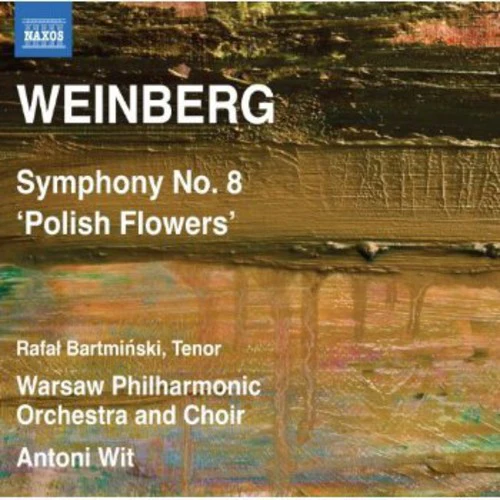
Weinberg: Symphony No 8 "Polish Flowers" / Wit, Warsaw Philharmonic
WEINBERG Symphony No. 8, “Polish Flowers” • Antoni Wit, cond; Rafal Bartminski (ten); Magdalena Dobrowolska (sop); Ewa Marciniec (alt); Warsaw PO & Ch • NAXOS 8.572873 (58:32)
Although I have written some very nice things about previous Weinberg CDs I’ve reviewed, this is one for the ages. It is the world premiere recording of his 1964 Eighth Symphony, subtitled “Polish Flowers” (Kwiaty Polskie) and based on the series of poems under that name by the famed poet Julian Tuwim (1894-1953). As usual with Naxos, none of the song texts are in the booklet in either language, and online in this case you can only access them in the original Polish. I was able, however, to find a brief translation of one poem online:
A box with paints from childhood’s time:
The colors of town are earth and grime.
An old worker at a dark doorway squats,
The spuds in his bowl are powdery dry.
It’s a face of yellowish and gray spots
In the midst of hunger, cold, dirt and slime.
Brief descriptions of all 10 poems are also given, in English, in the booklet. As one can surmise from the above, Tuwim’s poetry was often ironic, focusing “on Poland’s troubled past and ominous future,” covering such things as “social inequality, poverty, cruelty in times of war and a final luminous vision.” And Weinberg’s music is right there with him, redoubling its message and making dolorous or ironic comments of his own.
Like many such symphonies, the 10 “movements” are played continuously in one 58-minute work. The music is primarily tonal, but, as is the case with so much of Weinberg’s music, there are marvelous tonal “shifts” in the underlying structure, and the music seems often to flow rather than progress rhythmically. However, because so many of these poems focus on man’s cruelty to man, there are some intensely powerful rhythmic passages, primarily for the full chorus.
I know that these comments of mine may seem like constant reiteration, but Antoni Wit’s conducting is nothing short of miraculous. Not only does he impart full musical value to this work but he also draws the listener inward as he projects the emotions outward. In this way he creates a musical ambience that flows around the listener, almost like an enclosure of sorts. One is drawn into the musical web at the outset and not let go until the last note is sounded—and even then, one waits with bated breath to see if the music will continue. Yes, there are some pieces where Wit’s approach has its limitations, but in modern music that combines tonal and atonal qualities he is generally peerless. I can think of few other conductors who can create the kind of musical spell that Antoni Wit creates with regularity in his performances.
Needless to say, under such inspired direction the Warsaw Philharmonic Orchestra and Choir play and sing with fervent commitment, and I’m thrilled to say that his vocal soloists are all first-rate, particularly tenor Bartminski who gets the lion’s share of the solo music. He has a typically bright Polish tenor, lyrical yet with a bright “cut” on top similar to certain Russian or Spanish tenors, and his powers of interpretation are simply marvelous. Soprano Dobrowolska and alto Marciniec are not to be slighted—their contributions are equally telling, and equally well sung—yet it is Bartminski around whom so much of this music revolves.
In general style this symphony resembles some of the work of Benjamin Britten at his very best. I am not implying that Weinberg copied Britten’s style, merely trying to give the listener unfamiliar with his music a frame of reference. This symphony also contains elements that sound like Mahler or Orff, and there are many differences in the way Britten and Weinberg set texts and the overall musical development. In the final analysis, however, there is much here that sounds somewhat akin to the War Requiem. This was probably conditioned by the poetry used for the texts, just as Britten’s music was conditioned by the poetry of Wilfred Owen.
The liner notes say that this symphony is one of Weinberg’s most personal artistic statements. That’s rather an understatement. This is a very deep, emotional, and involving work that you will certainly be caught up in and not forget.
FANFARE: Lynn René Bayley
---------
Although he never returned to his native Poland after the Second World War, Mieczyslaw Weinberg never lost touch with his roots. His Eighth symphony of 1964 is a setting of 10 poems (in Polish) of poet Julian Tuwim for chorus, tenor, and orchestra, with brief contributions from soprano and alto soloists as well. The subjects range from images of nature (Gust of Spring, There was an Orchard, Elderberry) to social injustice (Lessons, Justice), to the depredations of the Nazi years (Warsaw Dogs, Mother). The music is compelling, often haunting, and quite touching. Weinberg’s scoring is sparse and for the most part restrained, keeping power in reserve for the central poems about cruelty and inhumanity (Lesson, Warsaw Dogs), while his vocal writing gets the most out of simple melodies that carefully project the text.
Antoni Wit and his Warsaw forces are almost always at their best in choral music (remember the stunning Mahler Eighth and vocal works of Penderecki). The chorus sings with the right purity and, where called for, intensity. Tenor Rafal Bartminski has a pleasing timbre and makes a very effective soloist. Both women handle their small parts as well as anyone could ask, and the whole production is very well recorded. Naxos makes texts and translations available on its website, fortunately, as the music really does ask that you know what the singing is all about. This is a very fine release of music by an elusive but tremendously sincere and worthy composer.
-- David Hurwitz, ClassicsToday.com
Although I have written some very nice things about previous Weinberg CDs I’ve reviewed, this is one for the ages. It is the world premiere recording of his 1964 Eighth Symphony, subtitled “Polish Flowers” (Kwiaty Polskie) and based on the series of poems under that name by the famed poet Julian Tuwim (1894-1953). As usual with Naxos, none of the song texts are in the booklet in either language, and online in this case you can only access them in the original Polish. I was able, however, to find a brief translation of one poem online:
A box with paints from childhood’s time:
The colors of town are earth and grime.
An old worker at a dark doorway squats,
The spuds in his bowl are powdery dry.
It’s a face of yellowish and gray spots
In the midst of hunger, cold, dirt and slime.
Brief descriptions of all 10 poems are also given, in English, in the booklet. As one can surmise from the above, Tuwim’s poetry was often ironic, focusing “on Poland’s troubled past and ominous future,” covering such things as “social inequality, poverty, cruelty in times of war and a final luminous vision.” And Weinberg’s music is right there with him, redoubling its message and making dolorous or ironic comments of his own.
Like many such symphonies, the 10 “movements” are played continuously in one 58-minute work. The music is primarily tonal, but, as is the case with so much of Weinberg’s music, there are marvelous tonal “shifts” in the underlying structure, and the music seems often to flow rather than progress rhythmically. However, because so many of these poems focus on man’s cruelty to man, there are some intensely powerful rhythmic passages, primarily for the full chorus.
I know that these comments of mine may seem like constant reiteration, but Antoni Wit’s conducting is nothing short of miraculous. Not only does he impart full musical value to this work but he also draws the listener inward as he projects the emotions outward. In this way he creates a musical ambience that flows around the listener, almost like an enclosure of sorts. One is drawn into the musical web at the outset and not let go until the last note is sounded—and even then, one waits with bated breath to see if the music will continue. Yes, there are some pieces where Wit’s approach has its limitations, but in modern music that combines tonal and atonal qualities he is generally peerless. I can think of few other conductors who can create the kind of musical spell that Antoni Wit creates with regularity in his performances.
Needless to say, under such inspired direction the Warsaw Philharmonic Orchestra and Choir play and sing with fervent commitment, and I’m thrilled to say that his vocal soloists are all first-rate, particularly tenor Bartminski who gets the lion’s share of the solo music. He has a typically bright Polish tenor, lyrical yet with a bright “cut” on top similar to certain Russian or Spanish tenors, and his powers of interpretation are simply marvelous. Soprano Dobrowolska and alto Marciniec are not to be slighted—their contributions are equally telling, and equally well sung—yet it is Bartminski around whom so much of this music revolves.
In general style this symphony resembles some of the work of Benjamin Britten at his very best. I am not implying that Weinberg copied Britten’s style, merely trying to give the listener unfamiliar with his music a frame of reference. This symphony also contains elements that sound like Mahler or Orff, and there are many differences in the way Britten and Weinberg set texts and the overall musical development. In the final analysis, however, there is much here that sounds somewhat akin to the War Requiem. This was probably conditioned by the poetry used for the texts, just as Britten’s music was conditioned by the poetry of Wilfred Owen.
The liner notes say that this symphony is one of Weinberg’s most personal artistic statements. That’s rather an understatement. This is a very deep, emotional, and involving work that you will certainly be caught up in and not forget.
FANFARE: Lynn René Bayley
---------
Although he never returned to his native Poland after the Second World War, Mieczyslaw Weinberg never lost touch with his roots. His Eighth symphony of 1964 is a setting of 10 poems (in Polish) of poet Julian Tuwim for chorus, tenor, and orchestra, with brief contributions from soprano and alto soloists as well. The subjects range from images of nature (Gust of Spring, There was an Orchard, Elderberry) to social injustice (Lessons, Justice), to the depredations of the Nazi years (Warsaw Dogs, Mother). The music is compelling, often haunting, and quite touching. Weinberg’s scoring is sparse and for the most part restrained, keeping power in reserve for the central poems about cruelty and inhumanity (Lesson, Warsaw Dogs), while his vocal writing gets the most out of simple melodies that carefully project the text.
Antoni Wit and his Warsaw forces are almost always at their best in choral music (remember the stunning Mahler Eighth and vocal works of Penderecki). The chorus sings with the right purity and, where called for, intensity. Tenor Rafal Bartminski has a pleasing timbre and makes a very effective soloist. Both women handle their small parts as well as anyone could ask, and the whole production is very well recorded. Naxos makes texts and translations available on its website, fortunately, as the music really does ask that you know what the singing is all about. This is a very fine release of music by an elusive but tremendously sincere and worthy composer.
-- David Hurwitz, ClassicsToday.com
WEINBERG Symphony No. 8, “Polish Flowers” • Antoni Wit, cond; Rafal Bartminski (ten); Magdalena Dobrowolska (sop); Ewa Marciniec (alt); Warsaw PO & Ch • NAXOS 8.572873 (58:32)
Although I have written some very nice things about previous Weinberg CDs I’ve reviewed, this is one for the ages. It is the world premiere recording of his 1964 Eighth Symphony, subtitled “Polish Flowers” (Kwiaty Polskie) and based on the series of poems under that name by the famed poet Julian Tuwim (1894-1953). As usual with Naxos, none of the song texts are in the booklet in either language, and online in this case you can only access them in the original Polish. I was able, however, to find a brief translation of one poem online:
A box with paints from childhood’s time:
The colors of town are earth and grime.
An old worker at a dark doorway squats,
The spuds in his bowl are powdery dry.
It’s a face of yellowish and gray spots
In the midst of hunger, cold, dirt and slime.
Brief descriptions of all 10 poems are also given, in English, in the booklet. As one can surmise from the above, Tuwim’s poetry was often ironic, focusing “on Poland’s troubled past and ominous future,” covering such things as “social inequality, poverty, cruelty in times of war and a final luminous vision.” And Weinberg’s music is right there with him, redoubling its message and making dolorous or ironic comments of his own.
Like many such symphonies, the 10 “movements” are played continuously in one 58-minute work. The music is primarily tonal, but, as is the case with so much of Weinberg’s music, there are marvelous tonal “shifts” in the underlying structure, and the music seems often to flow rather than progress rhythmically. However, because so many of these poems focus on man’s cruelty to man, there are some intensely powerful rhythmic passages, primarily for the full chorus.
I know that these comments of mine may seem like constant reiteration, but Antoni Wit’s conducting is nothing short of miraculous. Not only does he impart full musical value to this work but he also draws the listener inward as he projects the emotions outward. In this way he creates a musical ambience that flows around the listener, almost like an enclosure of sorts. One is drawn into the musical web at the outset and not let go until the last note is sounded—and even then, one waits with bated breath to see if the music will continue. Yes, there are some pieces where Wit’s approach has its limitations, but in modern music that combines tonal and atonal qualities he is generally peerless. I can think of few other conductors who can create the kind of musical spell that Antoni Wit creates with regularity in his performances.
Needless to say, under such inspired direction the Warsaw Philharmonic Orchestra and Choir play and sing with fervent commitment, and I’m thrilled to say that his vocal soloists are all first-rate, particularly tenor Bartminski who gets the lion’s share of the solo music. He has a typically bright Polish tenor, lyrical yet with a bright “cut” on top similar to certain Russian or Spanish tenors, and his powers of interpretation are simply marvelous. Soprano Dobrowolska and alto Marciniec are not to be slighted—their contributions are equally telling, and equally well sung—yet it is Bartminski around whom so much of this music revolves.
In general style this symphony resembles some of the work of Benjamin Britten at his very best. I am not implying that Weinberg copied Britten’s style, merely trying to give the listener unfamiliar with his music a frame of reference. This symphony also contains elements that sound like Mahler or Orff, and there are many differences in the way Britten and Weinberg set texts and the overall musical development. In the final analysis, however, there is much here that sounds somewhat akin to the War Requiem. This was probably conditioned by the poetry used for the texts, just as Britten’s music was conditioned by the poetry of Wilfred Owen.
The liner notes say that this symphony is one of Weinberg’s most personal artistic statements. That’s rather an understatement. This is a very deep, emotional, and involving work that you will certainly be caught up in and not forget.
FANFARE: Lynn René Bayley
---------
Although he never returned to his native Poland after the Second World War, Mieczyslaw Weinberg never lost touch with his roots. His Eighth symphony of 1964 is a setting of 10 poems (in Polish) of poet Julian Tuwim for chorus, tenor, and orchestra, with brief contributions from soprano and alto soloists as well. The subjects range from images of nature (Gust of Spring, There was an Orchard, Elderberry) to social injustice (Lessons, Justice), to the depredations of the Nazi years (Warsaw Dogs, Mother). The music is compelling, often haunting, and quite touching. Weinberg’s scoring is sparse and for the most part restrained, keeping power in reserve for the central poems about cruelty and inhumanity (Lesson, Warsaw Dogs), while his vocal writing gets the most out of simple melodies that carefully project the text.
Antoni Wit and his Warsaw forces are almost always at their best in choral music (remember the stunning Mahler Eighth and vocal works of Penderecki). The chorus sings with the right purity and, where called for, intensity. Tenor Rafal Bartminski has a pleasing timbre and makes a very effective soloist. Both women handle their small parts as well as anyone could ask, and the whole production is very well recorded. Naxos makes texts and translations available on its website, fortunately, as the music really does ask that you know what the singing is all about. This is a very fine release of music by an elusive but tremendously sincere and worthy composer.
-- David Hurwitz, ClassicsToday.com
Although I have written some very nice things about previous Weinberg CDs I’ve reviewed, this is one for the ages. It is the world premiere recording of his 1964 Eighth Symphony, subtitled “Polish Flowers” (Kwiaty Polskie) and based on the series of poems under that name by the famed poet Julian Tuwim (1894-1953). As usual with Naxos, none of the song texts are in the booklet in either language, and online in this case you can only access them in the original Polish. I was able, however, to find a brief translation of one poem online:
A box with paints from childhood’s time:
The colors of town are earth and grime.
An old worker at a dark doorway squats,
The spuds in his bowl are powdery dry.
It’s a face of yellowish and gray spots
In the midst of hunger, cold, dirt and slime.
Brief descriptions of all 10 poems are also given, in English, in the booklet. As one can surmise from the above, Tuwim’s poetry was often ironic, focusing “on Poland’s troubled past and ominous future,” covering such things as “social inequality, poverty, cruelty in times of war and a final luminous vision.” And Weinberg’s music is right there with him, redoubling its message and making dolorous or ironic comments of his own.
Like many such symphonies, the 10 “movements” are played continuously in one 58-minute work. The music is primarily tonal, but, as is the case with so much of Weinberg’s music, there are marvelous tonal “shifts” in the underlying structure, and the music seems often to flow rather than progress rhythmically. However, because so many of these poems focus on man’s cruelty to man, there are some intensely powerful rhythmic passages, primarily for the full chorus.
I know that these comments of mine may seem like constant reiteration, but Antoni Wit’s conducting is nothing short of miraculous. Not only does he impart full musical value to this work but he also draws the listener inward as he projects the emotions outward. In this way he creates a musical ambience that flows around the listener, almost like an enclosure of sorts. One is drawn into the musical web at the outset and not let go until the last note is sounded—and even then, one waits with bated breath to see if the music will continue. Yes, there are some pieces where Wit’s approach has its limitations, but in modern music that combines tonal and atonal qualities he is generally peerless. I can think of few other conductors who can create the kind of musical spell that Antoni Wit creates with regularity in his performances.
Needless to say, under such inspired direction the Warsaw Philharmonic Orchestra and Choir play and sing with fervent commitment, and I’m thrilled to say that his vocal soloists are all first-rate, particularly tenor Bartminski who gets the lion’s share of the solo music. He has a typically bright Polish tenor, lyrical yet with a bright “cut” on top similar to certain Russian or Spanish tenors, and his powers of interpretation are simply marvelous. Soprano Dobrowolska and alto Marciniec are not to be slighted—their contributions are equally telling, and equally well sung—yet it is Bartminski around whom so much of this music revolves.
In general style this symphony resembles some of the work of Benjamin Britten at his very best. I am not implying that Weinberg copied Britten’s style, merely trying to give the listener unfamiliar with his music a frame of reference. This symphony also contains elements that sound like Mahler or Orff, and there are many differences in the way Britten and Weinberg set texts and the overall musical development. In the final analysis, however, there is much here that sounds somewhat akin to the War Requiem. This was probably conditioned by the poetry used for the texts, just as Britten’s music was conditioned by the poetry of Wilfred Owen.
The liner notes say that this symphony is one of Weinberg’s most personal artistic statements. That’s rather an understatement. This is a very deep, emotional, and involving work that you will certainly be caught up in and not forget.
FANFARE: Lynn René Bayley
---------
Although he never returned to his native Poland after the Second World War, Mieczyslaw Weinberg never lost touch with his roots. His Eighth symphony of 1964 is a setting of 10 poems (in Polish) of poet Julian Tuwim for chorus, tenor, and orchestra, with brief contributions from soprano and alto soloists as well. The subjects range from images of nature (Gust of Spring, There was an Orchard, Elderberry) to social injustice (Lessons, Justice), to the depredations of the Nazi years (Warsaw Dogs, Mother). The music is compelling, often haunting, and quite touching. Weinberg’s scoring is sparse and for the most part restrained, keeping power in reserve for the central poems about cruelty and inhumanity (Lesson, Warsaw Dogs), while his vocal writing gets the most out of simple melodies that carefully project the text.
Antoni Wit and his Warsaw forces are almost always at their best in choral music (remember the stunning Mahler Eighth and vocal works of Penderecki). The chorus sings with the right purity and, where called for, intensity. Tenor Rafal Bartminski has a pleasing timbre and makes a very effective soloist. Both women handle their small parts as well as anyone could ask, and the whole production is very well recorded. Naxos makes texts and translations available on its website, fortunately, as the music really does ask that you know what the singing is all about. This is a very fine release of music by an elusive but tremendously sincere and worthy composer.
-- David Hurwitz, ClassicsToday.com
$19.99
Weinberg: Symphony No 8 "Polish Flowers" / Wit, Warsaw Philharmonic—
$19.99
Description
WEINBERG Symphony No. 8, “Polish Flowers” • Antoni Wit, cond; Rafal Bartminski (ten); Magdalena Dobrowolska (sop); Ewa Marciniec (alt); Warsaw PO & Ch • NAXOS 8.572873 (58:32)
Although I have written some very nice things about previous Weinberg CDs I’ve reviewed, this is one for the ages. It is the world premiere recording of his 1964 Eighth Symphony, subtitled “Polish Flowers” (Kwiaty Polskie) and based on the series of poems under that name by the famed poet Julian Tuwim (1894-1953). As usual with Naxos, none of the song texts are in the booklet in either language, and online in this case you can only access them in the original Polish. I was able, however, to find a brief translation of one poem online:
A box with paints from childhood’s time:
The colors of town are earth and grime.
An old worker at a dark doorway squats,
The spuds in his bowl are powdery dry.
It’s a face of yellowish and gray spots
In the midst of hunger, cold, dirt and slime.
Brief descriptions of all 10 poems are also given, in English, in the booklet. As one can surmise from the above, Tuwim’s poetry was often ironic, focusing “on Poland’s troubled past and ominous future,” covering such things as “social inequality, poverty, cruelty in times of war and a final luminous vision.” And Weinberg’s music is right there with him, redoubling its message and making dolorous or ironic comments of his own.
Like many such symphonies, the 10 “movements” are played continuously in one 58-minute work. The music is primarily tonal, but, as is the case with so much of Weinberg’s music, there are marvelous tonal “shifts” in the underlying structure, and the music seems often to flow rather than progress rhythmically. However, because so many of these poems focus on man’s cruelty to man, there are some intensely powerful rhythmic passages, primarily for the full chorus.
I know that these comments of mine may seem like constant reiteration, but Antoni Wit’s conducting is nothing short of miraculous. Not only does he impart full musical value to this work but he also draws the listener inward as he projects the emotions outward. In this way he creates a musical ambience that flows around the listener, almost like an enclosure of sorts. One is drawn into the musical web at the outset and not let go until the last note is sounded—and even then, one waits with bated breath to see if the music will continue. Yes, there are some pieces where Wit’s approach has its limitations, but in modern music that combines tonal and atonal qualities he is generally peerless. I can think of few other conductors who can create the kind of musical spell that Antoni Wit creates with regularity in his performances.
Needless to say, under such inspired direction the Warsaw Philharmonic Orchestra and Choir play and sing with fervent commitment, and I’m thrilled to say that his vocal soloists are all first-rate, particularly tenor Bartminski who gets the lion’s share of the solo music. He has a typically bright Polish tenor, lyrical yet with a bright “cut” on top similar to certain Russian or Spanish tenors, and his powers of interpretation are simply marvelous. Soprano Dobrowolska and alto Marciniec are not to be slighted—their contributions are equally telling, and equally well sung—yet it is Bartminski around whom so much of this music revolves.
In general style this symphony resembles some of the work of Benjamin Britten at his very best. I am not implying that Weinberg copied Britten’s style, merely trying to give the listener unfamiliar with his music a frame of reference. This symphony also contains elements that sound like Mahler or Orff, and there are many differences in the way Britten and Weinberg set texts and the overall musical development. In the final analysis, however, there is much here that sounds somewhat akin to the War Requiem. This was probably conditioned by the poetry used for the texts, just as Britten’s music was conditioned by the poetry of Wilfred Owen.
The liner notes say that this symphony is one of Weinberg’s most personal artistic statements. That’s rather an understatement. This is a very deep, emotional, and involving work that you will certainly be caught up in and not forget.
FANFARE: Lynn René Bayley
---------
Although he never returned to his native Poland after the Second World War, Mieczyslaw Weinberg never lost touch with his roots. His Eighth symphony of 1964 is a setting of 10 poems (in Polish) of poet Julian Tuwim for chorus, tenor, and orchestra, with brief contributions from soprano and alto soloists as well. The subjects range from images of nature (Gust of Spring, There was an Orchard, Elderberry) to social injustice (Lessons, Justice), to the depredations of the Nazi years (Warsaw Dogs, Mother). The music is compelling, often haunting, and quite touching. Weinberg’s scoring is sparse and for the most part restrained, keeping power in reserve for the central poems about cruelty and inhumanity (Lesson, Warsaw Dogs), while his vocal writing gets the most out of simple melodies that carefully project the text.
Antoni Wit and his Warsaw forces are almost always at their best in choral music (remember the stunning Mahler Eighth and vocal works of Penderecki). The chorus sings with the right purity and, where called for, intensity. Tenor Rafal Bartminski has a pleasing timbre and makes a very effective soloist. Both women handle their small parts as well as anyone could ask, and the whole production is very well recorded. Naxos makes texts and translations available on its website, fortunately, as the music really does ask that you know what the singing is all about. This is a very fine release of music by an elusive but tremendously sincere and worthy composer.
-- David Hurwitz, ClassicsToday.com
Although I have written some very nice things about previous Weinberg CDs I’ve reviewed, this is one for the ages. It is the world premiere recording of his 1964 Eighth Symphony, subtitled “Polish Flowers” (Kwiaty Polskie) and based on the series of poems under that name by the famed poet Julian Tuwim (1894-1953). As usual with Naxos, none of the song texts are in the booklet in either language, and online in this case you can only access them in the original Polish. I was able, however, to find a brief translation of one poem online:
A box with paints from childhood’s time:
The colors of town are earth and grime.
An old worker at a dark doorway squats,
The spuds in his bowl are powdery dry.
It’s a face of yellowish and gray spots
In the midst of hunger, cold, dirt and slime.
Brief descriptions of all 10 poems are also given, in English, in the booklet. As one can surmise from the above, Tuwim’s poetry was often ironic, focusing “on Poland’s troubled past and ominous future,” covering such things as “social inequality, poverty, cruelty in times of war and a final luminous vision.” And Weinberg’s music is right there with him, redoubling its message and making dolorous or ironic comments of his own.
Like many such symphonies, the 10 “movements” are played continuously in one 58-minute work. The music is primarily tonal, but, as is the case with so much of Weinberg’s music, there are marvelous tonal “shifts” in the underlying structure, and the music seems often to flow rather than progress rhythmically. However, because so many of these poems focus on man’s cruelty to man, there are some intensely powerful rhythmic passages, primarily for the full chorus.
I know that these comments of mine may seem like constant reiteration, but Antoni Wit’s conducting is nothing short of miraculous. Not only does he impart full musical value to this work but he also draws the listener inward as he projects the emotions outward. In this way he creates a musical ambience that flows around the listener, almost like an enclosure of sorts. One is drawn into the musical web at the outset and not let go until the last note is sounded—and even then, one waits with bated breath to see if the music will continue. Yes, there are some pieces where Wit’s approach has its limitations, but in modern music that combines tonal and atonal qualities he is generally peerless. I can think of few other conductors who can create the kind of musical spell that Antoni Wit creates with regularity in his performances.
Needless to say, under such inspired direction the Warsaw Philharmonic Orchestra and Choir play and sing with fervent commitment, and I’m thrilled to say that his vocal soloists are all first-rate, particularly tenor Bartminski who gets the lion’s share of the solo music. He has a typically bright Polish tenor, lyrical yet with a bright “cut” on top similar to certain Russian or Spanish tenors, and his powers of interpretation are simply marvelous. Soprano Dobrowolska and alto Marciniec are not to be slighted—their contributions are equally telling, and equally well sung—yet it is Bartminski around whom so much of this music revolves.
In general style this symphony resembles some of the work of Benjamin Britten at his very best. I am not implying that Weinberg copied Britten’s style, merely trying to give the listener unfamiliar with his music a frame of reference. This symphony also contains elements that sound like Mahler or Orff, and there are many differences in the way Britten and Weinberg set texts and the overall musical development. In the final analysis, however, there is much here that sounds somewhat akin to the War Requiem. This was probably conditioned by the poetry used for the texts, just as Britten’s music was conditioned by the poetry of Wilfred Owen.
The liner notes say that this symphony is one of Weinberg’s most personal artistic statements. That’s rather an understatement. This is a very deep, emotional, and involving work that you will certainly be caught up in and not forget.
FANFARE: Lynn René Bayley
---------
Although he never returned to his native Poland after the Second World War, Mieczyslaw Weinberg never lost touch with his roots. His Eighth symphony of 1964 is a setting of 10 poems (in Polish) of poet Julian Tuwim for chorus, tenor, and orchestra, with brief contributions from soprano and alto soloists as well. The subjects range from images of nature (Gust of Spring, There was an Orchard, Elderberry) to social injustice (Lessons, Justice), to the depredations of the Nazi years (Warsaw Dogs, Mother). The music is compelling, often haunting, and quite touching. Weinberg’s scoring is sparse and for the most part restrained, keeping power in reserve for the central poems about cruelty and inhumanity (Lesson, Warsaw Dogs), while his vocal writing gets the most out of simple melodies that carefully project the text.
Antoni Wit and his Warsaw forces are almost always at their best in choral music (remember the stunning Mahler Eighth and vocal works of Penderecki). The chorus sings with the right purity and, where called for, intensity. Tenor Rafal Bartminski has a pleasing timbre and makes a very effective soloist. Both women handle their small parts as well as anyone could ask, and the whole production is very well recorded. Naxos makes texts and translations available on its website, fortunately, as the music really does ask that you know what the singing is all about. This is a very fine release of music by an elusive but tremendously sincere and worthy composer.
-- David Hurwitz, ClassicsToday.com