🎉 Up to 70% Off Selected ItemsShop Sale

1 / 2
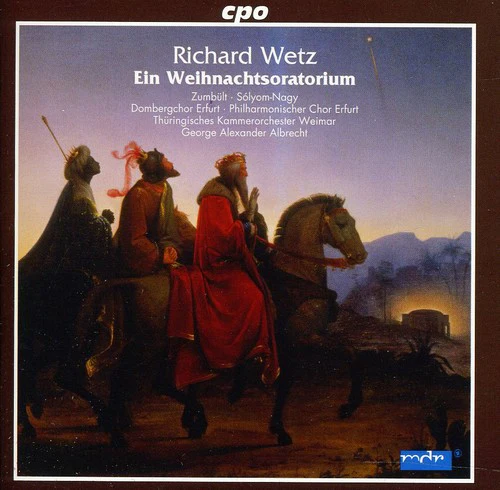
Wetz: Christmas Oratorio On Old German Poems, Op. 53 / Albrecht, Thuringische Kammerorchester
WETZ Christmas Oratorio • George Alexander Albrecht, cond; Marietta Zumbült (sop); Máté Sólyom-Nagy (bar); Thuringian CO; Erfurt P Ch; Dombergchor Erfurt • CPO 777 638-2 (70:02 Text and Translation)
In Fanfare . 20:5, William Zagorski reviewed cpo’s release of the Requiem by Richard Wetz (1875–1935). His enthusiastic appraisal of the work is more or less identical to my reaction to this Christmas Oratorio, a later Wetz work completed in 1928. Zagorski’s concluding endorsement well applies to this new recording: “Does this obscure offering by an obscure composer belong in the international standard repertoire? After listening to this fine and illuminating performance, I can answer that question in a single word: absolutely.”
The Christmas Oratorio—powerful at times, artfully composed in a way that sustains interest over its considerable length, and often affecting—is a significant discovery. Cpo does the music a great service by issuing it in such a fine, polished performance. Unfortunately, listeners eager to learn about this inexplicably neglected composer are shortchanged by the absence of a basic biography of Wetz in the booklet notes. Zagorski had the same complaint, and I refer subscribers to his review in the Fanfare Archive. It provides biographical background originally found on the website [email protected].
The oratorio has a three-part structure comparable to that of L’Enfance du Christ, though it’s less of a dramatic narrative, and lacks Berlioz’s moments of exoticism. The titles of the work’s three sections are “Expectation and Annunciation,” “The Birth of Christ,” and “The Three Kings.” Wetz’s text is made up of a sequence of old German folk poems and his musical setting effectively interweaves folk-like material into a more complex chromatic style. Part II builds to a grand finale and part III ends with a big, jubilant double fugue, a contrapuntal tour de force , but much of the oratorio maintains a consoling tone that steers clear of sentimentality or bombast. The overall effect is not unlike that of the Brahms Requiem.
Wetz’s three symphonies composed in the manner of Bruckner have been issued by cpo and praised by three Fanfare critics. There are some Brucknerian climaxes in the Christmas Oratorio, but its overall feeling has more of a kinship with the tuneful, evocative music of Hansel and Gretel . Wetz’s melodic lines have some of the character of Parsifal’s simpler leitmotifs, and his adherence to tonality has something in common with the music of his Austrian contemporary Franz Schmidt. But in re-listening to Schmidt’s 1935–37 oratorio The Book of the Seven Seals , its eclectic, more operatic striving for effect strikes me as more effortful than Wetz’s approach. Of course, the Book of Revelation calls for something less gentle than the Nativity story.
There’s a recurring pattern in the Christmas Oratorio that Zagorski notes in Wetz’s Requiem, a musical movement from darkness to light, or conflict to resolution. Wetz’s careful chromatic writing, often imitative, creates a mysterious, brooding atmosphere that’s eventually dispelled by the opposite mood. We hear the former in opening orchestral prelude, among many other passages, and the latter in the first entrance of the women’s chorus with a simple diatonic folk tune. It’s a magical effect.
If the names of the provincial-sounding choruses and orchestra are unfamiliar to you, have no fear. They perform at the highest level. Conductor George Alexander Albrecht leads an inspiring, well-balanced performance and it doesn’t hurt that the baritone soloist, Máté Sólyom-Nagy, who has a large role, sounds uncannily like Dietrich Fischer-Dieskau in his prime: a pure and resonant voice with glorious diction. Marietta Zumbült is adequate, but a more radiant, secure soprano soloist would have made this a perfect performance. The recorded sound is properly resonant with a wide dynamic range.
FANFARE: Paul Orgel
WETZ Christmas Oratorio • George Alexander Albrecht, cond; Marietta Zumbült (sop); Máté Sólyom-Nagy (bar); Thuringian CO; Erfurt P Ch; Dombergchor Erfurt • CPO 777 638-2 (70:02 Text and Translation)
In Fanfare . 20:5, William Zagorski reviewed cpo’s release of the Requiem by Richard Wetz (1875–1935). His enthusiastic appraisal of the work is more or less identical to my reaction to this Christmas Oratorio, a later Wetz work completed in 1928. Zagorski’s concluding endorsement well applies to this new recording: “Does this obscure offering by an obscure composer belong in the international standard repertoire? After listening to this fine and illuminating performance, I can answer that question in a single word: absolutely.”
The Christmas Oratorio—powerful at times, artfully composed in a way that sustains interest over its considerable length, and often affecting—is a significant discovery. Cpo does the music a great service by issuing it in such a fine, polished performance. Unfortunately, listeners eager to learn about this inexplicably neglected composer are shortchanged by the absence of a basic biography of Wetz in the booklet notes. Zagorski had the same complaint, and I refer subscribers to his review in the Fanfare Archive. It provides biographical background originally found on the website [email protected].
The oratorio has a three-part structure comparable to that of L’Enfance du Christ, though it’s less of a dramatic narrative, and lacks Berlioz’s moments of exoticism. The titles of the work’s three sections are “Expectation and Annunciation,” “The Birth of Christ,” and “The Three Kings.” Wetz’s text is made up of a sequence of old German folk poems and his musical setting effectively interweaves folk-like material into a more complex chromatic style. Part II builds to a grand finale and part III ends with a big, jubilant double fugue, a contrapuntal tour de force , but much of the oratorio maintains a consoling tone that steers clear of sentimentality or bombast. The overall effect is not unlike that of the Brahms Requiem.
Wetz’s three symphonies composed in the manner of Bruckner have been issued by cpo and praised by three Fanfare critics. There are some Brucknerian climaxes in the Christmas Oratorio, but its overall feeling has more of a kinship with the tuneful, evocative music of Hansel and Gretel . Wetz’s melodic lines have some of the character of Parsifal’s simpler leitmotifs, and his adherence to tonality has something in common with the music of his Austrian contemporary Franz Schmidt. But in re-listening to Schmidt’s 1935–37 oratorio The Book of the Seven Seals , its eclectic, more operatic striving for effect strikes me as more effortful than Wetz’s approach. Of course, the Book of Revelation calls for something less gentle than the Nativity story.
There’s a recurring pattern in the Christmas Oratorio that Zagorski notes in Wetz’s Requiem, a musical movement from darkness to light, or conflict to resolution. Wetz’s careful chromatic writing, often imitative, creates a mysterious, brooding atmosphere that’s eventually dispelled by the opposite mood. We hear the former in opening orchestral prelude, among many other passages, and the latter in the first entrance of the women’s chorus with a simple diatonic folk tune. It’s a magical effect.
If the names of the provincial-sounding choruses and orchestra are unfamiliar to you, have no fear. They perform at the highest level. Conductor George Alexander Albrecht leads an inspiring, well-balanced performance and it doesn’t hurt that the baritone soloist, Máté Sólyom-Nagy, who has a large role, sounds uncannily like Dietrich Fischer-Dieskau in his prime: a pure and resonant voice with glorious diction. Marietta Zumbült is adequate, but a more radiant, secure soprano soloist would have made this a perfect performance. The recorded sound is properly resonant with a wide dynamic range.
FANFARE: Paul Orgel
$4.90
Original: $13.99
-65%Wetz: Christmas Oratorio On Old German Poems, Op. 53 / Albrecht, Thuringische Kammerorchester—
$13.99
$4.90Description
WETZ Christmas Oratorio • George Alexander Albrecht, cond; Marietta Zumbült (sop); Máté Sólyom-Nagy (bar); Thuringian CO; Erfurt P Ch; Dombergchor Erfurt • CPO 777 638-2 (70:02 Text and Translation)
In Fanfare . 20:5, William Zagorski reviewed cpo’s release of the Requiem by Richard Wetz (1875–1935). His enthusiastic appraisal of the work is more or less identical to my reaction to this Christmas Oratorio, a later Wetz work completed in 1928. Zagorski’s concluding endorsement well applies to this new recording: “Does this obscure offering by an obscure composer belong in the international standard repertoire? After listening to this fine and illuminating performance, I can answer that question in a single word: absolutely.”
The Christmas Oratorio—powerful at times, artfully composed in a way that sustains interest over its considerable length, and often affecting—is a significant discovery. Cpo does the music a great service by issuing it in such a fine, polished performance. Unfortunately, listeners eager to learn about this inexplicably neglected composer are shortchanged by the absence of a basic biography of Wetz in the booklet notes. Zagorski had the same complaint, and I refer subscribers to his review in the Fanfare Archive. It provides biographical background originally found on the website [email protected].
The oratorio has a three-part structure comparable to that of L’Enfance du Christ, though it’s less of a dramatic narrative, and lacks Berlioz’s moments of exoticism. The titles of the work’s three sections are “Expectation and Annunciation,” “The Birth of Christ,” and “The Three Kings.” Wetz’s text is made up of a sequence of old German folk poems and his musical setting effectively interweaves folk-like material into a more complex chromatic style. Part II builds to a grand finale and part III ends with a big, jubilant double fugue, a contrapuntal tour de force , but much of the oratorio maintains a consoling tone that steers clear of sentimentality or bombast. The overall effect is not unlike that of the Brahms Requiem.
Wetz’s three symphonies composed in the manner of Bruckner have been issued by cpo and praised by three Fanfare critics. There are some Brucknerian climaxes in the Christmas Oratorio, but its overall feeling has more of a kinship with the tuneful, evocative music of Hansel and Gretel . Wetz’s melodic lines have some of the character of Parsifal’s simpler leitmotifs, and his adherence to tonality has something in common with the music of his Austrian contemporary Franz Schmidt. But in re-listening to Schmidt’s 1935–37 oratorio The Book of the Seven Seals , its eclectic, more operatic striving for effect strikes me as more effortful than Wetz’s approach. Of course, the Book of Revelation calls for something less gentle than the Nativity story.
There’s a recurring pattern in the Christmas Oratorio that Zagorski notes in Wetz’s Requiem, a musical movement from darkness to light, or conflict to resolution. Wetz’s careful chromatic writing, often imitative, creates a mysterious, brooding atmosphere that’s eventually dispelled by the opposite mood. We hear the former in opening orchestral prelude, among many other passages, and the latter in the first entrance of the women’s chorus with a simple diatonic folk tune. It’s a magical effect.
If the names of the provincial-sounding choruses and orchestra are unfamiliar to you, have no fear. They perform at the highest level. Conductor George Alexander Albrecht leads an inspiring, well-balanced performance and it doesn’t hurt that the baritone soloist, Máté Sólyom-Nagy, who has a large role, sounds uncannily like Dietrich Fischer-Dieskau in his prime: a pure and resonant voice with glorious diction. Marietta Zumbült is adequate, but a more radiant, secure soprano soloist would have made this a perfect performance. The recorded sound is properly resonant with a wide dynamic range.
FANFARE: Paul Orgel