🎉 Up to 70% Off Selected ItemsShop Sale

1 / 2
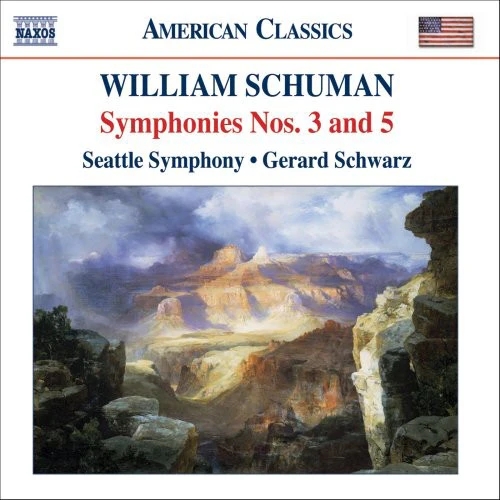
William Schuman: Symphony No 3 & 5 / Schwarz, Seattle
SCHUMAN Symphonies: No. 3; No. 5. Judith • Gerard Schwarz, cond; Seattle S • NAXOS 8.559317 (67:45)
In the early days of the LP, reviewing was a snap. The Schwann Catalog was the size of a pamphlet, a reviewer therefore had a pretty easy time assessing all that was out there, and in harmony with the Consumer Reports function of a magazine like Fanfare , could easily make his or her case for the best possible (implying definitive) recording of this or that work. Now it’s a whole different universe, with firms like Naxos attempting to record the entire and ever-expanding world’s worth of music—possibly even music not yet composed. To continue my reviewer’s lament for a moment: those of us who review only recordings work at a disadvantage. Critics who deal with live concerts know that a performance is merely a single event in an ever-evolving landscape. On the other hand, those of us who basically deal with recordings often fall into the trap of regarding their first-acquired recording of a particular work as a legitimate template. A live concert is a fleeting affair; a recording will be listened to over and over again until the gray matter of the auditor’s brain is thoroughly grooved and ossified. Add to this that my first exposure to the symphonies of William Schuman were from Leonard Bernstein’s 1960s landmark LP of Schuman’s Third and Fifth Symphonies, which inspired me to acquire his subsequent 1985 recording of Schuman’s Third Symphony paired with Harris’s Third Symphony on DG (similarly impressive, and captured in more impactful sound), one can easily understand my initial reaction when I found this Naxos release in my mailbox: “Why is Schwarz even bothering?”
Listening to this offering, my first reaction was to focus on what Schwarz missed—the snare drum rim shots at the end of the finale were not loud enough and the overlaying brass and woodwinds didn’t provide enough crescendo; his wind solos in the second movement were not as well characterized as Bernstein’s in both his recordings; his opening of the first movement was not nearly as bard-like as Bernstein’s, etc. etc. A good deal of this has to do with recording technology. That earliest 1960 Columbia Masterworks Bernstein offering was, by modern standards, dynamically compressed, making the score’s pianissimos louder, and leading to a more effectively detailed registration of the symphony’s opening bars. In the realm of recorded music, if it’s louder, it’s de facto more impressive. In Bernstein’s subsequent DG go around, the dynamics were more realistic and the resulting sound is closer to Schwarz’s. Nonetheless, Schwarz’s opening still sounds comparably weak and undercharacterized. But what follows does not.
Schwarz takes the symphony’s structure more literally than Bernstein. Its two movements are given Baroque sub designations—Passacaglia and Fugue; Chorale and Toccata. Schwarz is Baroqueishly strict in terms of tempo, and revealingly evenhanded in his instrumental balances; Bernstein is more episodic, projecting the Amerikanisch hymnody underlying so much of Schuman’s thought.
In sum, Bernstein’s two recordings are indeed hard acts to follow, but Schwarz does so with distinction. He achieves, throughout, stunning brass balances. He infuses the music with a wonderfully heady forward momentum, and his more modern recording conveys the loud low percussion with lease-breaking power. Over the years of his tenure as music director of the Seattle Symphony, Schwarz (himself a trumpet virtuoso, which accounts for his expertise in conducting his brass) has forged a fine ensemble able to rise to any and all musical demands.
In Schuman’s “Symphony for Strings,” also designated as the Fifth Symphony, Schwarz again comes head to head with Bernstein. In this piece Schuman proves that he can fugue with the best of them. Bernstein’s 1966 Columbia Masterworks (now Sony) recording is a typically in-your-face effort—viscerally exciting indeed. Here, Schwarz’s recording is more realistically balanced. When all is said and done, Bernstein emerges as the winner. His recording conveys more internal detail than is found here. That aside, Schwarz’s offering, in terms of tempos, is almost identical to Bernstein’s. Here the palm, alas, goes to Bernstein, but Schwarz’s effort is a commendable reading of the score.
The ringer is the last piece— Judith, a choreographic poem for orchestra—commissioned in 1949 by the Louisville Orchestra, which asked Martha Graham to create a ballet dealing with the beautiful Jewish widow who liberated her people from Nebuchadnezzar’s army by seducing and killing its general, Holofernes. The result was a typically Technicolor score from Schuman. Here it is realized most vividly.
As to which recording will I go to when I want to hear Schuman’s Third Symphony—well, it’s a toss up, and that says a lot.
FANFARE: William Zagorski
SCHUMAN Symphonies: No. 3; No. 5. Judith • Gerard Schwarz, cond; Seattle S • NAXOS 8.559317 (67:45)
In the early days of the LP, reviewing was a snap. The Schwann Catalog was the size of a pamphlet, a reviewer therefore had a pretty easy time assessing all that was out there, and in harmony with the Consumer Reports function of a magazine like Fanfare , could easily make his or her case for the best possible (implying definitive) recording of this or that work. Now it’s a whole different universe, with firms like Naxos attempting to record the entire and ever-expanding world’s worth of music—possibly even music not yet composed. To continue my reviewer’s lament for a moment: those of us who review only recordings work at a disadvantage. Critics who deal with live concerts know that a performance is merely a single event in an ever-evolving landscape. On the other hand, those of us who basically deal with recordings often fall into the trap of regarding their first-acquired recording of a particular work as a legitimate template. A live concert is a fleeting affair; a recording will be listened to over and over again until the gray matter of the auditor’s brain is thoroughly grooved and ossified. Add to this that my first exposure to the symphonies of William Schuman were from Leonard Bernstein’s 1960s landmark LP of Schuman’s Third and Fifth Symphonies, which inspired me to acquire his subsequent 1985 recording of Schuman’s Third Symphony paired with Harris’s Third Symphony on DG (similarly impressive, and captured in more impactful sound), one can easily understand my initial reaction when I found this Naxos release in my mailbox: “Why is Schwarz even bothering?”
Listening to this offering, my first reaction was to focus on what Schwarz missed—the snare drum rim shots at the end of the finale were not loud enough and the overlaying brass and woodwinds didn’t provide enough crescendo; his wind solos in the second movement were not as well characterized as Bernstein’s in both his recordings; his opening of the first movement was not nearly as bard-like as Bernstein’s, etc. etc. A good deal of this has to do with recording technology. That earliest 1960 Columbia Masterworks Bernstein offering was, by modern standards, dynamically compressed, making the score’s pianissimos louder, and leading to a more effectively detailed registration of the symphony’s opening bars. In the realm of recorded music, if it’s louder, it’s de facto more impressive. In Bernstein’s subsequent DG go around, the dynamics were more realistic and the resulting sound is closer to Schwarz’s. Nonetheless, Schwarz’s opening still sounds comparably weak and undercharacterized. But what follows does not.
Schwarz takes the symphony’s structure more literally than Bernstein. Its two movements are given Baroque sub designations—Passacaglia and Fugue; Chorale and Toccata. Schwarz is Baroqueishly strict in terms of tempo, and revealingly evenhanded in his instrumental balances; Bernstein is more episodic, projecting the Amerikanisch hymnody underlying so much of Schuman’s thought.
In sum, Bernstein’s two recordings are indeed hard acts to follow, but Schwarz does so with distinction. He achieves, throughout, stunning brass balances. He infuses the music with a wonderfully heady forward momentum, and his more modern recording conveys the loud low percussion with lease-breaking power. Over the years of his tenure as music director of the Seattle Symphony, Schwarz (himself a trumpet virtuoso, which accounts for his expertise in conducting his brass) has forged a fine ensemble able to rise to any and all musical demands.
In Schuman’s “Symphony for Strings,” also designated as the Fifth Symphony, Schwarz again comes head to head with Bernstein. In this piece Schuman proves that he can fugue with the best of them. Bernstein’s 1966 Columbia Masterworks (now Sony) recording is a typically in-your-face effort—viscerally exciting indeed. Here, Schwarz’s recording is more realistically balanced. When all is said and done, Bernstein emerges as the winner. His recording conveys more internal detail than is found here. That aside, Schwarz’s offering, in terms of tempos, is almost identical to Bernstein’s. Here the palm, alas, goes to Bernstein, but Schwarz’s effort is a commendable reading of the score.
The ringer is the last piece— Judith, a choreographic poem for orchestra—commissioned in 1949 by the Louisville Orchestra, which asked Martha Graham to create a ballet dealing with the beautiful Jewish widow who liberated her people from Nebuchadnezzar’s army by seducing and killing its general, Holofernes. The result was a typically Technicolor score from Schuman. Here it is realized most vividly.
As to which recording will I go to when I want to hear Schuman’s Third Symphony—well, it’s a toss up, and that says a lot.
FANFARE: William Zagorski
$19.99
William Schuman: Symphony No 3 & 5 / Schwarz, Seattle—
$19.99
Description
SCHUMAN Symphonies: No. 3; No. 5. Judith • Gerard Schwarz, cond; Seattle S • NAXOS 8.559317 (67:45)
In the early days of the LP, reviewing was a snap. The Schwann Catalog was the size of a pamphlet, a reviewer therefore had a pretty easy time assessing all that was out there, and in harmony with the Consumer Reports function of a magazine like Fanfare , could easily make his or her case for the best possible (implying definitive) recording of this or that work. Now it’s a whole different universe, with firms like Naxos attempting to record the entire and ever-expanding world’s worth of music—possibly even music not yet composed. To continue my reviewer’s lament for a moment: those of us who review only recordings work at a disadvantage. Critics who deal with live concerts know that a performance is merely a single event in an ever-evolving landscape. On the other hand, those of us who basically deal with recordings often fall into the trap of regarding their first-acquired recording of a particular work as a legitimate template. A live concert is a fleeting affair; a recording will be listened to over and over again until the gray matter of the auditor’s brain is thoroughly grooved and ossified. Add to this that my first exposure to the symphonies of William Schuman were from Leonard Bernstein’s 1960s landmark LP of Schuman’s Third and Fifth Symphonies, which inspired me to acquire his subsequent 1985 recording of Schuman’s Third Symphony paired with Harris’s Third Symphony on DG (similarly impressive, and captured in more impactful sound), one can easily understand my initial reaction when I found this Naxos release in my mailbox: “Why is Schwarz even bothering?”
Listening to this offering, my first reaction was to focus on what Schwarz missed—the snare drum rim shots at the end of the finale were not loud enough and the overlaying brass and woodwinds didn’t provide enough crescendo; his wind solos in the second movement were not as well characterized as Bernstein’s in both his recordings; his opening of the first movement was not nearly as bard-like as Bernstein’s, etc. etc. A good deal of this has to do with recording technology. That earliest 1960 Columbia Masterworks Bernstein offering was, by modern standards, dynamically compressed, making the score’s pianissimos louder, and leading to a more effectively detailed registration of the symphony’s opening bars. In the realm of recorded music, if it’s louder, it’s de facto more impressive. In Bernstein’s subsequent DG go around, the dynamics were more realistic and the resulting sound is closer to Schwarz’s. Nonetheless, Schwarz’s opening still sounds comparably weak and undercharacterized. But what follows does not.
Schwarz takes the symphony’s structure more literally than Bernstein. Its two movements are given Baroque sub designations—Passacaglia and Fugue; Chorale and Toccata. Schwarz is Baroqueishly strict in terms of tempo, and revealingly evenhanded in his instrumental balances; Bernstein is more episodic, projecting the Amerikanisch hymnody underlying so much of Schuman’s thought.
In sum, Bernstein’s two recordings are indeed hard acts to follow, but Schwarz does so with distinction. He achieves, throughout, stunning brass balances. He infuses the music with a wonderfully heady forward momentum, and his more modern recording conveys the loud low percussion with lease-breaking power. Over the years of his tenure as music director of the Seattle Symphony, Schwarz (himself a trumpet virtuoso, which accounts for his expertise in conducting his brass) has forged a fine ensemble able to rise to any and all musical demands.
In Schuman’s “Symphony for Strings,” also designated as the Fifth Symphony, Schwarz again comes head to head with Bernstein. In this piece Schuman proves that he can fugue with the best of them. Bernstein’s 1966 Columbia Masterworks (now Sony) recording is a typically in-your-face effort—viscerally exciting indeed. Here, Schwarz’s recording is more realistically balanced. When all is said and done, Bernstein emerges as the winner. His recording conveys more internal detail than is found here. That aside, Schwarz’s offering, in terms of tempos, is almost identical to Bernstein’s. Here the palm, alas, goes to Bernstein, but Schwarz’s effort is a commendable reading of the score.
The ringer is the last piece— Judith, a choreographic poem for orchestra—commissioned in 1949 by the Louisville Orchestra, which asked Martha Graham to create a ballet dealing with the beautiful Jewish widow who liberated her people from Nebuchadnezzar’s army by seducing and killing its general, Holofernes. The result was a typically Technicolor score from Schuman. Here it is realized most vividly.
As to which recording will I go to when I want to hear Schuman’s Third Symphony—well, it’s a toss up, and that says a lot.
FANFARE: William Zagorski