🎉 Up to 70% Off Selected ItemsShop Sale

1 / 2
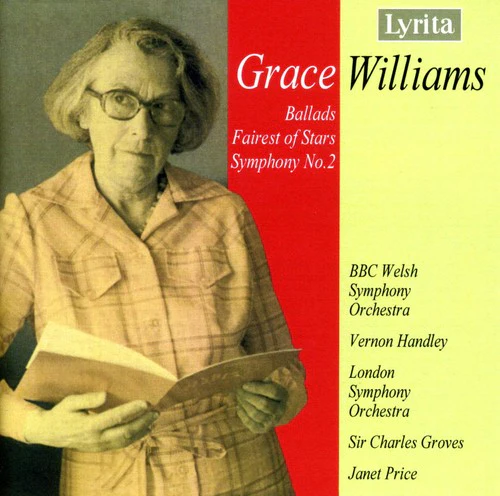
Williams: Ballads For Orchestra, Fairest Of Stars, Etc
This is Lyrita’s second CD of Grace Williams reissues. My review of the first (6/95) revealed that I had forgotten that the Second Symphony had been recorded back in 1979. Now it is reissued here, an absorbing work whose mix of styles and models serves as a reminder that pluralism in music is not just a phenomenon of the years since 1980. The symphony begins by evoking Shostakovich and Vaughan Williams but, by the finale, it is a late-romanticism recalling both Wagner and Mahler that provides the source for Williams’s most powerful utterances, before the final ‘return to earth’ – and to echoes of Vaughan Williams.
Something of the symphony’s stylistic blend, with its inherent and persistent tensions, can also be heard in Ballads. This is music with a strong narrative drive, full of incident and sturdily constructed, but Ballads and the symphony are quite heavily scored, and these performances, though excellent in many ways, now sound rather congested. A wider sonic canvas is needed, to let more light and air into the textures.
These orchestral compositions reveal a distinctive personality, but Williams is still more impressive in the neo-Straussian opulence of Fairest of Stars, a setting of Milton whose vocal line seems to reflect the wonder and ecstasy of Ariadne auf Naxos. At the same time, the composer’s familiarity with Britten’s music is also recalled in certain turns of phrase. Fairest of Stars has a symphonic expansiveness, yet the rich instrumental commentary never impedes the vocal part, here projected with admirable sensitivity by Janet Price.
Arnold Whittall, Gramophone [12/1996]
Something of the symphony’s stylistic blend, with its inherent and persistent tensions, can also be heard in Ballads. This is music with a strong narrative drive, full of incident and sturdily constructed, but Ballads and the symphony are quite heavily scored, and these performances, though excellent in many ways, now sound rather congested. A wider sonic canvas is needed, to let more light and air into the textures.
These orchestral compositions reveal a distinctive personality, but Williams is still more impressive in the neo-Straussian opulence of Fairest of Stars, a setting of Milton whose vocal line seems to reflect the wonder and ecstasy of Ariadne auf Naxos. At the same time, the composer’s familiarity with Britten’s music is also recalled in certain turns of phrase. Fairest of Stars has a symphonic expansiveness, yet the rich instrumental commentary never impedes the vocal part, here projected with admirable sensitivity by Janet Price.
Arnold Whittall, Gramophone [12/1996]
This is Lyrita’s second CD of Grace Williams reissues. My review of the first (6/95) revealed that I had forgotten that the Second Symphony had been recorded back in 1979. Now it is reissued here, an absorbing work whose mix of styles and models serves as a reminder that pluralism in music is not just a phenomenon of the years since 1980. The symphony begins by evoking Shostakovich and Vaughan Williams but, by the finale, it is a late-romanticism recalling both Wagner and Mahler that provides the source for Williams’s most powerful utterances, before the final ‘return to earth’ – and to echoes of Vaughan Williams.
Something of the symphony’s stylistic blend, with its inherent and persistent tensions, can also be heard in Ballads. This is music with a strong narrative drive, full of incident and sturdily constructed, but Ballads and the symphony are quite heavily scored, and these performances, though excellent in many ways, now sound rather congested. A wider sonic canvas is needed, to let more light and air into the textures.
These orchestral compositions reveal a distinctive personality, but Williams is still more impressive in the neo-Straussian opulence of Fairest of Stars, a setting of Milton whose vocal line seems to reflect the wonder and ecstasy of Ariadne auf Naxos. At the same time, the composer’s familiarity with Britten’s music is also recalled in certain turns of phrase. Fairest of Stars has a symphonic expansiveness, yet the rich instrumental commentary never impedes the vocal part, here projected with admirable sensitivity by Janet Price.
Arnold Whittall, Gramophone [12/1996]
Something of the symphony’s stylistic blend, with its inherent and persistent tensions, can also be heard in Ballads. This is music with a strong narrative drive, full of incident and sturdily constructed, but Ballads and the symphony are quite heavily scored, and these performances, though excellent in many ways, now sound rather congested. A wider sonic canvas is needed, to let more light and air into the textures.
These orchestral compositions reveal a distinctive personality, but Williams is still more impressive in the neo-Straussian opulence of Fairest of Stars, a setting of Milton whose vocal line seems to reflect the wonder and ecstasy of Ariadne auf Naxos. At the same time, the composer’s familiarity with Britten’s music is also recalled in certain turns of phrase. Fairest of Stars has a symphonic expansiveness, yet the rich instrumental commentary never impedes the vocal part, here projected with admirable sensitivity by Janet Price.
Arnold Whittall, Gramophone [12/1996]
$20.99
Williams: Ballads For Orchestra, Fairest Of Stars, Etc—
$20.99
Description
This is Lyrita’s second CD of Grace Williams reissues. My review of the first (6/95) revealed that I had forgotten that the Second Symphony had been recorded back in 1979. Now it is reissued here, an absorbing work whose mix of styles and models serves as a reminder that pluralism in music is not just a phenomenon of the years since 1980. The symphony begins by evoking Shostakovich and Vaughan Williams but, by the finale, it is a late-romanticism recalling both Wagner and Mahler that provides the source for Williams’s most powerful utterances, before the final ‘return to earth’ – and to echoes of Vaughan Williams.
Something of the symphony’s stylistic blend, with its inherent and persistent tensions, can also be heard in Ballads. This is music with a strong narrative drive, full of incident and sturdily constructed, but Ballads and the symphony are quite heavily scored, and these performances, though excellent in many ways, now sound rather congested. A wider sonic canvas is needed, to let more light and air into the textures.
These orchestral compositions reveal a distinctive personality, but Williams is still more impressive in the neo-Straussian opulence of Fairest of Stars, a setting of Milton whose vocal line seems to reflect the wonder and ecstasy of Ariadne auf Naxos. At the same time, the composer’s familiarity with Britten’s music is also recalled in certain turns of phrase. Fairest of Stars has a symphonic expansiveness, yet the rich instrumental commentary never impedes the vocal part, here projected with admirable sensitivity by Janet Price.
Arnold Whittall, Gramophone [12/1996]
Something of the symphony’s stylistic blend, with its inherent and persistent tensions, can also be heard in Ballads. This is music with a strong narrative drive, full of incident and sturdily constructed, but Ballads and the symphony are quite heavily scored, and these performances, though excellent in many ways, now sound rather congested. A wider sonic canvas is needed, to let more light and air into the textures.
These orchestral compositions reveal a distinctive personality, but Williams is still more impressive in the neo-Straussian opulence of Fairest of Stars, a setting of Milton whose vocal line seems to reflect the wonder and ecstasy of Ariadne auf Naxos. At the same time, the composer’s familiarity with Britten’s music is also recalled in certain turns of phrase. Fairest of Stars has a symphonic expansiveness, yet the rich instrumental commentary never impedes the vocal part, here projected with admirable sensitivity by Janet Price.
Arnold Whittall, Gramophone [12/1996]






















