🎉 Up to 70% Off Selected ItemsShop Sale

1 / 2
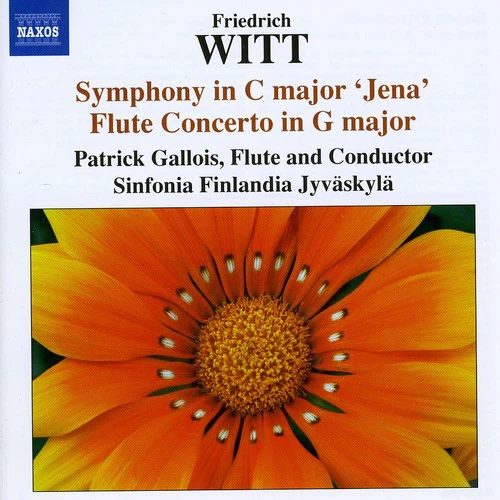
Witt: Symphony, Flute Concerto / Gallois, Sinfonia Finlandia Jyvaskyla
WITT Symphony in C, “Jena.” Symphony in A. Flute Concerto in G, op. 8 • Patrick Gallois (fl, cond); Sinfonia Finlandia Jyväskylä • NAXOS 8.572089 (69:37)
Born in the same year as Beethoven, the longer-lived Friedrich Witt (1770–1836) is acknowledged today, if a bit shamefacedly, as the composer of the so-called “Jena” Symphony once attributed to Beethoven. Not a single note of the score changed between the time it was believed to be by the great Ludwig Van and when it was discovered not to be; yet critical opinion of the work plummeted like the stock market on the report of bad news. Funny how that happens—yesterday buy, today sell, though nothing but the name of the note issuer of record has changed.
Recordings of Witt’s works represent but the tip of a sizeable iceberg; fewer than 10 of his works, as far as I can tell, have been recorded. Yet he is believed to have written as many as 23 symphonies, numerous concertos for various instruments, a considerable volume of chamber music, a number of operas, and an oratorio, Der leidende Heiland (The Suffering Savior), which secured him an appointment as Kapellmeister at the court of the Prince-Bishop of Würzburg in 1802.
Prior to this, however—sometime around 1792 or 1793—while Witt was serving as cellist at the court of Oettingen-Wallerstein and taking composition lessons from Antonio Rosetti, he laid eyes upon four of Haydn’s latest “London” Symphonies—Nos. 93, 96, 97, and 98—which Haydn had sent to Wallerstein. This, according to Keith Anderson’s booklet note, and other biographical sources I’ve come across, was Witt’s moment of dawning light, a light that, paradoxically, would eventually dim his own lamp in the pages of music history. Witt’s worst “crime,” it seems, was not simply imitating Haydn to the point of near plagiarism, but doing so at a time when Beethoven was busy “liberating music” from the strictures of classical content and style, if not quite yet classical form. In other words, Witt chose the path of the arch-conservative. History thereby ended up lumping him together with the lesser contemporaries of Haydn and Mozart instead of with the lesser contemporaries of Beethoven and Schubert, whom Witt outlived by the better part of a decade. Which lumping would have been better for Witt’s posthumous reputation I’m not sure; neither changes the music he wrote.
Witt’s G-Major Flute Concerto, newly recorded here, has been recorded before. It was included on an MDG Gold disc that also contained the composer’s Sixth, so-called “Turkish,” and Ninth symphonies. Johannes Moesus led the Hamburg Symphony Orchestra, and the concerto was played by flutist Susanne Barner. That release, which I happen to have, was reviewed by Barry Brenesal in Fanfare 29:2.
As for the “Jena” Symphony, don’t believe everything you find, or don’t find, at ArkivMusic. As of this writing, the site lists only the current Naxos recording. But the work has appeared on disc before as far back as the 1950s. An LP on the Concert Hall label with Walter Goehr conducting the Netherlands Philharmonic has been transferred to CD, and there is a downloadable Deutsche Grammophon version with Franz Konwitschny. Versions on Urania with Rolf Kleinert leading the Leipzig Philharmonic and with Wolfgang Hoffmann leading the Rhineland Philharmonia on Musical Heritage Society also exist.
In hindsight, it’s hard to imagine how Witt’s “Jena” Symphony, written sometime before 1796, could ever have been mistaken for a work by Beethoven. Even Beethoven’s earliest orchestral works, namely the first two piano concertos, present an entirely different sound world from Witt’s symphony. Beethoven’s melodic contours are different, as is his way of writing for winds and of extending and developing his thematic material. Witt’s symphony is pure Haydn. Listen to the first movement’s second theme beginning at 2:13. In shape and style, it’s close to a dead ringer for the first movement’s second theme in Haydn’s D-Major Symphony No. 93, which was one of the four “London” Symphonies that Witt had access to at Oettingen-Wallerstein.
The Adagio likewise proceeds in Haydnesque melodic phrases and harmonic gestures, while the Menuetto is big on formal flourishes, curtsies, and that big ballroom-band sound common to so many of Haydn’s minuet movements. It contains none of the sprinting, whiplash elements that, in Beethoven’s hands, would transform the minuet into a scherzo. The last movement, a spirited Allegro, would have brought a London audience to its feet, just as Haydn’s finales did. If you love Haydn (and who doesn’t?), and his 106 symphonies aren’t enough for you, you can listen to Witt’s “Jena” Symphony and pretend it’s Haydn’s 107th, or you can listen to it and appreciate it for what it is, the work of a master copycat.
The A-Major Symphony, written perhaps a year or two before the “Jena,” seems somehow lighter and fleeter of foot. A passage or two in the first movement sounds as if it’s about to lapse into the bubbly, scintillating passagework one hears in Mozart’s “Linz” Symphony. The one surprise Witt has in store for us is that he places his Menuetto in second position, before the Andante. Though not unprecedented—Haydn did it in his C-Major Symphony No. 32—the practice was uncommon before 1830. Beethoven, in fact, didn’t reverse the order of the two inner movements in any of his symphonies until the Ninth, though it’s arguable whether the Eighth even has a slow movement at all.
Though Haydn wrote close to four dozen concertos for various instruments, the medium was not his in the way it was Mozart’s, and Witt seemed instinctively to realize this, turning instead to Mozart’s concertos as the model for his own G-Major Flute Concerto of 1806. With so few of Witt’s works available on record, it would be rash to say that this concerto is his crowning achievement. I think it’s safe to say, however, that it displays a wealth of melodic invention, ample virtuosic challenges for the soloist, a richness of orchestral writing, and an originality of ideas that seemed lacking in the symphonies. With as fine a flute concerto as this, I’m surprised that flutists aren’t lining up to add it to their repertoires.
Until I received this recording, I thought that Susanne Barner on the aforementioned MDG disc was perfectly fine, but compared to renowned flutist Patrick Gallois on this new Naxos CD, she sounds rather laid-back and a bit mechanical in her delivery. Gallois sparkles and tosses off Witt’s arpeggios, runs, and roulades with panache. The Sinfonia Finlandia Jyväskylä, under Gallois’s direction, also sounds more spirited and alert, not to mention better recorded than the Hamburgers under Moesus.
Taking that into account, along with the fact that this, to my knowledge, is the only modern recording currently available of Witt’s “Jena” Symphony, Gallois becomes the entry of choice. A selling point of the MDG is that it contains two of Witt’s other symphonies not duplicated on the current disc. So, I shall be keeping both; but for those wanting to sample Witt’s work that has netted the most ink—the “Jena”—and what may be one of his most masterly works—the flute concerto—Naxos’s CD is a no-brainer and a bargain to boot.
FANFARE: Jerry Dubins
Hands up who has heard of Friedrich Witt. Not many probably, for Witt seldom even makes it to the footnotes of musical history books. His main claim to fame is that his Symphony in C major - which is the first work on this recording - was once mistakenly attributed to Beethoven. In the early 1900s musical researchers uncovered the score and found the master’s name written next to two parts of the manuscript. Remembering that Beethoven himself had intimated that he had once attempted a symphony in C, the researchers put two and two together and got it wrong. It was left to H.C. Robbins Landon to prove that the work was really by Witt, a cellist and composer from Wallerstein.
Nevertheless, the Naxos tradition of bringing the obscure to light has paid off in this recording. The three works presented give a fascinating insight into the kind of music that was being written in the tin-pot courts of Germany while the likes of Beethoven were developing revolutionary new means of expression in Vienna. This does not mean that the music is poor. Quite the opposite. It is bold and attractive stuff.
The C major symphony (nicknamed ‘Jena’ after the city’s university, where the manuscript was discovered in 1909) was composed in 1796 and is clearly influenced by Haydn. This is no coincidence. It is known that in 1792 or 1793 Haydn sent four of his London symphonies - Nos. 93, 96, 97 and 98 - to Wallerstein, where Witt must have seen them. The opening allegro is upbeat and playful, with a touch of Haydn wit. The ensuing ‘Adagio cantabile’ contains an attractive melody, while the finale is a fast-paced race to the finish that makes good use of the comparatively large orchestra at Witt’s disposal - including timpani and trumpets, as well as flute, oboes, bassoons, horns and strings.
The Symphony in A major is less riveting. Written about six years earlier, it lacks Haydn’s positive influence and is hemmed in by simple and rather restrictive sonata-form structures. The Flute Concerto in G is much more satisfying. This work was published in 1806 and benefits from a fuller, heavier, orchestral sound. Nevertheless, it still inhabits the sound-world of Haydn and Mozart rather than ‘Eroica’ Beethoven. Patrick Gallois ably tackles the tricky flute solos while simultaneously conducting the Sinfonia Finlandia Jyväskylä. There is a quasi-Romantic opening to the second movement, followed by a fine flute melody which is developed and decorated. But the final Rondo brings us safely back to the late eighteenth century.
-- John-Pierre Joyce, MusicWeb International
WITT Symphony in C, “Jena.” Symphony in A. Flute Concerto in G, op. 8 • Patrick Gallois (fl, cond); Sinfonia Finlandia Jyväskylä • NAXOS 8.572089 (69:37)
Born in the same year as Beethoven, the longer-lived Friedrich Witt (1770–1836) is acknowledged today, if a bit shamefacedly, as the composer of the so-called “Jena” Symphony once attributed to Beethoven. Not a single note of the score changed between the time it was believed to be by the great Ludwig Van and when it was discovered not to be; yet critical opinion of the work plummeted like the stock market on the report of bad news. Funny how that happens—yesterday buy, today sell, though nothing but the name of the note issuer of record has changed.
Recordings of Witt’s works represent but the tip of a sizeable iceberg; fewer than 10 of his works, as far as I can tell, have been recorded. Yet he is believed to have written as many as 23 symphonies, numerous concertos for various instruments, a considerable volume of chamber music, a number of operas, and an oratorio, Der leidende Heiland (The Suffering Savior), which secured him an appointment as Kapellmeister at the court of the Prince-Bishop of Würzburg in 1802.
Prior to this, however—sometime around 1792 or 1793—while Witt was serving as cellist at the court of Oettingen-Wallerstein and taking composition lessons from Antonio Rosetti, he laid eyes upon four of Haydn’s latest “London” Symphonies—Nos. 93, 96, 97, and 98—which Haydn had sent to Wallerstein. This, according to Keith Anderson’s booklet note, and other biographical sources I’ve come across, was Witt’s moment of dawning light, a light that, paradoxically, would eventually dim his own lamp in the pages of music history. Witt’s worst “crime,” it seems, was not simply imitating Haydn to the point of near plagiarism, but doing so at a time when Beethoven was busy “liberating music” from the strictures of classical content and style, if not quite yet classical form. In other words, Witt chose the path of the arch-conservative. History thereby ended up lumping him together with the lesser contemporaries of Haydn and Mozart instead of with the lesser contemporaries of Beethoven and Schubert, whom Witt outlived by the better part of a decade. Which lumping would have been better for Witt’s posthumous reputation I’m not sure; neither changes the music he wrote.
Witt’s G-Major Flute Concerto, newly recorded here, has been recorded before. It was included on an MDG Gold disc that also contained the composer’s Sixth, so-called “Turkish,” and Ninth symphonies. Johannes Moesus led the Hamburg Symphony Orchestra, and the concerto was played by flutist Susanne Barner. That release, which I happen to have, was reviewed by Barry Brenesal in Fanfare 29:2.
As for the “Jena” Symphony, don’t believe everything you find, or don’t find, at ArkivMusic. As of this writing, the site lists only the current Naxos recording. But the work has appeared on disc before as far back as the 1950s. An LP on the Concert Hall label with Walter Goehr conducting the Netherlands Philharmonic has been transferred to CD, and there is a downloadable Deutsche Grammophon version with Franz Konwitschny. Versions on Urania with Rolf Kleinert leading the Leipzig Philharmonic and with Wolfgang Hoffmann leading the Rhineland Philharmonia on Musical Heritage Society also exist.
In hindsight, it’s hard to imagine how Witt’s “Jena” Symphony, written sometime before 1796, could ever have been mistaken for a work by Beethoven. Even Beethoven’s earliest orchestral works, namely the first two piano concertos, present an entirely different sound world from Witt’s symphony. Beethoven’s melodic contours are different, as is his way of writing for winds and of extending and developing his thematic material. Witt’s symphony is pure Haydn. Listen to the first movement’s second theme beginning at 2:13. In shape and style, it’s close to a dead ringer for the first movement’s second theme in Haydn’s D-Major Symphony No. 93, which was one of the four “London” Symphonies that Witt had access to at Oettingen-Wallerstein.
The Adagio likewise proceeds in Haydnesque melodic phrases and harmonic gestures, while the Menuetto is big on formal flourishes, curtsies, and that big ballroom-band sound common to so many of Haydn’s minuet movements. It contains none of the sprinting, whiplash elements that, in Beethoven’s hands, would transform the minuet into a scherzo. The last movement, a spirited Allegro, would have brought a London audience to its feet, just as Haydn’s finales did. If you love Haydn (and who doesn’t?), and his 106 symphonies aren’t enough for you, you can listen to Witt’s “Jena” Symphony and pretend it’s Haydn’s 107th, or you can listen to it and appreciate it for what it is, the work of a master copycat.
The A-Major Symphony, written perhaps a year or two before the “Jena,” seems somehow lighter and fleeter of foot. A passage or two in the first movement sounds as if it’s about to lapse into the bubbly, scintillating passagework one hears in Mozart’s “Linz” Symphony. The one surprise Witt has in store for us is that he places his Menuetto in second position, before the Andante. Though not unprecedented—Haydn did it in his C-Major Symphony No. 32—the practice was uncommon before 1830. Beethoven, in fact, didn’t reverse the order of the two inner movements in any of his symphonies until the Ninth, though it’s arguable whether the Eighth even has a slow movement at all.
Though Haydn wrote close to four dozen concertos for various instruments, the medium was not his in the way it was Mozart’s, and Witt seemed instinctively to realize this, turning instead to Mozart’s concertos as the model for his own G-Major Flute Concerto of 1806. With so few of Witt’s works available on record, it would be rash to say that this concerto is his crowning achievement. I think it’s safe to say, however, that it displays a wealth of melodic invention, ample virtuosic challenges for the soloist, a richness of orchestral writing, and an originality of ideas that seemed lacking in the symphonies. With as fine a flute concerto as this, I’m surprised that flutists aren’t lining up to add it to their repertoires.
Until I received this recording, I thought that Susanne Barner on the aforementioned MDG disc was perfectly fine, but compared to renowned flutist Patrick Gallois on this new Naxos CD, she sounds rather laid-back and a bit mechanical in her delivery. Gallois sparkles and tosses off Witt’s arpeggios, runs, and roulades with panache. The Sinfonia Finlandia Jyväskylä, under Gallois’s direction, also sounds more spirited and alert, not to mention better recorded than the Hamburgers under Moesus.
Taking that into account, along with the fact that this, to my knowledge, is the only modern recording currently available of Witt’s “Jena” Symphony, Gallois becomes the entry of choice. A selling point of the MDG is that it contains two of Witt’s other symphonies not duplicated on the current disc. So, I shall be keeping both; but for those wanting to sample Witt’s work that has netted the most ink—the “Jena”—and what may be one of his most masterly works—the flute concerto—Naxos’s CD is a no-brainer and a bargain to boot.
FANFARE: Jerry Dubins
Hands up who has heard of Friedrich Witt. Not many probably, for Witt seldom even makes it to the footnotes of musical history books. His main claim to fame is that his Symphony in C major - which is the first work on this recording - was once mistakenly attributed to Beethoven. In the early 1900s musical researchers uncovered the score and found the master’s name written next to two parts of the manuscript. Remembering that Beethoven himself had intimated that he had once attempted a symphony in C, the researchers put two and two together and got it wrong. It was left to H.C. Robbins Landon to prove that the work was really by Witt, a cellist and composer from Wallerstein.
Nevertheless, the Naxos tradition of bringing the obscure to light has paid off in this recording. The three works presented give a fascinating insight into the kind of music that was being written in the tin-pot courts of Germany while the likes of Beethoven were developing revolutionary new means of expression in Vienna. This does not mean that the music is poor. Quite the opposite. It is bold and attractive stuff.
The C major symphony (nicknamed ‘Jena’ after the city’s university, where the manuscript was discovered in 1909) was composed in 1796 and is clearly influenced by Haydn. This is no coincidence. It is known that in 1792 or 1793 Haydn sent four of his London symphonies - Nos. 93, 96, 97 and 98 - to Wallerstein, where Witt must have seen them. The opening allegro is upbeat and playful, with a touch of Haydn wit. The ensuing ‘Adagio cantabile’ contains an attractive melody, while the finale is a fast-paced race to the finish that makes good use of the comparatively large orchestra at Witt’s disposal - including timpani and trumpets, as well as flute, oboes, bassoons, horns and strings.
The Symphony in A major is less riveting. Written about six years earlier, it lacks Haydn’s positive influence and is hemmed in by simple and rather restrictive sonata-form structures. The Flute Concerto in G is much more satisfying. This work was published in 1806 and benefits from a fuller, heavier, orchestral sound. Nevertheless, it still inhabits the sound-world of Haydn and Mozart rather than ‘Eroica’ Beethoven. Patrick Gallois ably tackles the tricky flute solos while simultaneously conducting the Sinfonia Finlandia Jyväskylä. There is a quasi-Romantic opening to the second movement, followed by a fine flute melody which is developed and decorated. But the final Rondo brings us safely back to the late eighteenth century.
-- John-Pierre Joyce, MusicWeb International
$4.90
Original: $13.99
-65%Witt: Symphony, Flute Concerto / Gallois, Sinfonia Finlandia Jyvaskyla—
$13.99
$4.90Description
WITT Symphony in C, “Jena.” Symphony in A. Flute Concerto in G, op. 8 • Patrick Gallois (fl, cond); Sinfonia Finlandia Jyväskylä • NAXOS 8.572089 (69:37)
Born in the same year as Beethoven, the longer-lived Friedrich Witt (1770–1836) is acknowledged today, if a bit shamefacedly, as the composer of the so-called “Jena” Symphony once attributed to Beethoven. Not a single note of the score changed between the time it was believed to be by the great Ludwig Van and when it was discovered not to be; yet critical opinion of the work plummeted like the stock market on the report of bad news. Funny how that happens—yesterday buy, today sell, though nothing but the name of the note issuer of record has changed.
Recordings of Witt’s works represent but the tip of a sizeable iceberg; fewer than 10 of his works, as far as I can tell, have been recorded. Yet he is believed to have written as many as 23 symphonies, numerous concertos for various instruments, a considerable volume of chamber music, a number of operas, and an oratorio, Der leidende Heiland (The Suffering Savior), which secured him an appointment as Kapellmeister at the court of the Prince-Bishop of Würzburg in 1802.
Prior to this, however—sometime around 1792 or 1793—while Witt was serving as cellist at the court of Oettingen-Wallerstein and taking composition lessons from Antonio Rosetti, he laid eyes upon four of Haydn’s latest “London” Symphonies—Nos. 93, 96, 97, and 98—which Haydn had sent to Wallerstein. This, according to Keith Anderson’s booklet note, and other biographical sources I’ve come across, was Witt’s moment of dawning light, a light that, paradoxically, would eventually dim his own lamp in the pages of music history. Witt’s worst “crime,” it seems, was not simply imitating Haydn to the point of near plagiarism, but doing so at a time when Beethoven was busy “liberating music” from the strictures of classical content and style, if not quite yet classical form. In other words, Witt chose the path of the arch-conservative. History thereby ended up lumping him together with the lesser contemporaries of Haydn and Mozart instead of with the lesser contemporaries of Beethoven and Schubert, whom Witt outlived by the better part of a decade. Which lumping would have been better for Witt’s posthumous reputation I’m not sure; neither changes the music he wrote.
Witt’s G-Major Flute Concerto, newly recorded here, has been recorded before. It was included on an MDG Gold disc that also contained the composer’s Sixth, so-called “Turkish,” and Ninth symphonies. Johannes Moesus led the Hamburg Symphony Orchestra, and the concerto was played by flutist Susanne Barner. That release, which I happen to have, was reviewed by Barry Brenesal in Fanfare 29:2.
As for the “Jena” Symphony, don’t believe everything you find, or don’t find, at ArkivMusic. As of this writing, the site lists only the current Naxos recording. But the work has appeared on disc before as far back as the 1950s. An LP on the Concert Hall label with Walter Goehr conducting the Netherlands Philharmonic has been transferred to CD, and there is a downloadable Deutsche Grammophon version with Franz Konwitschny. Versions on Urania with Rolf Kleinert leading the Leipzig Philharmonic and with Wolfgang Hoffmann leading the Rhineland Philharmonia on Musical Heritage Society also exist.
In hindsight, it’s hard to imagine how Witt’s “Jena” Symphony, written sometime before 1796, could ever have been mistaken for a work by Beethoven. Even Beethoven’s earliest orchestral works, namely the first two piano concertos, present an entirely different sound world from Witt’s symphony. Beethoven’s melodic contours are different, as is his way of writing for winds and of extending and developing his thematic material. Witt’s symphony is pure Haydn. Listen to the first movement’s second theme beginning at 2:13. In shape and style, it’s close to a dead ringer for the first movement’s second theme in Haydn’s D-Major Symphony No. 93, which was one of the four “London” Symphonies that Witt had access to at Oettingen-Wallerstein.
The Adagio likewise proceeds in Haydnesque melodic phrases and harmonic gestures, while the Menuetto is big on formal flourishes, curtsies, and that big ballroom-band sound common to so many of Haydn’s minuet movements. It contains none of the sprinting, whiplash elements that, in Beethoven’s hands, would transform the minuet into a scherzo. The last movement, a spirited Allegro, would have brought a London audience to its feet, just as Haydn’s finales did. If you love Haydn (and who doesn’t?), and his 106 symphonies aren’t enough for you, you can listen to Witt’s “Jena” Symphony and pretend it’s Haydn’s 107th, or you can listen to it and appreciate it for what it is, the work of a master copycat.
The A-Major Symphony, written perhaps a year or two before the “Jena,” seems somehow lighter and fleeter of foot. A passage or two in the first movement sounds as if it’s about to lapse into the bubbly, scintillating passagework one hears in Mozart’s “Linz” Symphony. The one surprise Witt has in store for us is that he places his Menuetto in second position, before the Andante. Though not unprecedented—Haydn did it in his C-Major Symphony No. 32—the practice was uncommon before 1830. Beethoven, in fact, didn’t reverse the order of the two inner movements in any of his symphonies until the Ninth, though it’s arguable whether the Eighth even has a slow movement at all.
Though Haydn wrote close to four dozen concertos for various instruments, the medium was not his in the way it was Mozart’s, and Witt seemed instinctively to realize this, turning instead to Mozart’s concertos as the model for his own G-Major Flute Concerto of 1806. With so few of Witt’s works available on record, it would be rash to say that this concerto is his crowning achievement. I think it’s safe to say, however, that it displays a wealth of melodic invention, ample virtuosic challenges for the soloist, a richness of orchestral writing, and an originality of ideas that seemed lacking in the symphonies. With as fine a flute concerto as this, I’m surprised that flutists aren’t lining up to add it to their repertoires.
Until I received this recording, I thought that Susanne Barner on the aforementioned MDG disc was perfectly fine, but compared to renowned flutist Patrick Gallois on this new Naxos CD, she sounds rather laid-back and a bit mechanical in her delivery. Gallois sparkles and tosses off Witt’s arpeggios, runs, and roulades with panache. The Sinfonia Finlandia Jyväskylä, under Gallois’s direction, also sounds more spirited and alert, not to mention better recorded than the Hamburgers under Moesus.
Taking that into account, along with the fact that this, to my knowledge, is the only modern recording currently available of Witt’s “Jena” Symphony, Gallois becomes the entry of choice. A selling point of the MDG is that it contains two of Witt’s other symphonies not duplicated on the current disc. So, I shall be keeping both; but for those wanting to sample Witt’s work that has netted the most ink—the “Jena”—and what may be one of his most masterly works—the flute concerto—Naxos’s CD is a no-brainer and a bargain to boot.
FANFARE: Jerry Dubins
Hands up who has heard of Friedrich Witt. Not many probably, for Witt seldom even makes it to the footnotes of musical history books. His main claim to fame is that his Symphony in C major - which is the first work on this recording - was once mistakenly attributed to Beethoven. In the early 1900s musical researchers uncovered the score and found the master’s name written next to two parts of the manuscript. Remembering that Beethoven himself had intimated that he had once attempted a symphony in C, the researchers put two and two together and got it wrong. It was left to H.C. Robbins Landon to prove that the work was really by Witt, a cellist and composer from Wallerstein.
Nevertheless, the Naxos tradition of bringing the obscure to light has paid off in this recording. The three works presented give a fascinating insight into the kind of music that was being written in the tin-pot courts of Germany while the likes of Beethoven were developing revolutionary new means of expression in Vienna. This does not mean that the music is poor. Quite the opposite. It is bold and attractive stuff.
The C major symphony (nicknamed ‘Jena’ after the city’s university, where the manuscript was discovered in 1909) was composed in 1796 and is clearly influenced by Haydn. This is no coincidence. It is known that in 1792 or 1793 Haydn sent four of his London symphonies - Nos. 93, 96, 97 and 98 - to Wallerstein, where Witt must have seen them. The opening allegro is upbeat and playful, with a touch of Haydn wit. The ensuing ‘Adagio cantabile’ contains an attractive melody, while the finale is a fast-paced race to the finish that makes good use of the comparatively large orchestra at Witt’s disposal - including timpani and trumpets, as well as flute, oboes, bassoons, horns and strings.
The Symphony in A major is less riveting. Written about six years earlier, it lacks Haydn’s positive influence and is hemmed in by simple and rather restrictive sonata-form structures. The Flute Concerto in G is much more satisfying. This work was published in 1806 and benefits from a fuller, heavier, orchestral sound. Nevertheless, it still inhabits the sound-world of Haydn and Mozart rather than ‘Eroica’ Beethoven. Patrick Gallois ably tackles the tricky flute solos while simultaneously conducting the Sinfonia Finlandia Jyväskylä. There is a quasi-Romantic opening to the second movement, followed by a fine flute melody which is developed and decorated. But the final Rondo brings us safely back to the late eighteenth century.
-- John-Pierre Joyce, MusicWeb International