🎉 Up to 70% Off Selected ItemsShop Sale

1 / 2
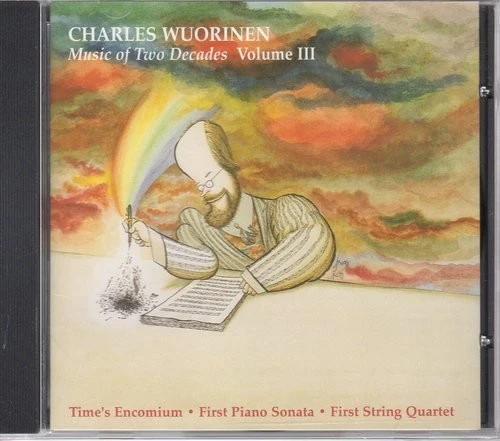
Wuorinen: Music Of Two Decades Vol 3 / Miller, Fine Arts Quartet
Like Volumes 1 and 2, Volume 3 of Charles Wuorinen: Music of Two Decades consists in large part of recordings that appeared first as LPs. One doesn't drape terms like invaluable as bunting. For exotic example, the Concerto for Amplified Violin and Orchestra (Volume 2) appeared first on University of Iowa Press vinyl. Not exactly your household name. (I refer to the label. Were Wuorinen's to become such, I'm sure he'd begin wondering where he went wrong. Another performance by violinist Paul Zukovsky, Inbal conducting the Orchestra of the Hessian Radio, may some day be released.) As an instance of nlh degree rarity, Easley Blackwood's own recording of his live performance of Wuorinen's Piano Variations dwelt prior to Volume l's appearance as a 7'/2-i.p.s. tape on Charles Wuorinen's library shelves. Volume 2's Grand Bamboula, Chamber Concerto, and Ringing Changes got good distribution as Nonesuch LPs which, as a format the label has long since abandoned, have been long out of print. As further reason to applaud these Music & Arts Wuorinen discs, a succession of solid performances rates soundwise from adequate to excellent. In other words, the bad news simply isn't. So, to put conclusions first, as gratifyingly large as a “difficult“ living composer's CDiscography already is, the collector with an interest in the music of his time and place cannot afford to ignore these good resurrections. (Of all the one-man operations I admire—I offer the term as an alternative to “little“ label, which in terms of long catalogs many are not—Fred Maroth's Music & Arts Programs of America, Inc., remains among the more endearingly hydra-headed.)
It's a lot easier to tell you what the electronic piece, Time's Encomium, isn't: it isn't imitative of nature or acoustic musical instruments. If the point seems inappropriate or trivial, I remind the reader that a great deal of synthesized sound appears to exist for these kitsch aspirations. So then, while Times's Encomium in this narrow regard falls on the ear as abstraction pure but far from simple, I urge the reader not to conflate abstract with offputting. The piece abounds with playful energies. When disparate sounds interact as friskily as they do here, play of one kind or another, whether or not one knows the game's name, is obviously the thing, Wuorinen is the kind of cerebral practitioner who requires one's attention in a state of openness. We do not hear Time's Encomium transpiring toward a direction. The logic is rather that of extraordinary fireflies of various heft, hue, and gravitas. As anyone who's spent a country night outdoors, a lightshow's enjoyment need not connect with those forces that stage it. The listener is content (if he's wise) to perceive the co.nposer as firefly or, better yet, the firefly's First Mover. Wuorinen composed the work between 1968-69 at the Columbia-Princeton Electronic Music Center In New York.“ . . . The RCA synthesizer . . . is prejudiced by design toward 12-tone equal temperament . . . [I]f one accepts the limitation as a boundary condition . . . it ceases to be a problem. . . . Afterwards, I made the large-scale structure by processing the synthesized materials in one of the [center's] analog studios. Thus the work consists of a core of synthesized music, most of which appears in Part I, surrounded and interlarded with analog-studio transformations of that music. The synthesized [can be] identified by its clarity of pitch. . . . The processed almost always contains reverberation. Thus metaphorically, the listener stands in the midst of the synthesized music, which presents itself . . . with maximal clarity; and stretching away from him, becoming more and more blurred in detail, the various transformations . . .“ I assume that Wuorinen speaks in “standing] in the midst“ of the four-channel original, which one hears to his regret as a two-channel mixdown. We are back on my Fanfare hobby horse.
In no way strange to say, Wuorinen's Piano Sonata (No. 1, 1969) appears on its surface to share in those compositional impulses and schemata that yielded Time's Encomium. This seems to me especially true of the music's fast-paced, angular energies. Of particular interest is the sonata's performer, the late Robert Black. As others have for David Tudor, Wuorinen composed an obviously difficult work in large measure as a tribute to Black's strengths and sympathies. (Because music absorbs its background, we tend to overlook an executant's sometime part in a work's conception, no less its successful performance—which Black's certainly sounds to be.)
Wuorinen's comments about his here handsomely performed First String Quartet have the ring of a manifesto. “The [quartet of 1971] reflects fundamental concerns . . . with questions of large-scale form, in particular the issue of an appropriate developmental—or 'directed'—structure suited to a non tonal environment. I had already become . . . impatient with [much of new music's directionlessness] and wanted to establish formal procedures that would allow local flexibility while solidly undergirding a musical progress analogous to the very powerfully directed structure of tonality [my italics].“ Wuorinen then gives a summary of his solution, which need not detain us here. Enough to know what was then on the mind that remains aloof from a world, in too large part, of half-baked juvenalia. The String Quartet (No. 1) plays vis-à-vis the electronic and solo-piano work a tad richer in lyrical interest, in acknowledgement perhaps of a four-string ensemble's native soulfulness. The insert mentions an earlier Music & Arts CD of this Wuorinen quartet, with one of Milton Babbitt's, as an inferior transfer. While I haven't that disc to compare, the present digitization of an analog master sounds very good indeed. Again, the three volumes of this Wuorinen edition—there are no immediate plans for a fourth—address a need. All three volumes heartily recommended.
-- Mike Silverton, FANFARE [3/1997]
It's a lot easier to tell you what the electronic piece, Time's Encomium, isn't: it isn't imitative of nature or acoustic musical instruments. If the point seems inappropriate or trivial, I remind the reader that a great deal of synthesized sound appears to exist for these kitsch aspirations. So then, while Times's Encomium in this narrow regard falls on the ear as abstraction pure but far from simple, I urge the reader not to conflate abstract with offputting. The piece abounds with playful energies. When disparate sounds interact as friskily as they do here, play of one kind or another, whether or not one knows the game's name, is obviously the thing, Wuorinen is the kind of cerebral practitioner who requires one's attention in a state of openness. We do not hear Time's Encomium transpiring toward a direction. The logic is rather that of extraordinary fireflies of various heft, hue, and gravitas. As anyone who's spent a country night outdoors, a lightshow's enjoyment need not connect with those forces that stage it. The listener is content (if he's wise) to perceive the co.nposer as firefly or, better yet, the firefly's First Mover. Wuorinen composed the work between 1968-69 at the Columbia-Princeton Electronic Music Center In New York.“ . . . The RCA synthesizer . . . is prejudiced by design toward 12-tone equal temperament . . . [I]f one accepts the limitation as a boundary condition . . . it ceases to be a problem. . . . Afterwards, I made the large-scale structure by processing the synthesized materials in one of the [center's] analog studios. Thus the work consists of a core of synthesized music, most of which appears in Part I, surrounded and interlarded with analog-studio transformations of that music. The synthesized [can be] identified by its clarity of pitch. . . . The processed almost always contains reverberation. Thus metaphorically, the listener stands in the midst of the synthesized music, which presents itself . . . with maximal clarity; and stretching away from him, becoming more and more blurred in detail, the various transformations . . .“ I assume that Wuorinen speaks in “standing] in the midst“ of the four-channel original, which one hears to his regret as a two-channel mixdown. We are back on my Fanfare hobby horse.
In no way strange to say, Wuorinen's Piano Sonata (No. 1, 1969) appears on its surface to share in those compositional impulses and schemata that yielded Time's Encomium. This seems to me especially true of the music's fast-paced, angular energies. Of particular interest is the sonata's performer, the late Robert Black. As others have for David Tudor, Wuorinen composed an obviously difficult work in large measure as a tribute to Black's strengths and sympathies. (Because music absorbs its background, we tend to overlook an executant's sometime part in a work's conception, no less its successful performance—which Black's certainly sounds to be.)
Wuorinen's comments about his here handsomely performed First String Quartet have the ring of a manifesto. “The [quartet of 1971] reflects fundamental concerns . . . with questions of large-scale form, in particular the issue of an appropriate developmental—or 'directed'—structure suited to a non tonal environment. I had already become . . . impatient with [much of new music's directionlessness] and wanted to establish formal procedures that would allow local flexibility while solidly undergirding a musical progress analogous to the very powerfully directed structure of tonality [my italics].“ Wuorinen then gives a summary of his solution, which need not detain us here. Enough to know what was then on the mind that remains aloof from a world, in too large part, of half-baked juvenalia. The String Quartet (No. 1) plays vis-à-vis the electronic and solo-piano work a tad richer in lyrical interest, in acknowledgement perhaps of a four-string ensemble's native soulfulness. The insert mentions an earlier Music & Arts CD of this Wuorinen quartet, with one of Milton Babbitt's, as an inferior transfer. While I haven't that disc to compare, the present digitization of an analog master sounds very good indeed. Again, the three volumes of this Wuorinen edition—there are no immediate plans for a fourth—address a need. All three volumes heartily recommended.
-- Mike Silverton, FANFARE [3/1997]
Like Volumes 1 and 2, Volume 3 of Charles Wuorinen: Music of Two Decades consists in large part of recordings that appeared first as LPs. One doesn't drape terms like invaluable as bunting. For exotic example, the Concerto for Amplified Violin and Orchestra (Volume 2) appeared first on University of Iowa Press vinyl. Not exactly your household name. (I refer to the label. Were Wuorinen's to become such, I'm sure he'd begin wondering where he went wrong. Another performance by violinist Paul Zukovsky, Inbal conducting the Orchestra of the Hessian Radio, may some day be released.) As an instance of nlh degree rarity, Easley Blackwood's own recording of his live performance of Wuorinen's Piano Variations dwelt prior to Volume l's appearance as a 7'/2-i.p.s. tape on Charles Wuorinen's library shelves. Volume 2's Grand Bamboula, Chamber Concerto, and Ringing Changes got good distribution as Nonesuch LPs which, as a format the label has long since abandoned, have been long out of print. As further reason to applaud these Music & Arts Wuorinen discs, a succession of solid performances rates soundwise from adequate to excellent. In other words, the bad news simply isn't. So, to put conclusions first, as gratifyingly large as a “difficult“ living composer's CDiscography already is, the collector with an interest in the music of his time and place cannot afford to ignore these good resurrections. (Of all the one-man operations I admire—I offer the term as an alternative to “little“ label, which in terms of long catalogs many are not—Fred Maroth's Music & Arts Programs of America, Inc., remains among the more endearingly hydra-headed.)
It's a lot easier to tell you what the electronic piece, Time's Encomium, isn't: it isn't imitative of nature or acoustic musical instruments. If the point seems inappropriate or trivial, I remind the reader that a great deal of synthesized sound appears to exist for these kitsch aspirations. So then, while Times's Encomium in this narrow regard falls on the ear as abstraction pure but far from simple, I urge the reader not to conflate abstract with offputting. The piece abounds with playful energies. When disparate sounds interact as friskily as they do here, play of one kind or another, whether or not one knows the game's name, is obviously the thing, Wuorinen is the kind of cerebral practitioner who requires one's attention in a state of openness. We do not hear Time's Encomium transpiring toward a direction. The logic is rather that of extraordinary fireflies of various heft, hue, and gravitas. As anyone who's spent a country night outdoors, a lightshow's enjoyment need not connect with those forces that stage it. The listener is content (if he's wise) to perceive the co.nposer as firefly or, better yet, the firefly's First Mover. Wuorinen composed the work between 1968-69 at the Columbia-Princeton Electronic Music Center In New York.“ . . . The RCA synthesizer . . . is prejudiced by design toward 12-tone equal temperament . . . [I]f one accepts the limitation as a boundary condition . . . it ceases to be a problem. . . . Afterwards, I made the large-scale structure by processing the synthesized materials in one of the [center's] analog studios. Thus the work consists of a core of synthesized music, most of which appears in Part I, surrounded and interlarded with analog-studio transformations of that music. The synthesized [can be] identified by its clarity of pitch. . . . The processed almost always contains reverberation. Thus metaphorically, the listener stands in the midst of the synthesized music, which presents itself . . . with maximal clarity; and stretching away from him, becoming more and more blurred in detail, the various transformations . . .“ I assume that Wuorinen speaks in “standing] in the midst“ of the four-channel original, which one hears to his regret as a two-channel mixdown. We are back on my Fanfare hobby horse.
In no way strange to say, Wuorinen's Piano Sonata (No. 1, 1969) appears on its surface to share in those compositional impulses and schemata that yielded Time's Encomium. This seems to me especially true of the music's fast-paced, angular energies. Of particular interest is the sonata's performer, the late Robert Black. As others have for David Tudor, Wuorinen composed an obviously difficult work in large measure as a tribute to Black's strengths and sympathies. (Because music absorbs its background, we tend to overlook an executant's sometime part in a work's conception, no less its successful performance—which Black's certainly sounds to be.)
Wuorinen's comments about his here handsomely performed First String Quartet have the ring of a manifesto. “The [quartet of 1971] reflects fundamental concerns . . . with questions of large-scale form, in particular the issue of an appropriate developmental—or 'directed'—structure suited to a non tonal environment. I had already become . . . impatient with [much of new music's directionlessness] and wanted to establish formal procedures that would allow local flexibility while solidly undergirding a musical progress analogous to the very powerfully directed structure of tonality [my italics].“ Wuorinen then gives a summary of his solution, which need not detain us here. Enough to know what was then on the mind that remains aloof from a world, in too large part, of half-baked juvenalia. The String Quartet (No. 1) plays vis-à-vis the electronic and solo-piano work a tad richer in lyrical interest, in acknowledgement perhaps of a four-string ensemble's native soulfulness. The insert mentions an earlier Music & Arts CD of this Wuorinen quartet, with one of Milton Babbitt's, as an inferior transfer. While I haven't that disc to compare, the present digitization of an analog master sounds very good indeed. Again, the three volumes of this Wuorinen edition—there are no immediate plans for a fourth—address a need. All three volumes heartily recommended.
-- Mike Silverton, FANFARE [3/1997]
It's a lot easier to tell you what the electronic piece, Time's Encomium, isn't: it isn't imitative of nature or acoustic musical instruments. If the point seems inappropriate or trivial, I remind the reader that a great deal of synthesized sound appears to exist for these kitsch aspirations. So then, while Times's Encomium in this narrow regard falls on the ear as abstraction pure but far from simple, I urge the reader not to conflate abstract with offputting. The piece abounds with playful energies. When disparate sounds interact as friskily as they do here, play of one kind or another, whether or not one knows the game's name, is obviously the thing, Wuorinen is the kind of cerebral practitioner who requires one's attention in a state of openness. We do not hear Time's Encomium transpiring toward a direction. The logic is rather that of extraordinary fireflies of various heft, hue, and gravitas. As anyone who's spent a country night outdoors, a lightshow's enjoyment need not connect with those forces that stage it. The listener is content (if he's wise) to perceive the co.nposer as firefly or, better yet, the firefly's First Mover. Wuorinen composed the work between 1968-69 at the Columbia-Princeton Electronic Music Center In New York.“ . . . The RCA synthesizer . . . is prejudiced by design toward 12-tone equal temperament . . . [I]f one accepts the limitation as a boundary condition . . . it ceases to be a problem. . . . Afterwards, I made the large-scale structure by processing the synthesized materials in one of the [center's] analog studios. Thus the work consists of a core of synthesized music, most of which appears in Part I, surrounded and interlarded with analog-studio transformations of that music. The synthesized [can be] identified by its clarity of pitch. . . . The processed almost always contains reverberation. Thus metaphorically, the listener stands in the midst of the synthesized music, which presents itself . . . with maximal clarity; and stretching away from him, becoming more and more blurred in detail, the various transformations . . .“ I assume that Wuorinen speaks in “standing] in the midst“ of the four-channel original, which one hears to his regret as a two-channel mixdown. We are back on my Fanfare hobby horse.
In no way strange to say, Wuorinen's Piano Sonata (No. 1, 1969) appears on its surface to share in those compositional impulses and schemata that yielded Time's Encomium. This seems to me especially true of the music's fast-paced, angular energies. Of particular interest is the sonata's performer, the late Robert Black. As others have for David Tudor, Wuorinen composed an obviously difficult work in large measure as a tribute to Black's strengths and sympathies. (Because music absorbs its background, we tend to overlook an executant's sometime part in a work's conception, no less its successful performance—which Black's certainly sounds to be.)
Wuorinen's comments about his here handsomely performed First String Quartet have the ring of a manifesto. “The [quartet of 1971] reflects fundamental concerns . . . with questions of large-scale form, in particular the issue of an appropriate developmental—or 'directed'—structure suited to a non tonal environment. I had already become . . . impatient with [much of new music's directionlessness] and wanted to establish formal procedures that would allow local flexibility while solidly undergirding a musical progress analogous to the very powerfully directed structure of tonality [my italics].“ Wuorinen then gives a summary of his solution, which need not detain us here. Enough to know what was then on the mind that remains aloof from a world, in too large part, of half-baked juvenalia. The String Quartet (No. 1) plays vis-à-vis the electronic and solo-piano work a tad richer in lyrical interest, in acknowledgement perhaps of a four-string ensemble's native soulfulness. The insert mentions an earlier Music & Arts CD of this Wuorinen quartet, with one of Milton Babbitt's, as an inferior transfer. While I haven't that disc to compare, the present digitization of an analog master sounds very good indeed. Again, the three volumes of this Wuorinen edition—there are no immediate plans for a fourth—address a need. All three volumes heartily recommended.
-- Mike Silverton, FANFARE [3/1997]
$7.00
Original: $19.99
-65%Wuorinen: Music Of Two Decades Vol 3 / Miller, Fine Arts Quartet—
$19.99
$7.00Description
Like Volumes 1 and 2, Volume 3 of Charles Wuorinen: Music of Two Decades consists in large part of recordings that appeared first as LPs. One doesn't drape terms like invaluable as bunting. For exotic example, the Concerto for Amplified Violin and Orchestra (Volume 2) appeared first on University of Iowa Press vinyl. Not exactly your household name. (I refer to the label. Were Wuorinen's to become such, I'm sure he'd begin wondering where he went wrong. Another performance by violinist Paul Zukovsky, Inbal conducting the Orchestra of the Hessian Radio, may some day be released.) As an instance of nlh degree rarity, Easley Blackwood's own recording of his live performance of Wuorinen's Piano Variations dwelt prior to Volume l's appearance as a 7'/2-i.p.s. tape on Charles Wuorinen's library shelves. Volume 2's Grand Bamboula, Chamber Concerto, and Ringing Changes got good distribution as Nonesuch LPs which, as a format the label has long since abandoned, have been long out of print. As further reason to applaud these Music & Arts Wuorinen discs, a succession of solid performances rates soundwise from adequate to excellent. In other words, the bad news simply isn't. So, to put conclusions first, as gratifyingly large as a “difficult“ living composer's CDiscography already is, the collector with an interest in the music of his time and place cannot afford to ignore these good resurrections. (Of all the one-man operations I admire—I offer the term as an alternative to “little“ label, which in terms of long catalogs many are not—Fred Maroth's Music & Arts Programs of America, Inc., remains among the more endearingly hydra-headed.)
It's a lot easier to tell you what the electronic piece, Time's Encomium, isn't: it isn't imitative of nature or acoustic musical instruments. If the point seems inappropriate or trivial, I remind the reader that a great deal of synthesized sound appears to exist for these kitsch aspirations. So then, while Times's Encomium in this narrow regard falls on the ear as abstraction pure but far from simple, I urge the reader not to conflate abstract with offputting. The piece abounds with playful energies. When disparate sounds interact as friskily as they do here, play of one kind or another, whether or not one knows the game's name, is obviously the thing, Wuorinen is the kind of cerebral practitioner who requires one's attention in a state of openness. We do not hear Time's Encomium transpiring toward a direction. The logic is rather that of extraordinary fireflies of various heft, hue, and gravitas. As anyone who's spent a country night outdoors, a lightshow's enjoyment need not connect with those forces that stage it. The listener is content (if he's wise) to perceive the co.nposer as firefly or, better yet, the firefly's First Mover. Wuorinen composed the work between 1968-69 at the Columbia-Princeton Electronic Music Center In New York.“ . . . The RCA synthesizer . . . is prejudiced by design toward 12-tone equal temperament . . . [I]f one accepts the limitation as a boundary condition . . . it ceases to be a problem. . . . Afterwards, I made the large-scale structure by processing the synthesized materials in one of the [center's] analog studios. Thus the work consists of a core of synthesized music, most of which appears in Part I, surrounded and interlarded with analog-studio transformations of that music. The synthesized [can be] identified by its clarity of pitch. . . . The processed almost always contains reverberation. Thus metaphorically, the listener stands in the midst of the synthesized music, which presents itself . . . with maximal clarity; and stretching away from him, becoming more and more blurred in detail, the various transformations . . .“ I assume that Wuorinen speaks in “standing] in the midst“ of the four-channel original, which one hears to his regret as a two-channel mixdown. We are back on my Fanfare hobby horse.
In no way strange to say, Wuorinen's Piano Sonata (No. 1, 1969) appears on its surface to share in those compositional impulses and schemata that yielded Time's Encomium. This seems to me especially true of the music's fast-paced, angular energies. Of particular interest is the sonata's performer, the late Robert Black. As others have for David Tudor, Wuorinen composed an obviously difficult work in large measure as a tribute to Black's strengths and sympathies. (Because music absorbs its background, we tend to overlook an executant's sometime part in a work's conception, no less its successful performance—which Black's certainly sounds to be.)
Wuorinen's comments about his here handsomely performed First String Quartet have the ring of a manifesto. “The [quartet of 1971] reflects fundamental concerns . . . with questions of large-scale form, in particular the issue of an appropriate developmental—or 'directed'—structure suited to a non tonal environment. I had already become . . . impatient with [much of new music's directionlessness] and wanted to establish formal procedures that would allow local flexibility while solidly undergirding a musical progress analogous to the very powerfully directed structure of tonality [my italics].“ Wuorinen then gives a summary of his solution, which need not detain us here. Enough to know what was then on the mind that remains aloof from a world, in too large part, of half-baked juvenalia. The String Quartet (No. 1) plays vis-à-vis the electronic and solo-piano work a tad richer in lyrical interest, in acknowledgement perhaps of a four-string ensemble's native soulfulness. The insert mentions an earlier Music & Arts CD of this Wuorinen quartet, with one of Milton Babbitt's, as an inferior transfer. While I haven't that disc to compare, the present digitization of an analog master sounds very good indeed. Again, the three volumes of this Wuorinen edition—there are no immediate plans for a fourth—address a need. All three volumes heartily recommended.
-- Mike Silverton, FANFARE [3/1997]
It's a lot easier to tell you what the electronic piece, Time's Encomium, isn't: it isn't imitative of nature or acoustic musical instruments. If the point seems inappropriate or trivial, I remind the reader that a great deal of synthesized sound appears to exist for these kitsch aspirations. So then, while Times's Encomium in this narrow regard falls on the ear as abstraction pure but far from simple, I urge the reader not to conflate abstract with offputting. The piece abounds with playful energies. When disparate sounds interact as friskily as they do here, play of one kind or another, whether or not one knows the game's name, is obviously the thing, Wuorinen is the kind of cerebral practitioner who requires one's attention in a state of openness. We do not hear Time's Encomium transpiring toward a direction. The logic is rather that of extraordinary fireflies of various heft, hue, and gravitas. As anyone who's spent a country night outdoors, a lightshow's enjoyment need not connect with those forces that stage it. The listener is content (if he's wise) to perceive the co.nposer as firefly or, better yet, the firefly's First Mover. Wuorinen composed the work between 1968-69 at the Columbia-Princeton Electronic Music Center In New York.“ . . . The RCA synthesizer . . . is prejudiced by design toward 12-tone equal temperament . . . [I]f one accepts the limitation as a boundary condition . . . it ceases to be a problem. . . . Afterwards, I made the large-scale structure by processing the synthesized materials in one of the [center's] analog studios. Thus the work consists of a core of synthesized music, most of which appears in Part I, surrounded and interlarded with analog-studio transformations of that music. The synthesized [can be] identified by its clarity of pitch. . . . The processed almost always contains reverberation. Thus metaphorically, the listener stands in the midst of the synthesized music, which presents itself . . . with maximal clarity; and stretching away from him, becoming more and more blurred in detail, the various transformations . . .“ I assume that Wuorinen speaks in “standing] in the midst“ of the four-channel original, which one hears to his regret as a two-channel mixdown. We are back on my Fanfare hobby horse.
In no way strange to say, Wuorinen's Piano Sonata (No. 1, 1969) appears on its surface to share in those compositional impulses and schemata that yielded Time's Encomium. This seems to me especially true of the music's fast-paced, angular energies. Of particular interest is the sonata's performer, the late Robert Black. As others have for David Tudor, Wuorinen composed an obviously difficult work in large measure as a tribute to Black's strengths and sympathies. (Because music absorbs its background, we tend to overlook an executant's sometime part in a work's conception, no less its successful performance—which Black's certainly sounds to be.)
Wuorinen's comments about his here handsomely performed First String Quartet have the ring of a manifesto. “The [quartet of 1971] reflects fundamental concerns . . . with questions of large-scale form, in particular the issue of an appropriate developmental—or 'directed'—structure suited to a non tonal environment. I had already become . . . impatient with [much of new music's directionlessness] and wanted to establish formal procedures that would allow local flexibility while solidly undergirding a musical progress analogous to the very powerfully directed structure of tonality [my italics].“ Wuorinen then gives a summary of his solution, which need not detain us here. Enough to know what was then on the mind that remains aloof from a world, in too large part, of half-baked juvenalia. The String Quartet (No. 1) plays vis-à-vis the electronic and solo-piano work a tad richer in lyrical interest, in acknowledgement perhaps of a four-string ensemble's native soulfulness. The insert mentions an earlier Music & Arts CD of this Wuorinen quartet, with one of Milton Babbitt's, as an inferior transfer. While I haven't that disc to compare, the present digitization of an analog master sounds very good indeed. Again, the three volumes of this Wuorinen edition—there are no immediate plans for a fourth—address a need. All three volumes heartily recommended.
-- Mike Silverton, FANFARE [3/1997]