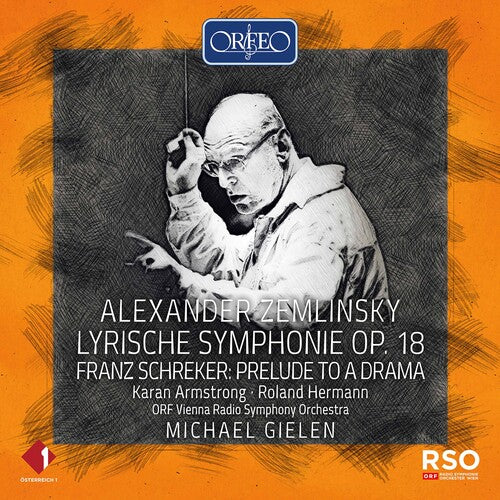
Zemlinsky & Schreker / Gielen, ORF Vienna Radio Symphony
Alexander Zemlinsky composed his Lyric Symphony op. 18 for soprano, baritone and orchestra during his time as musical director of the New German Theatre in Prague, where he had moved in 1911 from Vienna. It was generally regarded as his corresponding equivalent to Mahler’s Lied von der Erde (C210021) and is based on Nobel Prize laureate and most important representative of modern Indian literature Rabindranath Tagore. The work is combined with the befriended and three years older ‘phantasmogorist’ Franz Schreker’s Prelude to a Drama, which is a version of the overture of his Die Gezeichneten. It might be considered symptomatic for the most notable characteristic of Schreker’s music: the dominance of chordal sounds over the melodic element.
REVIEW:
Zemlinsky’s seven-movement Lyric Symphony lays claim to being his best-known work and is certainly the only one to attract a significant number of prominent conductors. This live account from Vienna in 1989 was Gielen’s second recording of the work, and it finds him in prime form. He leads a powerful orchestral reading that is all the more impressive because Vienna’s proficient Radio Symphony was the last orchestra I expected to be virtuosic. Every section is totally committed to the score’s voluptuous passions, however, and the recorded sound from Austrian Radio is wonderfully clear and vivid, no small achievement where Zemlinsky’s dense orchestration is concerned.
In the soprano part the choice has typically been big, dramatic voices on the order of Deborah Voigt and Alessandra Marc. Karen Armstrong can’t compete in that league, and wisely she doesn’t try to. By not pushing her voice, singing the chromatic lines accurately, and paying attention to the verse, she delivers a more than respectable performance. But realistically neither singer has the most beautiful or distinctive voice. Orfeo supplies no texts or translations, which means that this recording can only be supplementary to one that does. There are enough drawbacks, despite Gielen’s outstanding conducting, to place this release somewhere in the middle of the pack.
The pairing of Franz Schreker’s 20-minute Prelude to a Drama from 1914 isn’t a new addition to Gielen’s discography, since it also served as the filler to his Mahler Fourth Symphony. The Prelude is rich in themes and incidents, and so skillfully structured that it can be analyzed as a sonata movement. Schreker was a colorist, as he described himself: “I am a sound artist, a phantasmagorist of sound, a sound-aesthete, and there’s not a trace of melody in me.”
The music is lovely, and Gielen’s performance glows with ardent feeling, not a mode I associate with him.
For me the evocation of history hangs heavily over this release, but it holds considerable musical rewards, too, especially for aficionados of an aesthetic doomed to be wiped out through political denunciation.
-- Fanfare (Huntley Dent)
Alexander Zemlinsky composed his Lyric Symphony op. 18 for soprano, baritone and orchestra during his time as musical director of the New German Theatre in Prague, where he had moved in 1911 from Vienna. It was generally regarded as his corresponding equivalent to Mahler’s Lied von der Erde (C210021) and is based on Nobel Prize laureate and most important representative of modern Indian literature Rabindranath Tagore. The work is combined with the befriended and three years older ‘phantasmogorist’ Franz Schreker’s Prelude to a Drama, which is a version of the overture of his Die Gezeichneten. It might be considered symptomatic for the most notable characteristic of Schreker’s music: the dominance of chordal sounds over the melodic element.
REVIEW:
Zemlinsky’s seven-movement Lyric Symphony lays claim to being his best-known work and is certainly the only one to attract a significant number of prominent conductors. This live account from Vienna in 1989 was Gielen’s second recording of the work, and it finds him in prime form. He leads a powerful orchestral reading that is all the more impressive because Vienna’s proficient Radio Symphony was the last orchestra I expected to be virtuosic. Every section is totally committed to the score’s voluptuous passions, however, and the recorded sound from Austrian Radio is wonderfully clear and vivid, no small achievement where Zemlinsky’s dense orchestration is concerned.
In the soprano part the choice has typically been big, dramatic voices on the order of Deborah Voigt and Alessandra Marc. Karen Armstrong can’t compete in that league, and wisely she doesn’t try to. By not pushing her voice, singing the chromatic lines accurately, and paying attention to the verse, she delivers a more than respectable performance. But realistically neither singer has the most beautiful or distinctive voice. Orfeo supplies no texts or translations, which means that this recording can only be supplementary to one that does. There are enough drawbacks, despite Gielen’s outstanding conducting, to place this release somewhere in the middle of the pack.
The pairing of Franz Schreker’s 20-minute Prelude to a Drama from 1914 isn’t a new addition to Gielen’s discography, since it also served as the filler to his Mahler Fourth Symphony. The Prelude is rich in themes and incidents, and so skillfully structured that it can be analyzed as a sonata movement. Schreker was a colorist, as he described himself: “I am a sound artist, a phantasmagorist of sound, a sound-aesthete, and there’s not a trace of melody in me.”
The music is lovely, and Gielen’s performance glows with ardent feeling, not a mode I associate with him.
For me the evocation of history hangs heavily over this release, but it holds considerable musical rewards, too, especially for aficionados of an aesthetic doomed to be wiped out through political denunciation.
-- Fanfare (Huntley Dent)
Original: $20.99
-65%$20.99
$7.35Description
Alexander Zemlinsky composed his Lyric Symphony op. 18 for soprano, baritone and orchestra during his time as musical director of the New German Theatre in Prague, where he had moved in 1911 from Vienna. It was generally regarded as his corresponding equivalent to Mahler’s Lied von der Erde (C210021) and is based on Nobel Prize laureate and most important representative of modern Indian literature Rabindranath Tagore. The work is combined with the befriended and three years older ‘phantasmogorist’ Franz Schreker’s Prelude to a Drama, which is a version of the overture of his Die Gezeichneten. It might be considered symptomatic for the most notable characteristic of Schreker’s music: the dominance of chordal sounds over the melodic element.
REVIEW:
Zemlinsky’s seven-movement Lyric Symphony lays claim to being his best-known work and is certainly the only one to attract a significant number of prominent conductors. This live account from Vienna in 1989 was Gielen’s second recording of the work, and it finds him in prime form. He leads a powerful orchestral reading that is all the more impressive because Vienna’s proficient Radio Symphony was the last orchestra I expected to be virtuosic. Every section is totally committed to the score’s voluptuous passions, however, and the recorded sound from Austrian Radio is wonderfully clear and vivid, no small achievement where Zemlinsky’s dense orchestration is concerned.
In the soprano part the choice has typically been big, dramatic voices on the order of Deborah Voigt and Alessandra Marc. Karen Armstrong can’t compete in that league, and wisely she doesn’t try to. By not pushing her voice, singing the chromatic lines accurately, and paying attention to the verse, she delivers a more than respectable performance. But realistically neither singer has the most beautiful or distinctive voice. Orfeo supplies no texts or translations, which means that this recording can only be supplementary to one that does. There are enough drawbacks, despite Gielen’s outstanding conducting, to place this release somewhere in the middle of the pack.
The pairing of Franz Schreker’s 20-minute Prelude to a Drama from 1914 isn’t a new addition to Gielen’s discography, since it also served as the filler to his Mahler Fourth Symphony. The Prelude is rich in themes and incidents, and so skillfully structured that it can be analyzed as a sonata movement. Schreker was a colorist, as he described himself: “I am a sound artist, a phantasmagorist of sound, a sound-aesthete, and there’s not a trace of melody in me.”
The music is lovely, and Gielen’s performance glows with ardent feeling, not a mode I associate with him.
For me the evocation of history hangs heavily over this release, but it holds considerable musical rewards, too, especially for aficionados of an aesthetic doomed to be wiped out through political denunciation.
-- Fanfare (Huntley Dent)