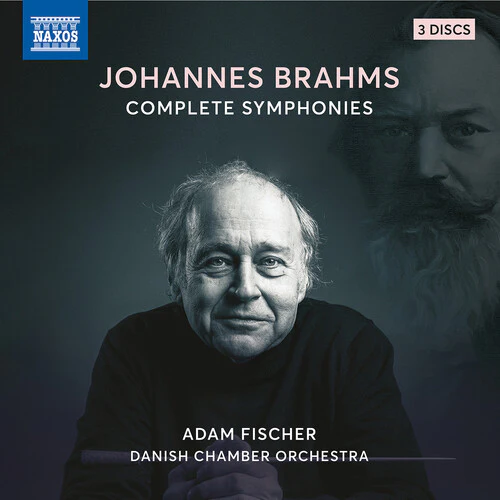
Brahms: The Complete Symphonies / Fischer, Danish Chamber Orchestra
Brahms was 43 years old when, after a long period of maturation, his First Symphony was published. Felix Weingartner commented on it ‘taking hold like the claw of a lion’ and its urgency marked a new phase in Brahms’ musical development. The Second Symphony is traditionally seen as the pastoral element in the cycle, while the Third, with its melodic beauty, has the courage to end quietly, an act of astonishing serenity. The compelling Passacaglia finale of the Fourth Symphony represents a fitting summation to one of the greatest symphonic cycles in the classical canon. The symphonies are only available in a box not separately. This year marks the 25th anniversary of the collaboration between Ádám Fischer and the Danish Chamber Orchestra– so it’s a ‘Silver Wedding’ recording. Fischer has called his relationship with the orchestra ‘a musical marriage’.
REVIEW:
For this set of Brahms’ four symphonies with the Danish Chamber Orchestra, the overarching idea is the use of an unusually small ensemble. One result is to favor the rhythmic structures of the symphonies, with percussion lines emerging with unusual clarity. Hear how the percussion strokes at the beginning of the Symphony No. 1 in C minor, Op. 68, produce a momentum that lasts through the entire symphony and even perhaps beyond. The Symphony No. 4 perhaps loses needed breadth in Fischer’s reading, especially in the finale; there is however, close attention to detail throughout. The orchestra punches above its weight. Even listeners completely unfamiliar with Fischer will get a lot out of this cycle.
-- AllMusic.com (James Manheim)
Brahms was 43 years old when, after a long period of maturation, his First Symphony was published. Felix Weingartner commented on it ‘taking hold like the claw of a lion’ and its urgency marked a new phase in Brahms’ musical development. The Second Symphony is traditionally seen as the pastoral element in the cycle, while the Third, with its melodic beauty, has the courage to end quietly, an act of astonishing serenity. The compelling Passacaglia finale of the Fourth Symphony represents a fitting summation to one of the greatest symphonic cycles in the classical canon. The symphonies are only available in a box not separately. This year marks the 25th anniversary of the collaboration between Ádám Fischer and the Danish Chamber Orchestra– so it’s a ‘Silver Wedding’ recording. Fischer has called his relationship with the orchestra ‘a musical marriage’.
REVIEW:
For this set of Brahms’ four symphonies with the Danish Chamber Orchestra, the overarching idea is the use of an unusually small ensemble. One result is to favor the rhythmic structures of the symphonies, with percussion lines emerging with unusual clarity. Hear how the percussion strokes at the beginning of the Symphony No. 1 in C minor, Op. 68, produce a momentum that lasts through the entire symphony and even perhaps beyond. The Symphony No. 4 perhaps loses needed breadth in Fischer’s reading, especially in the finale; there is however, close attention to detail throughout. The orchestra punches above its weight. Even listeners completely unfamiliar with Fischer will get a lot out of this cycle.
-- AllMusic.com (James Manheim)
Description
Brahms was 43 years old when, after a long period of maturation, his First Symphony was published. Felix Weingartner commented on it ‘taking hold like the claw of a lion’ and its urgency marked a new phase in Brahms’ musical development. The Second Symphony is traditionally seen as the pastoral element in the cycle, while the Third, with its melodic beauty, has the courage to end quietly, an act of astonishing serenity. The compelling Passacaglia finale of the Fourth Symphony represents a fitting summation to one of the greatest symphonic cycles in the classical canon. The symphonies are only available in a box not separately. This year marks the 25th anniversary of the collaboration between Ádám Fischer and the Danish Chamber Orchestra– so it’s a ‘Silver Wedding’ recording. Fischer has called his relationship with the orchestra ‘a musical marriage’.
REVIEW:
For this set of Brahms’ four symphonies with the Danish Chamber Orchestra, the overarching idea is the use of an unusually small ensemble. One result is to favor the rhythmic structures of the symphonies, with percussion lines emerging with unusual clarity. Hear how the percussion strokes at the beginning of the Symphony No. 1 in C minor, Op. 68, produce a momentum that lasts through the entire symphony and even perhaps beyond. The Symphony No. 4 perhaps loses needed breadth in Fischer’s reading, especially in the finale; there is however, close attention to detail throughout. The orchestra punches above its weight. Even listeners completely unfamiliar with Fischer will get a lot out of this cycle.
-- AllMusic.com (James Manheim)