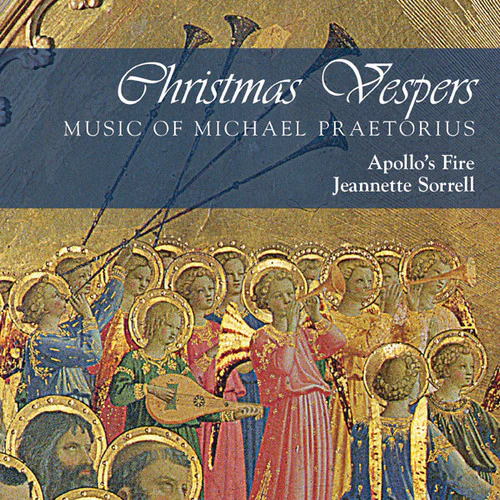
Christmas Vespers: Music Of Michael Praetorius
Martin Luther had many students and disciples. One of them was named Praetorius, and that student had a son named Michael. Michael became – along with J.S. Bach – one of the two greatest composers in the history of Protestant church music. Michael Praetorius left us an enormous quantity of sacred music, for children’s choir, adult choir, strings, brass, lutes, and soloists. He was also acclaimed as an organist and theorist. His monumental music treatise, Syntagma musicum (1619), is considered the most important work of music theory in the early Baroque, and provides musicians with a wealth of practical information.
Living at the same time as Monteverdi, the great revolutionary composer of Italy, Praetorius was aware of the new and virtuosic elements of Monteverdi’s music; however, he firmly upheld Luther’s ideal that the common people should be able to participate in the music-making in some way. Therefore, while Monteverdi’s music requires an entirely professional ensemble of virtuoso singers, such as existed at St. Mark’s in Venice, Praetorius channeled his imaginative flair toward writing music that brought together professional singers,
humble village choirs, children’s voices, and even congregational singing.
Thus, Praetorius’ music combines the drama and virtuosity of something like the Monteverdi Vespers, with the simple and accessible traditions of Lutheran hymn-tunes that many Protestants know by heart.
Martin Luther had many students and disciples. One of them was named Praetorius, and that student had a son named Michael. Michael became – along with J.S. Bach – one of the two greatest composers in the history of Protestant church music. Michael Praetorius left us an enormous quantity of sacred music, for children’s choir, adult choir, strings, brass, lutes, and soloists. He was also acclaimed as an organist and theorist. His monumental music treatise, Syntagma musicum (1619), is considered the most important work of music theory in the early Baroque, and provides musicians with a wealth of practical information.
Living at the same time as Monteverdi, the great revolutionary composer of Italy, Praetorius was aware of the new and virtuosic elements of Monteverdi’s music; however, he firmly upheld Luther’s ideal that the common people should be able to participate in the music-making in some way. Therefore, while Monteverdi’s music requires an entirely professional ensemble of virtuoso singers, such as existed at St. Mark’s in Venice, Praetorius channeled his imaginative flair toward writing music that brought together professional singers,
humble village choirs, children’s voices, and even congregational singing.
Thus, Praetorius’ music combines the drama and virtuosity of something like the Monteverdi Vespers, with the simple and accessible traditions of Lutheran hymn-tunes that many Protestants know by heart.
Description
Martin Luther had many students and disciples. One of them was named Praetorius, and that student had a son named Michael. Michael became – along with J.S. Bach – one of the two greatest composers in the history of Protestant church music. Michael Praetorius left us an enormous quantity of sacred music, for children’s choir, adult choir, strings, brass, lutes, and soloists. He was also acclaimed as an organist and theorist. His monumental music treatise, Syntagma musicum (1619), is considered the most important work of music theory in the early Baroque, and provides musicians with a wealth of practical information.
Living at the same time as Monteverdi, the great revolutionary composer of Italy, Praetorius was aware of the new and virtuosic elements of Monteverdi’s music; however, he firmly upheld Luther’s ideal that the common people should be able to participate in the music-making in some way. Therefore, while Monteverdi’s music requires an entirely professional ensemble of virtuoso singers, such as existed at St. Mark’s in Venice, Praetorius channeled his imaginative flair toward writing music that brought together professional singers,
humble village choirs, children’s voices, and even congregational singing.
Thus, Praetorius’ music combines the drama and virtuosity of something like the Monteverdi Vespers, with the simple and accessible traditions of Lutheran hymn-tunes that many Protestants know by heart.