🎉 Up to 70% Off Selected ItemsShop Sale

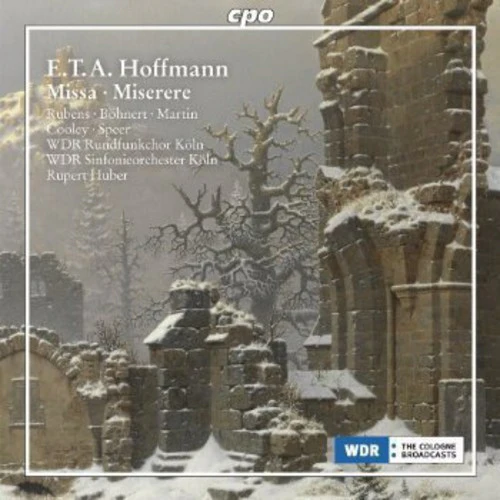
E . T. A. Hoffmann: Missa; Miserere / Rupert Huber, Wdr Symphony Orchestra Cologne
E. T. A. HOFFMANN Mass in d, AV 18. Miserere in b?, AV 42 • Rupert Huber, cond; Sibylla Rubens, Jutta Böhnert (sop); Rebecca Martin (mez); Thomas Cooley (ten); York Felix Speer (bs); WDR Radio Ch; WDR SO • CPO 777832 (62:01 Text and Translation)
Butcher, baker, candlestick maker? Well, not exactly, but it wouldn’t be off the mark to call E. T. A. Hoffmann (1776–1822) a polymath, for he was one of Germany’s greatest early Romantic writers of fantasy fiction and horror tales, a lawyer and a jurist, a draftsman and a caricaturist, and a music critic and serious writer on the art of music and its aesthetics. And, oh yes, by the way, did I mention that in his spare time he was a composer? His output includes a symphony, several stage works, a handful of piano sonatas, a piano trio, a harp quintet, and of course, the concerted choral-orchestral Mass and Miserere on this disc.
Hoffmann’s literary works are commonly cited as the inspiration for Schumann’s Kreisleriana and Offenbach’s The Tales of Hoffmann, but less often noted is that Hoffmann’s novella The Nutcracker and the Mouse King was the basis for Tchaikovsky’s Nutcracker, and that Léo Delibes’s ballet Coppélia is also based on stories by Hoffmann.
Hoffmann’s literary works had more of an influence on 19th-century composers and the Romantic movement than his musical compositions did, for his abilities as a composer were judged to be more modest than his talent for the written word. Add to that his relatively small output, and it’s hardly surprising that there’s not a lot of E. T. A. Hoffmann’s music on disc. In light of this, what’s perhaps surprising is that this is at least the third recording of the Miserere I’m aware of. A performance on Koch-Schwann/Music Sacra with a different conductor and cast of vocal soloists, but the same chorus and, I believe, the same orchestra was reviewed by David Johnson in 12:4. And yet another recording, also on Koch Schwann, but this time with an entirely different cast of singers, players, and conductor—Rolf Beck, leading the Southwest German Vocal Ensemble and the Concerto Bamberg—was released in 1997, 10 years later.
Johnson was mightily impressed by the Miserere, calling it “a work of genuine, even astonishing power and beauty,” an assessment with which I wholly concur. The piece wasn’t published in Hoffmann’s lifetime, and the exact date of composition isn’t given. It can be deduced, however, that Hoffmann had to have completed it towards the end of 1806 or the beginning of 1807, for the work was to have been performed at the ceremonies earlier in 1806 when Archduke Ferdinand of Austria became the Grand Duke of Würzburg, but the score wasn’t ready in time. It didn’t receive its first performance until Good Friday, 1809.
It’s important to keep in mind when listening to this masterful piece of choral/orchestral writing that its date of composition coincides with that of Beethoven’s C-Major Mass, op. 86. Yet if I had to make a comparison to Hoffmann’s Miserere, it wouldn’t be to Beethoven’s chronologically contemporary Mass, but to a work of 17 or so years earlier, Mozart’s Requiem. Whether Hoffmann was consciously imitating the musical style of that work or not, it’s impossible to say, but the similarities are striking.
Listen to the sighs in the strings just seconds into the opening movement, and tell me you don’t expect to hear the mournful entry of the basset horns. Or tell me there isn’t a resemblance between the Miserere’s “Ecce enim in veritatem” and the Offertorium of the Requiem in the Süssmayer completion.
Understand that in no way am I diminishing Hoffmann’s effort. His Miserere is a gorgeous work, and there’s much in it that postdates Mozart stylistically, specifically the vocal solos, which tend to be more ornate and less liturgical sounding than what Mozart would have considered proper for a sacred setting of such a solemn text, and also in the more symphonic scoring and treatment of the orchestral parts. But as noted by Johnson, Hoffmann additionally takes great pains to fully demonstrate his contrapuntal skills, composing “grand choral double fugues that Bach, himself, could have found no fault with.”
However you hear Hoffmann’s Miserere—whether as an echo of Mozart, a sympathetic vibration with Beethoven, or a precursor to Verdi—it doesn’t matter, as long as you hear it, because it’s a stunning work, which really ought to spark a reassessment of E. T. A. Hoffmann’s output in general.
The Mass in D Minor is a little earlier than the Miserere, dating from between 1803 and 1805, but it’s composed on an equally grand scale. The solemn introductory measures followed by a running fugue is reminiscent of the type of Baroque overture one hears at the beginning of Handel’s Messiah, and simultaneously anticipatory of the overture to Mendelssohn’s Elijah.
As in the Miserere, Mozart looms large over major portions of the Mass. Listen, for example, to the Kyrie, which once again reverberates with recollections of Mozart’s Requiem. But now Haydn takes a bow in the joyful Gloria. Yet through it all, a new Romantic spirit infuses Hoffmann’s work. It’s not as daring as Beethoven’s adventures of the same timeframe, but then whose were?
One thing that deserves some criticism, in my opinion, is Hoffmann’s over-reliance on fugue. At first, one marvels at his aptitude for counterpoint, but when a fugue appears in practically every movement, not only does one begin to wonder if Hoffmann isn’t short on arrows in his quiver, but the recurring fugal textures begin to become a bit tiresome. Remember Saint-Saëns’s dictum: “A fugue is a piece where the voices come in and the audience goes out one at a time.”
Koch-Schwann seems to have taken more than a passing interest in E. T. A. Hoffmann back in the 1990s, for in addition to the above-cited recordings of the Miserere, the label also released a recording of this Mass in 1999, featuring the chorus and orchestra of the Capella Cracoviensis, led by Roland Bader. Unfortunately, I haven’t heard that one either, so I have no basis for comparing different versions of the works on this disc. CPO, however, rarely disappoints in its releases, and the soloists, chorus, and orchestra heard in these performances sound secure in execution and thoroughly engaged in the moment of the music. The recording, too, is excellent—open, spacious, bright, and detailed, without any reverb to muddy the singers’ diction. Very strongly recommended.
FANFARE: Jerry Dubins
E. T. A. HOFFMANN Mass in d, AV 18. Miserere in b?, AV 42 • Rupert Huber, cond; Sibylla Rubens, Jutta Böhnert (sop); Rebecca Martin (mez); Thomas Cooley (ten); York Felix Speer (bs); WDR Radio Ch; WDR SO • CPO 777832 (62:01 Text and Translation)
Butcher, baker, candlestick maker? Well, not exactly, but it wouldn’t be off the mark to call E. T. A. Hoffmann (1776–1822) a polymath, for he was one of Germany’s greatest early Romantic writers of fantasy fiction and horror tales, a lawyer and a jurist, a draftsman and a caricaturist, and a music critic and serious writer on the art of music and its aesthetics. And, oh yes, by the way, did I mention that in his spare time he was a composer? His output includes a symphony, several stage works, a handful of piano sonatas, a piano trio, a harp quintet, and of course, the concerted choral-orchestral Mass and Miserere on this disc.
Hoffmann’s literary works are commonly cited as the inspiration for Schumann’s Kreisleriana and Offenbach’s The Tales of Hoffmann, but less often noted is that Hoffmann’s novella The Nutcracker and the Mouse King was the basis for Tchaikovsky’s Nutcracker, and that Léo Delibes’s ballet Coppélia is also based on stories by Hoffmann.
Hoffmann’s literary works had more of an influence on 19th-century composers and the Romantic movement than his musical compositions did, for his abilities as a composer were judged to be more modest than his talent for the written word. Add to that his relatively small output, and it’s hardly surprising that there’s not a lot of E. T. A. Hoffmann’s music on disc. In light of this, what’s perhaps surprising is that this is at least the third recording of the Miserere I’m aware of. A performance on Koch-Schwann/Music Sacra with a different conductor and cast of vocal soloists, but the same chorus and, I believe, the same orchestra was reviewed by David Johnson in 12:4. And yet another recording, also on Koch Schwann, but this time with an entirely different cast of singers, players, and conductor—Rolf Beck, leading the Southwest German Vocal Ensemble and the Concerto Bamberg—was released in 1997, 10 years later.
Johnson was mightily impressed by the Miserere, calling it “a work of genuine, even astonishing power and beauty,” an assessment with which I wholly concur. The piece wasn’t published in Hoffmann’s lifetime, and the exact date of composition isn’t given. It can be deduced, however, that Hoffmann had to have completed it towards the end of 1806 or the beginning of 1807, for the work was to have been performed at the ceremonies earlier in 1806 when Archduke Ferdinand of Austria became the Grand Duke of Würzburg, but the score wasn’t ready in time. It didn’t receive its first performance until Good Friday, 1809.
It’s important to keep in mind when listening to this masterful piece of choral/orchestral writing that its date of composition coincides with that of Beethoven’s C-Major Mass, op. 86. Yet if I had to make a comparison to Hoffmann’s Miserere, it wouldn’t be to Beethoven’s chronologically contemporary Mass, but to a work of 17 or so years earlier, Mozart’s Requiem. Whether Hoffmann was consciously imitating the musical style of that work or not, it’s impossible to say, but the similarities are striking.
Listen to the sighs in the strings just seconds into the opening movement, and tell me you don’t expect to hear the mournful entry of the basset horns. Or tell me there isn’t a resemblance between the Miserere’s “Ecce enim in veritatem” and the Offertorium of the Requiem in the Süssmayer completion.
Understand that in no way am I diminishing Hoffmann’s effort. His Miserere is a gorgeous work, and there’s much in it that postdates Mozart stylistically, specifically the vocal solos, which tend to be more ornate and less liturgical sounding than what Mozart would have considered proper for a sacred setting of such a solemn text, and also in the more symphonic scoring and treatment of the orchestral parts. But as noted by Johnson, Hoffmann additionally takes great pains to fully demonstrate his contrapuntal skills, composing “grand choral double fugues that Bach, himself, could have found no fault with.”
However you hear Hoffmann’s Miserere—whether as an echo of Mozart, a sympathetic vibration with Beethoven, or a precursor to Verdi—it doesn’t matter, as long as you hear it, because it’s a stunning work, which really ought to spark a reassessment of E. T. A. Hoffmann’s output in general.
The Mass in D Minor is a little earlier than the Miserere, dating from between 1803 and 1805, but it’s composed on an equally grand scale. The solemn introductory measures followed by a running fugue is reminiscent of the type of Baroque overture one hears at the beginning of Handel’s Messiah, and simultaneously anticipatory of the overture to Mendelssohn’s Elijah.
As in the Miserere, Mozart looms large over major portions of the Mass. Listen, for example, to the Kyrie, which once again reverberates with recollections of Mozart’s Requiem. But now Haydn takes a bow in the joyful Gloria. Yet through it all, a new Romantic spirit infuses Hoffmann’s work. It’s not as daring as Beethoven’s adventures of the same timeframe, but then whose were?
One thing that deserves some criticism, in my opinion, is Hoffmann’s over-reliance on fugue. At first, one marvels at his aptitude for counterpoint, but when a fugue appears in practically every movement, not only does one begin to wonder if Hoffmann isn’t short on arrows in his quiver, but the recurring fugal textures begin to become a bit tiresome. Remember Saint-Saëns’s dictum: “A fugue is a piece where the voices come in and the audience goes out one at a time.”
Koch-Schwann seems to have taken more than a passing interest in E. T. A. Hoffmann back in the 1990s, for in addition to the above-cited recordings of the Miserere, the label also released a recording of this Mass in 1999, featuring the chorus and orchestra of the Capella Cracoviensis, led by Roland Bader. Unfortunately, I haven’t heard that one either, so I have no basis for comparing different versions of the works on this disc. CPO, however, rarely disappoints in its releases, and the soloists, chorus, and orchestra heard in these performances sound secure in execution and thoroughly engaged in the moment of the music. The recording, too, is excellent—open, spacious, bright, and detailed, without any reverb to muddy the singers’ diction. Very strongly recommended.
FANFARE: Jerry Dubins
$18.99
E . T. A. Hoffmann: Missa; Miserere / Rupert Huber, Wdr Symphony Orchestra Cologne—
$18.99
Description
E. T. A. HOFFMANN Mass in d, AV 18. Miserere in b?, AV 42 • Rupert Huber, cond; Sibylla Rubens, Jutta Böhnert (sop); Rebecca Martin (mez); Thomas Cooley (ten); York Felix Speer (bs); WDR Radio Ch; WDR SO • CPO 777832 (62:01 Text and Translation)
Butcher, baker, candlestick maker? Well, not exactly, but it wouldn’t be off the mark to call E. T. A. Hoffmann (1776–1822) a polymath, for he was one of Germany’s greatest early Romantic writers of fantasy fiction and horror tales, a lawyer and a jurist, a draftsman and a caricaturist, and a music critic and serious writer on the art of music and its aesthetics. And, oh yes, by the way, did I mention that in his spare time he was a composer? His output includes a symphony, several stage works, a handful of piano sonatas, a piano trio, a harp quintet, and of course, the concerted choral-orchestral Mass and Miserere on this disc.
Hoffmann’s literary works are commonly cited as the inspiration for Schumann’s Kreisleriana and Offenbach’s The Tales of Hoffmann, but less often noted is that Hoffmann’s novella The Nutcracker and the Mouse King was the basis for Tchaikovsky’s Nutcracker, and that Léo Delibes’s ballet Coppélia is also based on stories by Hoffmann.
Hoffmann’s literary works had more of an influence on 19th-century composers and the Romantic movement than his musical compositions did, for his abilities as a composer were judged to be more modest than his talent for the written word. Add to that his relatively small output, and it’s hardly surprising that there’s not a lot of E. T. A. Hoffmann’s music on disc. In light of this, what’s perhaps surprising is that this is at least the third recording of the Miserere I’m aware of. A performance on Koch-Schwann/Music Sacra with a different conductor and cast of vocal soloists, but the same chorus and, I believe, the same orchestra was reviewed by David Johnson in 12:4. And yet another recording, also on Koch Schwann, but this time with an entirely different cast of singers, players, and conductor—Rolf Beck, leading the Southwest German Vocal Ensemble and the Concerto Bamberg—was released in 1997, 10 years later.
Johnson was mightily impressed by the Miserere, calling it “a work of genuine, even astonishing power and beauty,” an assessment with which I wholly concur. The piece wasn’t published in Hoffmann’s lifetime, and the exact date of composition isn’t given. It can be deduced, however, that Hoffmann had to have completed it towards the end of 1806 or the beginning of 1807, for the work was to have been performed at the ceremonies earlier in 1806 when Archduke Ferdinand of Austria became the Grand Duke of Würzburg, but the score wasn’t ready in time. It didn’t receive its first performance until Good Friday, 1809.
It’s important to keep in mind when listening to this masterful piece of choral/orchestral writing that its date of composition coincides with that of Beethoven’s C-Major Mass, op. 86. Yet if I had to make a comparison to Hoffmann’s Miserere, it wouldn’t be to Beethoven’s chronologically contemporary Mass, but to a work of 17 or so years earlier, Mozart’s Requiem. Whether Hoffmann was consciously imitating the musical style of that work or not, it’s impossible to say, but the similarities are striking.
Listen to the sighs in the strings just seconds into the opening movement, and tell me you don’t expect to hear the mournful entry of the basset horns. Or tell me there isn’t a resemblance between the Miserere’s “Ecce enim in veritatem” and the Offertorium of the Requiem in the Süssmayer completion.
Understand that in no way am I diminishing Hoffmann’s effort. His Miserere is a gorgeous work, and there’s much in it that postdates Mozart stylistically, specifically the vocal solos, which tend to be more ornate and less liturgical sounding than what Mozart would have considered proper for a sacred setting of such a solemn text, and also in the more symphonic scoring and treatment of the orchestral parts. But as noted by Johnson, Hoffmann additionally takes great pains to fully demonstrate his contrapuntal skills, composing “grand choral double fugues that Bach, himself, could have found no fault with.”
However you hear Hoffmann’s Miserere—whether as an echo of Mozart, a sympathetic vibration with Beethoven, or a precursor to Verdi—it doesn’t matter, as long as you hear it, because it’s a stunning work, which really ought to spark a reassessment of E. T. A. Hoffmann’s output in general.
The Mass in D Minor is a little earlier than the Miserere, dating from between 1803 and 1805, but it’s composed on an equally grand scale. The solemn introductory measures followed by a running fugue is reminiscent of the type of Baroque overture one hears at the beginning of Handel’s Messiah, and simultaneously anticipatory of the overture to Mendelssohn’s Elijah.
As in the Miserere, Mozart looms large over major portions of the Mass. Listen, for example, to the Kyrie, which once again reverberates with recollections of Mozart’s Requiem. But now Haydn takes a bow in the joyful Gloria. Yet through it all, a new Romantic spirit infuses Hoffmann’s work. It’s not as daring as Beethoven’s adventures of the same timeframe, but then whose were?
One thing that deserves some criticism, in my opinion, is Hoffmann’s over-reliance on fugue. At first, one marvels at his aptitude for counterpoint, but when a fugue appears in practically every movement, not only does one begin to wonder if Hoffmann isn’t short on arrows in his quiver, but the recurring fugal textures begin to become a bit tiresome. Remember Saint-Saëns’s dictum: “A fugue is a piece where the voices come in and the audience goes out one at a time.”
Koch-Schwann seems to have taken more than a passing interest in E. T. A. Hoffmann back in the 1990s, for in addition to the above-cited recordings of the Miserere, the label also released a recording of this Mass in 1999, featuring the chorus and orchestra of the Capella Cracoviensis, led by Roland Bader. Unfortunately, I haven’t heard that one either, so I have no basis for comparing different versions of the works on this disc. CPO, however, rarely disappoints in its releases, and the soloists, chorus, and orchestra heard in these performances sound secure in execution and thoroughly engaged in the moment of the music. The recording, too, is excellent—open, spacious, bright, and detailed, without any reverb to muddy the singers’ diction. Very strongly recommended.
FANFARE: Jerry Dubins