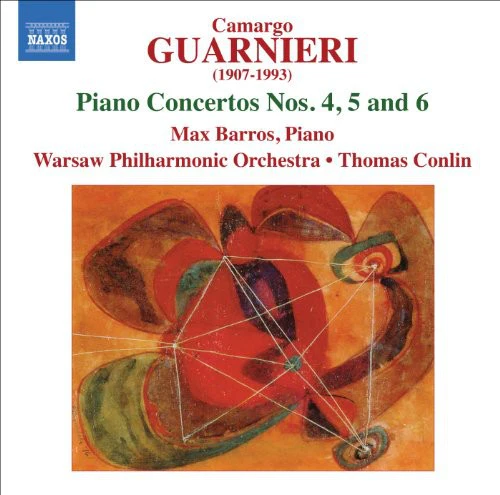
Guarnieri: Piano Concertos No 4, 5 & 6 / Barros, Conlin, Warsaw PO
Mozart Camargo Guarnieri is universally recognised as the most important Brazilian composer after Villa-Lobos. The Six Piano Concertos, composed over a period of forty years, offer a complete panorama of Guarnieri’s stylistic evolution, in particular his blend of sophisticated compositional techniques and the improvisational character of Brazilian folk-music. The Piano Concertos Nos. 4 and 5 display a number of avant-garde features that are fundamentally different from the more nationalistic vocabulary that informs the earlier three piano concertos (Naxos 8.557666). Completed shortly after the composer’s eightieth birthday, the chamber-like, intimate Piano Concerto No. 6 returns to an earlier style.
Mozart Camargo Guarnieri is universally recognised as the most important Brazilian composer after Villa-Lobos. The Six Piano Concertos, composed over a period of forty years, offer a complete panorama of Guarnieri’s stylistic evolution, in particular his blend of sophisticated compositional techniques and the improvisational character of Brazilian folk-music. The Piano Concertos Nos. 4 and 5 display a number of avant-garde features that are fundamentally different from the more nationalistic vocabulary that informs the earlier three piano concertos (Naxos 8.557666). Completed shortly after the composer’s eightieth birthday, the chamber-like, intimate Piano Concerto No. 6 returns to an earlier style.
Description
Mozart Camargo Guarnieri is universally recognised as the most important Brazilian composer after Villa-Lobos. The Six Piano Concertos, composed over a period of forty years, offer a complete panorama of Guarnieri’s stylistic evolution, in particular his blend of sophisticated compositional techniques and the improvisational character of Brazilian folk-music. The Piano Concertos Nos. 4 and 5 display a number of avant-garde features that are fundamentally different from the more nationalistic vocabulary that informs the earlier three piano concertos (Naxos 8.557666). Completed shortly after the composer’s eightieth birthday, the chamber-like, intimate Piano Concerto No. 6 returns to an earlier style.