🎉 Up to 70% Off Selected ItemsShop Sale

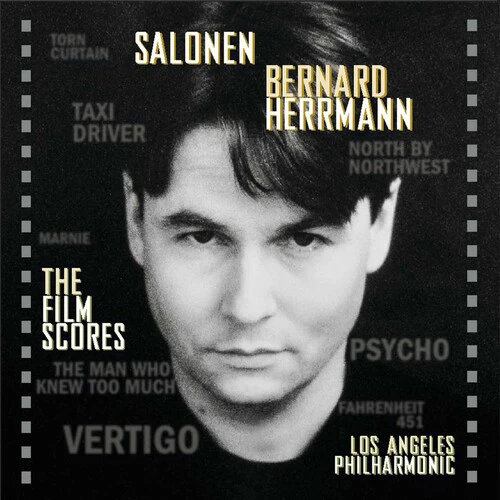
Herrmann: The Film Scores - Vertigo, Psycho, Etc / Salonen
This disc received the 1998 Cannes Classical Music Award for "Best 20th-Century Orchestral Recording." It was also nominated for the 1998 Grammy Award for "Best Engineered Album, Classical."
-----
There is much to savour here: the thrilling sense of spectacle engendered in the brazen Prelude to The Man Who Knew Too Much (1956); the sweep and lustre of the LAPO’s response in the two extended excerpts from Marnie (1964); the aural feast served up by the score rejected by Hitchcock for Torn Curtain (1966, whose characteristically unconventional instrumentation includes 16 horns, 12 flutes, nine trombones and two tubas). In the Suite from Psycho (1960) Salonen draws playing of terrific bite and menace from his Los Angeles string section. Most striking of all is the remarkable concentration this partnership brings to those pivotal slow numbers like “The Madhouse” and “The Swamp” (both of which convey such numbing dread through their indeterminate tonality). Salonen’s finely sculpted realization of the suite for strings, harp and percussion from Herrmann’s score to Francois Truffaut’s Fahrenheit 451 (1966) has a wistfulness (especially in the poignant bars of the concluding “The Road”) that rather scores over Joel McNeely’s recent Varese Sarabande version with the Seattle SO. How good, too, that room was found for Christopher Palmer’s effective synthesis of Herrmann’s very last composition, the magnificently sinister and moody score for Martin Scorsese’s Taxi Driver (1975).
“Any grumbles at all?”, I hear you ask. Well, just a couple. In the overture to North by Northwest (1959) Salonen’s chosen tempo strikes me as just a little too hectic to give quite enough lift to those obsessive fandango rhythms, whereas Herrmann’s own soundtrack recording on EMI Premier conveys an altogether greater sense of menace. Salonen also tries to wring too much out of the gorgeous “Scene d’amour” from Vertigo (1958) – McNeely with the RSNO on Varese Sarabande is less self-consciously sticky and infinitely more moving as a result. Otherwise, I have nothing but praise.
A winner of a disc, in sum, resplendently played and engineered, and excellently annotated by Alex Ross. If this generous new Sony collection doesn’t succeed in alerting a whole new audience to the genius of Bernard Herrmann, then nothing will.
-- Gramophone [1/1997]
-----
There is much to savour here: the thrilling sense of spectacle engendered in the brazen Prelude to The Man Who Knew Too Much (1956); the sweep and lustre of the LAPO’s response in the two extended excerpts from Marnie (1964); the aural feast served up by the score rejected by Hitchcock for Torn Curtain (1966, whose characteristically unconventional instrumentation includes 16 horns, 12 flutes, nine trombones and two tubas). In the Suite from Psycho (1960) Salonen draws playing of terrific bite and menace from his Los Angeles string section. Most striking of all is the remarkable concentration this partnership brings to those pivotal slow numbers like “The Madhouse” and “The Swamp” (both of which convey such numbing dread through their indeterminate tonality). Salonen’s finely sculpted realization of the suite for strings, harp and percussion from Herrmann’s score to Francois Truffaut’s Fahrenheit 451 (1966) has a wistfulness (especially in the poignant bars of the concluding “The Road”) that rather scores over Joel McNeely’s recent Varese Sarabande version with the Seattle SO. How good, too, that room was found for Christopher Palmer’s effective synthesis of Herrmann’s very last composition, the magnificently sinister and moody score for Martin Scorsese’s Taxi Driver (1975).
“Any grumbles at all?”, I hear you ask. Well, just a couple. In the overture to North by Northwest (1959) Salonen’s chosen tempo strikes me as just a little too hectic to give quite enough lift to those obsessive fandango rhythms, whereas Herrmann’s own soundtrack recording on EMI Premier conveys an altogether greater sense of menace. Salonen also tries to wring too much out of the gorgeous “Scene d’amour” from Vertigo (1958) – McNeely with the RSNO on Varese Sarabande is less self-consciously sticky and infinitely more moving as a result. Otherwise, I have nothing but praise.
A winner of a disc, in sum, resplendently played and engineered, and excellently annotated by Alex Ross. If this generous new Sony collection doesn’t succeed in alerting a whole new audience to the genius of Bernard Herrmann, then nothing will.
-- Gramophone [1/1997]
This disc received the 1998 Cannes Classical Music Award for "Best 20th-Century Orchestral Recording." It was also nominated for the 1998 Grammy Award for "Best Engineered Album, Classical."
-----
There is much to savour here: the thrilling sense of spectacle engendered in the brazen Prelude to The Man Who Knew Too Much (1956); the sweep and lustre of the LAPO’s response in the two extended excerpts from Marnie (1964); the aural feast served up by the score rejected by Hitchcock for Torn Curtain (1966, whose characteristically unconventional instrumentation includes 16 horns, 12 flutes, nine trombones and two tubas). In the Suite from Psycho (1960) Salonen draws playing of terrific bite and menace from his Los Angeles string section. Most striking of all is the remarkable concentration this partnership brings to those pivotal slow numbers like “The Madhouse” and “The Swamp” (both of which convey such numbing dread through their indeterminate tonality). Salonen’s finely sculpted realization of the suite for strings, harp and percussion from Herrmann’s score to Francois Truffaut’s Fahrenheit 451 (1966) has a wistfulness (especially in the poignant bars of the concluding “The Road”) that rather scores over Joel McNeely’s recent Varese Sarabande version with the Seattle SO. How good, too, that room was found for Christopher Palmer’s effective synthesis of Herrmann’s very last composition, the magnificently sinister and moody score for Martin Scorsese’s Taxi Driver (1975).
“Any grumbles at all?”, I hear you ask. Well, just a couple. In the overture to North by Northwest (1959) Salonen’s chosen tempo strikes me as just a little too hectic to give quite enough lift to those obsessive fandango rhythms, whereas Herrmann’s own soundtrack recording on EMI Premier conveys an altogether greater sense of menace. Salonen also tries to wring too much out of the gorgeous “Scene d’amour” from Vertigo (1958) – McNeely with the RSNO on Varese Sarabande is less self-consciously sticky and infinitely more moving as a result. Otherwise, I have nothing but praise.
A winner of a disc, in sum, resplendently played and engineered, and excellently annotated by Alex Ross. If this generous new Sony collection doesn’t succeed in alerting a whole new audience to the genius of Bernard Herrmann, then nothing will.
-- Gramophone [1/1997]
-----
There is much to savour here: the thrilling sense of spectacle engendered in the brazen Prelude to The Man Who Knew Too Much (1956); the sweep and lustre of the LAPO’s response in the two extended excerpts from Marnie (1964); the aural feast served up by the score rejected by Hitchcock for Torn Curtain (1966, whose characteristically unconventional instrumentation includes 16 horns, 12 flutes, nine trombones and two tubas). In the Suite from Psycho (1960) Salonen draws playing of terrific bite and menace from his Los Angeles string section. Most striking of all is the remarkable concentration this partnership brings to those pivotal slow numbers like “The Madhouse” and “The Swamp” (both of which convey such numbing dread through their indeterminate tonality). Salonen’s finely sculpted realization of the suite for strings, harp and percussion from Herrmann’s score to Francois Truffaut’s Fahrenheit 451 (1966) has a wistfulness (especially in the poignant bars of the concluding “The Road”) that rather scores over Joel McNeely’s recent Varese Sarabande version with the Seattle SO. How good, too, that room was found for Christopher Palmer’s effective synthesis of Herrmann’s very last composition, the magnificently sinister and moody score for Martin Scorsese’s Taxi Driver (1975).
“Any grumbles at all?”, I hear you ask. Well, just a couple. In the overture to North by Northwest (1959) Salonen’s chosen tempo strikes me as just a little too hectic to give quite enough lift to those obsessive fandango rhythms, whereas Herrmann’s own soundtrack recording on EMI Premier conveys an altogether greater sense of menace. Salonen also tries to wring too much out of the gorgeous “Scene d’amour” from Vertigo (1958) – McNeely with the RSNO on Varese Sarabande is less self-consciously sticky and infinitely more moving as a result. Otherwise, I have nothing but praise.
A winner of a disc, in sum, resplendently played and engineered, and excellently annotated by Alex Ross. If this generous new Sony collection doesn’t succeed in alerting a whole new audience to the genius of Bernard Herrmann, then nothing will.
-- Gramophone [1/1997]
$6.30
Original: $17.99
-65%Herrmann: The Film Scores - Vertigo, Psycho, Etc / Salonen—
$17.99
$6.30Description
This disc received the 1998 Cannes Classical Music Award for "Best 20th-Century Orchestral Recording." It was also nominated for the 1998 Grammy Award for "Best Engineered Album, Classical."
-----
There is much to savour here: the thrilling sense of spectacle engendered in the brazen Prelude to The Man Who Knew Too Much (1956); the sweep and lustre of the LAPO’s response in the two extended excerpts from Marnie (1964); the aural feast served up by the score rejected by Hitchcock for Torn Curtain (1966, whose characteristically unconventional instrumentation includes 16 horns, 12 flutes, nine trombones and two tubas). In the Suite from Psycho (1960) Salonen draws playing of terrific bite and menace from his Los Angeles string section. Most striking of all is the remarkable concentration this partnership brings to those pivotal slow numbers like “The Madhouse” and “The Swamp” (both of which convey such numbing dread through their indeterminate tonality). Salonen’s finely sculpted realization of the suite for strings, harp and percussion from Herrmann’s score to Francois Truffaut’s Fahrenheit 451 (1966) has a wistfulness (especially in the poignant bars of the concluding “The Road”) that rather scores over Joel McNeely’s recent Varese Sarabande version with the Seattle SO. How good, too, that room was found for Christopher Palmer’s effective synthesis of Herrmann’s very last composition, the magnificently sinister and moody score for Martin Scorsese’s Taxi Driver (1975).
“Any grumbles at all?”, I hear you ask. Well, just a couple. In the overture to North by Northwest (1959) Salonen’s chosen tempo strikes me as just a little too hectic to give quite enough lift to those obsessive fandango rhythms, whereas Herrmann’s own soundtrack recording on EMI Premier conveys an altogether greater sense of menace. Salonen also tries to wring too much out of the gorgeous “Scene d’amour” from Vertigo (1958) – McNeely with the RSNO on Varese Sarabande is less self-consciously sticky and infinitely more moving as a result. Otherwise, I have nothing but praise.
A winner of a disc, in sum, resplendently played and engineered, and excellently annotated by Alex Ross. If this generous new Sony collection doesn’t succeed in alerting a whole new audience to the genius of Bernard Herrmann, then nothing will.
-- Gramophone [1/1997]
-----
There is much to savour here: the thrilling sense of spectacle engendered in the brazen Prelude to The Man Who Knew Too Much (1956); the sweep and lustre of the LAPO’s response in the two extended excerpts from Marnie (1964); the aural feast served up by the score rejected by Hitchcock for Torn Curtain (1966, whose characteristically unconventional instrumentation includes 16 horns, 12 flutes, nine trombones and two tubas). In the Suite from Psycho (1960) Salonen draws playing of terrific bite and menace from his Los Angeles string section. Most striking of all is the remarkable concentration this partnership brings to those pivotal slow numbers like “The Madhouse” and “The Swamp” (both of which convey such numbing dread through their indeterminate tonality). Salonen’s finely sculpted realization of the suite for strings, harp and percussion from Herrmann’s score to Francois Truffaut’s Fahrenheit 451 (1966) has a wistfulness (especially in the poignant bars of the concluding “The Road”) that rather scores over Joel McNeely’s recent Varese Sarabande version with the Seattle SO. How good, too, that room was found for Christopher Palmer’s effective synthesis of Herrmann’s very last composition, the magnificently sinister and moody score for Martin Scorsese’s Taxi Driver (1975).
“Any grumbles at all?”, I hear you ask. Well, just a couple. In the overture to North by Northwest (1959) Salonen’s chosen tempo strikes me as just a little too hectic to give quite enough lift to those obsessive fandango rhythms, whereas Herrmann’s own soundtrack recording on EMI Premier conveys an altogether greater sense of menace. Salonen also tries to wring too much out of the gorgeous “Scene d’amour” from Vertigo (1958) – McNeely with the RSNO on Varese Sarabande is less self-consciously sticky and infinitely more moving as a result. Otherwise, I have nothing but praise.
A winner of a disc, in sum, resplendently played and engineered, and excellently annotated by Alex Ross. If this generous new Sony collection doesn’t succeed in alerting a whole new audience to the genius of Bernard Herrmann, then nothing will.
-- Gramophone [1/1997]