🎉 Up to 70% Off Selected ItemsShop Sale

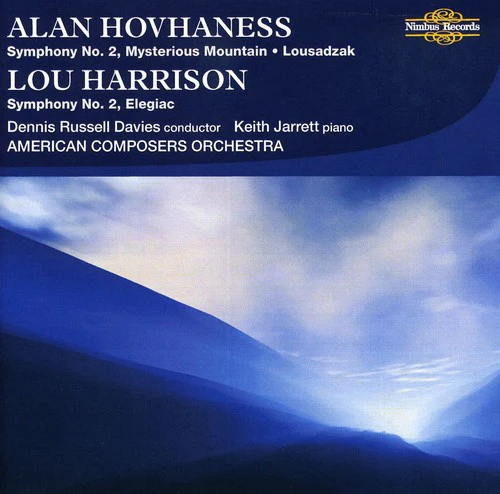
Hovhaness, Harrison: Symphonies / Russell Davies, Jarrett
HOVHANESS Lousadzak. 1 Symphony No. 2, “Mysterious Mountain.” HARRISON Symphony No. 2, “Elegiac” • Dennis Russell Davies, cond; Keith Jarrett (pn); 1 American Composers O • NIMBUS 2512 (67:00)
This is a reissue of a recording originally released on the Music Masters label in 1989. It brings together the music of two composers who, as Tim Page’s program notes point out, first came to public attention as kindred spirits, linked together with John Cage, interestingly enough. Readers may be aware that Lou Harrison was one of the composer-critics whom Virgil Thomson ushered in as associates to the New York Herald Tribune during the mid 1940s. This was the period when Alan Hovhaness, until then an impoverished eccentric struggling to gain attention in the Boston area, attempted to cast his lot in the broader arena of New York City, after having essentially been ridiculed out of Tanglewood by Aaron Copland and his coterie. Both Thomson and Harrison were among the first with access to an influential forum of opinion to champion Hovhaness’s music, and their enthusiastic advocacy contributed significantly to establishing his early reputation. Of course, as the years passed, each of these figures—stubborn individualists themselves—proceeded in his own personal direction, and each ended his career at quite a different point from the others on the American compositional matrix.
Lousadzak , composed in 1944, is certainly one of the most unusual piano concertos ever written (neither a single chord nor sequence of octaves appears in the piano part). The music assigned to the solo instrument imitates a number of Armenian folk instruments, especially those in the dulcimer family, while the string ensemble plays the role of a folk orchestra, providing an accompaniment of primitive polyphony. Both Harrison and Cage were present at the work’s New York premiere, and evidently it really took the audience by surprise. Harrison later recalled that it “was the closest I’ve ever been to one of those renowned artistic riots.” From the standpoint of some six decades later, when Hovhaness is no longer alive, having left behind a legacy of hundreds upon hundreds more compositions, Lousadzak stands as one of his indisputable masterpieces. Somehow the work evokes—as its name, meaning “the coming of light,” implies—a haunting and mysterious sense of the beginning of time. It also has a real sense of drama—not drama in the romantic, climactic sense, but a gradual accumulation of passion and intensity as the work unfolds. No one who has written off Hovhaness after having heard only the over-inflated, endlessly soporific compositions of his later years should fail to acquaint himself with this important representation of one of the composer’s most fertile periods. One is hard-pressed to name another work of his that is as consistently compelling and inspired.
That a pianist with the varied interests and talents—not to mention the distinguished reputation—of Keith Jarrett turned his attention to Lousadzak has served to attract the notice of listeners unlikely otherwise to have encountered such a work. And Jarrett’s performance has much to recommend it. But there are also aspects of his reading that I find wrong-headed. The ethnomusical context from which this work derives is one of individual improvisation alternating with passages in which the ensemble comes to the fore. The improvisational passages tend to be rhythmically free and rhapsodic (an approach of which Jarrett—in other contexts—is a consummate master). Though thoroughly notated, Lousadzak emulates this style, and should be performed in a manner that is in keeping with it. But for some reason Jarrett approaches this profoundly non-virtuosic music as if trying to press it into service as some sort of technical showpiece, with overly driven, frenetically rushed tempos. Conductor Davies seems of the same mind as Jarrett, constantly pressing the piece forward, squaring off its phrase rhythms, and sacrificing much of its depth and subtlety. A performance that better captures the work’s spirit was released in 2005 on the Black Box label (see Fanfare 29:3), featuring pianist Martin Berkofsky. Although the Russian Globalis Symphony Orchestra lacks the precision and refinement of the American Composers Orchestra, pianist Berkofsky evinces a deeper understanding of the mode of expression represented by Hovhaness’s work.
“Mysterious Mountain” has loomed as Hovhaness’s best-known and most popular composition ever since it first appeared on recording during the late 1950s. (The fact that this work is identified as Symphony No. 2 should not be taken to mean that it was the second symphony Hovhaness composed. In fact, it was not given this appellation until a number of years after it was composed. To summarize briefly, toward the middle of his career, Hovhaness revised, retitled, destroyed, or partially or completely recast many of his compositions, leaving “holes” in his opus number listings and, in some cases, his numbering of symphonies. He would often “plug up” these “holes” with works composed either earlier or later than the numberings would suggest.) The great success of “Mysterious Mountain,” composed in its final form in 1955 (although portions date back to the 1930s), can be attributed to two factors: (1) Just two or three years after its completion, Fritz Reiner and the Chicago Symphony Orchestra recorded it for RCA Victor; (2) It is a beautifully tranquil and euphonious work in a neo-ecclesiastical vein almost entirely devoid of harmonic dissonance. Readers may be interested to learn that in a letter written in May 1961, the composer wrote, “As to my ‘Mysterious Mountain’ my feelings are mixed—I am happy it is popular but I have written much better music and it is a very impersonal work, in which I omit my deeper searching.”
The Reiner/Chicago recording set a performance standard for “Mysterious Mountain” that is hard to surpass, although even that performance is marred by a blemish or two. But its overall pacing and phrasing seem little short of ideal. By now there have been at least half a dozen recorded performances of this work. Most tend to take the first movement, Andante con moto, at tempos much faster than Reiner’s 7:25. Of them, Davies’s 5:09 may be the fastest. Andante con moto is a very vague tempo indication, leaving much room for interpretation, even more than most such designations. The expressive content of the music must be the determinant, and at Davies’s tempo, this quintessentially tranquil movement sounds brusque and rushed—clearly against the grain of the music. The more actively polyphonic second movement, which happens to be my favorite, is done magnificently. The mysterious opening of the third movement is again disconcertingly hasty, while the remainder of the movement proceeds lovingly, the pure, consonant harmony exquisitely in tune.
It is perhaps not too much of a stretch to observe that the “Elegiac” Symphony plays a similar role within Lou Harrison’s œuvre that “Mysterious Mountain” plays in Hovhaness’s: that is, they both attempt to integrate the spirit, as well as some of the exotic usages, of Eastern music within a Western symphonic context. This makes Harrison’s piece, in particular, especially unusual. A large work (longer than both Hovhaness pieces together), the “Elegiac” Symphony comprises five movements, and reportedly occupied Harrison intermittently from 1942 until 1975. Perhaps its dedication to the memory of Serge and Natalie Koussevitzky accounts for the symphonic approach. Harrison’s familiar fingerprints—modal melodies of somewhat Balinese cast presented in unison or with a heterophonic or simple polyphonic treatment—are clearly evident (especially in movements 1, 3, and 5), but are here expanded to symphonic proportions—not solely a matter of duration, but also of a certain grandeur of both gesture and sonority. This very aspect of the work may alienate some of the composer’s more extreme admirers, while others are likely to find it all the more appealing for the same reason. The symphony is scored for a large orchestra, which is approached with considerable subtlety and delicacy—especially the use of the tack piano, a specialty of the composer, somewhat related to Cage’s “prepared piano.” The three odd-numbered movements—entitled “Tears of the Angel Israfel,” “Tears of the Angel Israfel II,” and “The Sweetness of Epicurus” respectively—are indeed “elegiac,” but not in the highly personal, Samuel Barber-like sense, but rather, in a more abstract, cosmic, contemplative sense, conveying a feeling of serene acceptance. The last movement is especially warm and poignant, concluding the work with deep, heartfelt beauty. The second movement, Allegro, poco presto, is scherzo-like and more Western in style, with some chromaticism, although gamelan-like effects clearly identify the composer. The fourth movement, “Praises for Michael the Archangel,” presents a stark contrast. Its harsh, aggressive harmonic dissonance and 12-tone material remind us that at one point Harrison studied with Arnold Schoenberg. Altogether, Harrison’s Symphony No. 2 serves as an excellent introduction to, and consolidation of, the many facets of this unique composer, presented in a fashion accessible to the more traditionally oriented listener.
FANFARE: Walter Simmons
HOVHANESS Lousadzak. 1 Symphony No. 2, “Mysterious Mountain.” HARRISON Symphony No. 2, “Elegiac” • Dennis Russell Davies, cond; Keith Jarrett (pn); 1 American Composers O • NIMBUS 2512 (67:00)
This is a reissue of a recording originally released on the Music Masters label in 1989. It brings together the music of two composers who, as Tim Page’s program notes point out, first came to public attention as kindred spirits, linked together with John Cage, interestingly enough. Readers may be aware that Lou Harrison was one of the composer-critics whom Virgil Thomson ushered in as associates to the New York Herald Tribune during the mid 1940s. This was the period when Alan Hovhaness, until then an impoverished eccentric struggling to gain attention in the Boston area, attempted to cast his lot in the broader arena of New York City, after having essentially been ridiculed out of Tanglewood by Aaron Copland and his coterie. Both Thomson and Harrison were among the first with access to an influential forum of opinion to champion Hovhaness’s music, and their enthusiastic advocacy contributed significantly to establishing his early reputation. Of course, as the years passed, each of these figures—stubborn individualists themselves—proceeded in his own personal direction, and each ended his career at quite a different point from the others on the American compositional matrix.
Lousadzak , composed in 1944, is certainly one of the most unusual piano concertos ever written (neither a single chord nor sequence of octaves appears in the piano part). The music assigned to the solo instrument imitates a number of Armenian folk instruments, especially those in the dulcimer family, while the string ensemble plays the role of a folk orchestra, providing an accompaniment of primitive polyphony. Both Harrison and Cage were present at the work’s New York premiere, and evidently it really took the audience by surprise. Harrison later recalled that it “was the closest I’ve ever been to one of those renowned artistic riots.” From the standpoint of some six decades later, when Hovhaness is no longer alive, having left behind a legacy of hundreds upon hundreds more compositions, Lousadzak stands as one of his indisputable masterpieces. Somehow the work evokes—as its name, meaning “the coming of light,” implies—a haunting and mysterious sense of the beginning of time. It also has a real sense of drama—not drama in the romantic, climactic sense, but a gradual accumulation of passion and intensity as the work unfolds. No one who has written off Hovhaness after having heard only the over-inflated, endlessly soporific compositions of his later years should fail to acquaint himself with this important representation of one of the composer’s most fertile periods. One is hard-pressed to name another work of his that is as consistently compelling and inspired.
That a pianist with the varied interests and talents—not to mention the distinguished reputation—of Keith Jarrett turned his attention to Lousadzak has served to attract the notice of listeners unlikely otherwise to have encountered such a work. And Jarrett’s performance has much to recommend it. But there are also aspects of his reading that I find wrong-headed. The ethnomusical context from which this work derives is one of individual improvisation alternating with passages in which the ensemble comes to the fore. The improvisational passages tend to be rhythmically free and rhapsodic (an approach of which Jarrett—in other contexts—is a consummate master). Though thoroughly notated, Lousadzak emulates this style, and should be performed in a manner that is in keeping with it. But for some reason Jarrett approaches this profoundly non-virtuosic music as if trying to press it into service as some sort of technical showpiece, with overly driven, frenetically rushed tempos. Conductor Davies seems of the same mind as Jarrett, constantly pressing the piece forward, squaring off its phrase rhythms, and sacrificing much of its depth and subtlety. A performance that better captures the work’s spirit was released in 2005 on the Black Box label (see Fanfare 29:3), featuring pianist Martin Berkofsky. Although the Russian Globalis Symphony Orchestra lacks the precision and refinement of the American Composers Orchestra, pianist Berkofsky evinces a deeper understanding of the mode of expression represented by Hovhaness’s work.
“Mysterious Mountain” has loomed as Hovhaness’s best-known and most popular composition ever since it first appeared on recording during the late 1950s. (The fact that this work is identified as Symphony No. 2 should not be taken to mean that it was the second symphony Hovhaness composed. In fact, it was not given this appellation until a number of years after it was composed. To summarize briefly, toward the middle of his career, Hovhaness revised, retitled, destroyed, or partially or completely recast many of his compositions, leaving “holes” in his opus number listings and, in some cases, his numbering of symphonies. He would often “plug up” these “holes” with works composed either earlier or later than the numberings would suggest.) The great success of “Mysterious Mountain,” composed in its final form in 1955 (although portions date back to the 1930s), can be attributed to two factors: (1) Just two or three years after its completion, Fritz Reiner and the Chicago Symphony Orchestra recorded it for RCA Victor; (2) It is a beautifully tranquil and euphonious work in a neo-ecclesiastical vein almost entirely devoid of harmonic dissonance. Readers may be interested to learn that in a letter written in May 1961, the composer wrote, “As to my ‘Mysterious Mountain’ my feelings are mixed—I am happy it is popular but I have written much better music and it is a very impersonal work, in which I omit my deeper searching.”
The Reiner/Chicago recording set a performance standard for “Mysterious Mountain” that is hard to surpass, although even that performance is marred by a blemish or two. But its overall pacing and phrasing seem little short of ideal. By now there have been at least half a dozen recorded performances of this work. Most tend to take the first movement, Andante con moto, at tempos much faster than Reiner’s 7:25. Of them, Davies’s 5:09 may be the fastest. Andante con moto is a very vague tempo indication, leaving much room for interpretation, even more than most such designations. The expressive content of the music must be the determinant, and at Davies’s tempo, this quintessentially tranquil movement sounds brusque and rushed—clearly against the grain of the music. The more actively polyphonic second movement, which happens to be my favorite, is done magnificently. The mysterious opening of the third movement is again disconcertingly hasty, while the remainder of the movement proceeds lovingly, the pure, consonant harmony exquisitely in tune.
It is perhaps not too much of a stretch to observe that the “Elegiac” Symphony plays a similar role within Lou Harrison’s œuvre that “Mysterious Mountain” plays in Hovhaness’s: that is, they both attempt to integrate the spirit, as well as some of the exotic usages, of Eastern music within a Western symphonic context. This makes Harrison’s piece, in particular, especially unusual. A large work (longer than both Hovhaness pieces together), the “Elegiac” Symphony comprises five movements, and reportedly occupied Harrison intermittently from 1942 until 1975. Perhaps its dedication to the memory of Serge and Natalie Koussevitzky accounts for the symphonic approach. Harrison’s familiar fingerprints—modal melodies of somewhat Balinese cast presented in unison or with a heterophonic or simple polyphonic treatment—are clearly evident (especially in movements 1, 3, and 5), but are here expanded to symphonic proportions—not solely a matter of duration, but also of a certain grandeur of both gesture and sonority. This very aspect of the work may alienate some of the composer’s more extreme admirers, while others are likely to find it all the more appealing for the same reason. The symphony is scored for a large orchestra, which is approached with considerable subtlety and delicacy—especially the use of the tack piano, a specialty of the composer, somewhat related to Cage’s “prepared piano.” The three odd-numbered movements—entitled “Tears of the Angel Israfel,” “Tears of the Angel Israfel II,” and “The Sweetness of Epicurus” respectively—are indeed “elegiac,” but not in the highly personal, Samuel Barber-like sense, but rather, in a more abstract, cosmic, contemplative sense, conveying a feeling of serene acceptance. The last movement is especially warm and poignant, concluding the work with deep, heartfelt beauty. The second movement, Allegro, poco presto, is scherzo-like and more Western in style, with some chromaticism, although gamelan-like effects clearly identify the composer. The fourth movement, “Praises for Michael the Archangel,” presents a stark contrast. Its harsh, aggressive harmonic dissonance and 12-tone material remind us that at one point Harrison studied with Arnold Schoenberg. Altogether, Harrison’s Symphony No. 2 serves as an excellent introduction to, and consolidation of, the many facets of this unique composer, presented in a fashion accessible to the more traditionally oriented listener.
FANFARE: Walter Simmons
$16.99
Hovhaness, Harrison: Symphonies / Russell Davies, Jarrett—
$16.99
Description
HOVHANESS Lousadzak. 1 Symphony No. 2, “Mysterious Mountain.” HARRISON Symphony No. 2, “Elegiac” • Dennis Russell Davies, cond; Keith Jarrett (pn); 1 American Composers O • NIMBUS 2512 (67:00)
This is a reissue of a recording originally released on the Music Masters label in 1989. It brings together the music of two composers who, as Tim Page’s program notes point out, first came to public attention as kindred spirits, linked together with John Cage, interestingly enough. Readers may be aware that Lou Harrison was one of the composer-critics whom Virgil Thomson ushered in as associates to the New York Herald Tribune during the mid 1940s. This was the period when Alan Hovhaness, until then an impoverished eccentric struggling to gain attention in the Boston area, attempted to cast his lot in the broader arena of New York City, after having essentially been ridiculed out of Tanglewood by Aaron Copland and his coterie. Both Thomson and Harrison were among the first with access to an influential forum of opinion to champion Hovhaness’s music, and their enthusiastic advocacy contributed significantly to establishing his early reputation. Of course, as the years passed, each of these figures—stubborn individualists themselves—proceeded in his own personal direction, and each ended his career at quite a different point from the others on the American compositional matrix.
Lousadzak , composed in 1944, is certainly one of the most unusual piano concertos ever written (neither a single chord nor sequence of octaves appears in the piano part). The music assigned to the solo instrument imitates a number of Armenian folk instruments, especially those in the dulcimer family, while the string ensemble plays the role of a folk orchestra, providing an accompaniment of primitive polyphony. Both Harrison and Cage were present at the work’s New York premiere, and evidently it really took the audience by surprise. Harrison later recalled that it “was the closest I’ve ever been to one of those renowned artistic riots.” From the standpoint of some six decades later, when Hovhaness is no longer alive, having left behind a legacy of hundreds upon hundreds more compositions, Lousadzak stands as one of his indisputable masterpieces. Somehow the work evokes—as its name, meaning “the coming of light,” implies—a haunting and mysterious sense of the beginning of time. It also has a real sense of drama—not drama in the romantic, climactic sense, but a gradual accumulation of passion and intensity as the work unfolds. No one who has written off Hovhaness after having heard only the over-inflated, endlessly soporific compositions of his later years should fail to acquaint himself with this important representation of one of the composer’s most fertile periods. One is hard-pressed to name another work of his that is as consistently compelling and inspired.
That a pianist with the varied interests and talents—not to mention the distinguished reputation—of Keith Jarrett turned his attention to Lousadzak has served to attract the notice of listeners unlikely otherwise to have encountered such a work. And Jarrett’s performance has much to recommend it. But there are also aspects of his reading that I find wrong-headed. The ethnomusical context from which this work derives is one of individual improvisation alternating with passages in which the ensemble comes to the fore. The improvisational passages tend to be rhythmically free and rhapsodic (an approach of which Jarrett—in other contexts—is a consummate master). Though thoroughly notated, Lousadzak emulates this style, and should be performed in a manner that is in keeping with it. But for some reason Jarrett approaches this profoundly non-virtuosic music as if trying to press it into service as some sort of technical showpiece, with overly driven, frenetically rushed tempos. Conductor Davies seems of the same mind as Jarrett, constantly pressing the piece forward, squaring off its phrase rhythms, and sacrificing much of its depth and subtlety. A performance that better captures the work’s spirit was released in 2005 on the Black Box label (see Fanfare 29:3), featuring pianist Martin Berkofsky. Although the Russian Globalis Symphony Orchestra lacks the precision and refinement of the American Composers Orchestra, pianist Berkofsky evinces a deeper understanding of the mode of expression represented by Hovhaness’s work.
“Mysterious Mountain” has loomed as Hovhaness’s best-known and most popular composition ever since it first appeared on recording during the late 1950s. (The fact that this work is identified as Symphony No. 2 should not be taken to mean that it was the second symphony Hovhaness composed. In fact, it was not given this appellation until a number of years after it was composed. To summarize briefly, toward the middle of his career, Hovhaness revised, retitled, destroyed, or partially or completely recast many of his compositions, leaving “holes” in his opus number listings and, in some cases, his numbering of symphonies. He would often “plug up” these “holes” with works composed either earlier or later than the numberings would suggest.) The great success of “Mysterious Mountain,” composed in its final form in 1955 (although portions date back to the 1930s), can be attributed to two factors: (1) Just two or three years after its completion, Fritz Reiner and the Chicago Symphony Orchestra recorded it for RCA Victor; (2) It is a beautifully tranquil and euphonious work in a neo-ecclesiastical vein almost entirely devoid of harmonic dissonance. Readers may be interested to learn that in a letter written in May 1961, the composer wrote, “As to my ‘Mysterious Mountain’ my feelings are mixed—I am happy it is popular but I have written much better music and it is a very impersonal work, in which I omit my deeper searching.”
The Reiner/Chicago recording set a performance standard for “Mysterious Mountain” that is hard to surpass, although even that performance is marred by a blemish or two. But its overall pacing and phrasing seem little short of ideal. By now there have been at least half a dozen recorded performances of this work. Most tend to take the first movement, Andante con moto, at tempos much faster than Reiner’s 7:25. Of them, Davies’s 5:09 may be the fastest. Andante con moto is a very vague tempo indication, leaving much room for interpretation, even more than most such designations. The expressive content of the music must be the determinant, and at Davies’s tempo, this quintessentially tranquil movement sounds brusque and rushed—clearly against the grain of the music. The more actively polyphonic second movement, which happens to be my favorite, is done magnificently. The mysterious opening of the third movement is again disconcertingly hasty, while the remainder of the movement proceeds lovingly, the pure, consonant harmony exquisitely in tune.
It is perhaps not too much of a stretch to observe that the “Elegiac” Symphony plays a similar role within Lou Harrison’s œuvre that “Mysterious Mountain” plays in Hovhaness’s: that is, they both attempt to integrate the spirit, as well as some of the exotic usages, of Eastern music within a Western symphonic context. This makes Harrison’s piece, in particular, especially unusual. A large work (longer than both Hovhaness pieces together), the “Elegiac” Symphony comprises five movements, and reportedly occupied Harrison intermittently from 1942 until 1975. Perhaps its dedication to the memory of Serge and Natalie Koussevitzky accounts for the symphonic approach. Harrison’s familiar fingerprints—modal melodies of somewhat Balinese cast presented in unison or with a heterophonic or simple polyphonic treatment—are clearly evident (especially in movements 1, 3, and 5), but are here expanded to symphonic proportions—not solely a matter of duration, but also of a certain grandeur of both gesture and sonority. This very aspect of the work may alienate some of the composer’s more extreme admirers, while others are likely to find it all the more appealing for the same reason. The symphony is scored for a large orchestra, which is approached with considerable subtlety and delicacy—especially the use of the tack piano, a specialty of the composer, somewhat related to Cage’s “prepared piano.” The three odd-numbered movements—entitled “Tears of the Angel Israfel,” “Tears of the Angel Israfel II,” and “The Sweetness of Epicurus” respectively—are indeed “elegiac,” but not in the highly personal, Samuel Barber-like sense, but rather, in a more abstract, cosmic, contemplative sense, conveying a feeling of serene acceptance. The last movement is especially warm and poignant, concluding the work with deep, heartfelt beauty. The second movement, Allegro, poco presto, is scherzo-like and more Western in style, with some chromaticism, although gamelan-like effects clearly identify the composer. The fourth movement, “Praises for Michael the Archangel,” presents a stark contrast. Its harsh, aggressive harmonic dissonance and 12-tone material remind us that at one point Harrison studied with Arnold Schoenberg. Altogether, Harrison’s Symphony No. 2 serves as an excellent introduction to, and consolidation of, the many facets of this unique composer, presented in a fashion accessible to the more traditionally oriented listener.
FANFARE: Walter Simmons