🎉 Up to 70% Off Selected ItemsShop Sale

1 / 2
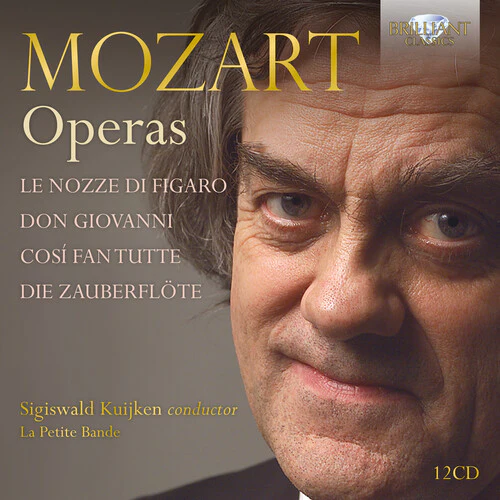
Mozart Operas / Kuijken, La Petite Bande
The scion of a Dutch family deeply involved in the historically informed performance movement for the past 70 years, Sigiswald Kuijken made his name as a violinist. The combination of scholarly diligence, performing flair and unwavering determination – ‘I’ve always been fanatical about doing things the way they were done in their day,’ as he remarked in an interview – produced recordings of solo, chamber and concerted Bach as deeply considered as they were imbued with rhythmic vitality.
In 1972 he gathered like-minded friends and colleagues to form La Petite Bande as a recording ensemble; led from the first desk by Kuijken himself, the ensemble quickly gained renown through performances and tours, and their repertoire evolved naturally over time until they began a project to record Mozart’s major operas in 1992 with Don Giovanni.
Kuijken’s approach was characteristically definitive: ‘These pieces are immortal, they don’t need arranging. If you say you’re playing Don Giovanni and it’s a piece of modern theatre with music by Mozart, it’s not the same piece.’ Thus he made no apologies for casting singers who were often young, and more experienced in early-music idioms than in treading the boards of the world’s great opera houses; or for putting them in stagings which Mozart and da Ponte would have recognized. At the same time, Kuijken always sought to uncover the spiritual dimension of music that explores the farthest reaches of human emotion. ‘There is something strange that Bach shares with Mozart,’ he said. ‘It appears that their music has a deeper source. I know it’s a romantic idea to say that, but I’m not ashamed to do so and in fact I feel it increasingly.’ Critics responded warmly from the beginning to this ‘informed Romanticism’, which was caught on the wing in live recordings. The booklet to this set contains detailed synopses of each opera.
In 1972 he gathered like-minded friends and colleagues to form La Petite Bande as a recording ensemble; led from the first desk by Kuijken himself, the ensemble quickly gained renown through performances and tours, and their repertoire evolved naturally over time until they began a project to record Mozart’s major operas in 1992 with Don Giovanni.
Kuijken’s approach was characteristically definitive: ‘These pieces are immortal, they don’t need arranging. If you say you’re playing Don Giovanni and it’s a piece of modern theatre with music by Mozart, it’s not the same piece.’ Thus he made no apologies for casting singers who were often young, and more experienced in early-music idioms than in treading the boards of the world’s great opera houses; or for putting them in stagings which Mozart and da Ponte would have recognized. At the same time, Kuijken always sought to uncover the spiritual dimension of music that explores the farthest reaches of human emotion. ‘There is something strange that Bach shares with Mozart,’ he said. ‘It appears that their music has a deeper source. I know it’s a romantic idea to say that, but I’m not ashamed to do so and in fact I feel it increasingly.’ Critics responded warmly from the beginning to this ‘informed Romanticism’, which was caught on the wing in live recordings. The booklet to this set contains detailed synopses of each opera.
The scion of a Dutch family deeply involved in the historically informed performance movement for the past 70 years, Sigiswald Kuijken made his name as a violinist. The combination of scholarly diligence, performing flair and unwavering determination – ‘I’ve always been fanatical about doing things the way they were done in their day,’ as he remarked in an interview – produced recordings of solo, chamber and concerted Bach as deeply considered as they were imbued with rhythmic vitality.
In 1972 he gathered like-minded friends and colleagues to form La Petite Bande as a recording ensemble; led from the first desk by Kuijken himself, the ensemble quickly gained renown through performances and tours, and their repertoire evolved naturally over time until they began a project to record Mozart’s major operas in 1992 with Don Giovanni.
Kuijken’s approach was characteristically definitive: ‘These pieces are immortal, they don’t need arranging. If you say you’re playing Don Giovanni and it’s a piece of modern theatre with music by Mozart, it’s not the same piece.’ Thus he made no apologies for casting singers who were often young, and more experienced in early-music idioms than in treading the boards of the world’s great opera houses; or for putting them in stagings which Mozart and da Ponte would have recognized. At the same time, Kuijken always sought to uncover the spiritual dimension of music that explores the farthest reaches of human emotion. ‘There is something strange that Bach shares with Mozart,’ he said. ‘It appears that their music has a deeper source. I know it’s a romantic idea to say that, but I’m not ashamed to do so and in fact I feel it increasingly.’ Critics responded warmly from the beginning to this ‘informed Romanticism’, which was caught on the wing in live recordings. The booklet to this set contains detailed synopses of each opera.
In 1972 he gathered like-minded friends and colleagues to form La Petite Bande as a recording ensemble; led from the first desk by Kuijken himself, the ensemble quickly gained renown through performances and tours, and their repertoire evolved naturally over time until they began a project to record Mozart’s major operas in 1992 with Don Giovanni.
Kuijken’s approach was characteristically definitive: ‘These pieces are immortal, they don’t need arranging. If you say you’re playing Don Giovanni and it’s a piece of modern theatre with music by Mozart, it’s not the same piece.’ Thus he made no apologies for casting singers who were often young, and more experienced in early-music idioms than in treading the boards of the world’s great opera houses; or for putting them in stagings which Mozart and da Ponte would have recognized. At the same time, Kuijken always sought to uncover the spiritual dimension of music that explores the farthest reaches of human emotion. ‘There is something strange that Bach shares with Mozart,’ he said. ‘It appears that their music has a deeper source. I know it’s a romantic idea to say that, but I’m not ashamed to do so and in fact I feel it increasingly.’ Critics responded warmly from the beginning to this ‘informed Romanticism’, which was caught on the wing in live recordings. The booklet to this set contains detailed synopses of each opera.
$58.99
Mozart Operas / Kuijken, La Petite Bande—
$58.99
Description
The scion of a Dutch family deeply involved in the historically informed performance movement for the past 70 years, Sigiswald Kuijken made his name as a violinist. The combination of scholarly diligence, performing flair and unwavering determination – ‘I’ve always been fanatical about doing things the way they were done in their day,’ as he remarked in an interview – produced recordings of solo, chamber and concerted Bach as deeply considered as they were imbued with rhythmic vitality.
In 1972 he gathered like-minded friends and colleagues to form La Petite Bande as a recording ensemble; led from the first desk by Kuijken himself, the ensemble quickly gained renown through performances and tours, and their repertoire evolved naturally over time until they began a project to record Mozart’s major operas in 1992 with Don Giovanni.
Kuijken’s approach was characteristically definitive: ‘These pieces are immortal, they don’t need arranging. If you say you’re playing Don Giovanni and it’s a piece of modern theatre with music by Mozart, it’s not the same piece.’ Thus he made no apologies for casting singers who were often young, and more experienced in early-music idioms than in treading the boards of the world’s great opera houses; or for putting them in stagings which Mozart and da Ponte would have recognized. At the same time, Kuijken always sought to uncover the spiritual dimension of music that explores the farthest reaches of human emotion. ‘There is something strange that Bach shares with Mozart,’ he said. ‘It appears that their music has a deeper source. I know it’s a romantic idea to say that, but I’m not ashamed to do so and in fact I feel it increasingly.’ Critics responded warmly from the beginning to this ‘informed Romanticism’, which was caught on the wing in live recordings. The booklet to this set contains detailed synopses of each opera.
In 1972 he gathered like-minded friends and colleagues to form La Petite Bande as a recording ensemble; led from the first desk by Kuijken himself, the ensemble quickly gained renown through performances and tours, and their repertoire evolved naturally over time until they began a project to record Mozart’s major operas in 1992 with Don Giovanni.
Kuijken’s approach was characteristically definitive: ‘These pieces are immortal, they don’t need arranging. If you say you’re playing Don Giovanni and it’s a piece of modern theatre with music by Mozart, it’s not the same piece.’ Thus he made no apologies for casting singers who were often young, and more experienced in early-music idioms than in treading the boards of the world’s great opera houses; or for putting them in stagings which Mozart and da Ponte would have recognized. At the same time, Kuijken always sought to uncover the spiritual dimension of music that explores the farthest reaches of human emotion. ‘There is something strange that Bach shares with Mozart,’ he said. ‘It appears that their music has a deeper source. I know it’s a romantic idea to say that, but I’m not ashamed to do so and in fact I feel it increasingly.’ Critics responded warmly from the beginning to this ‘informed Romanticism’, which was caught on the wing in live recordings. The booklet to this set contains detailed synopses of each opera.