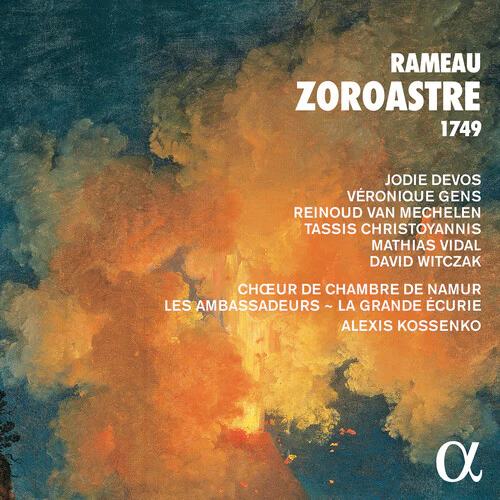
Rameau: Zoroastre 1749 / Devos, Gens, Kossenko, Les Ambassadeurs
Jean-Philippe Rameau (1683-1764) left two very different versions of his tragédie en musique Zoroastre: the first, in 1749, suffered from cabals and the work was withdrawn from the repertory. Rameau gave it a thoroughgoing revision in 1756. At this time, he was at the height of his powers. Melody, harmony, orchestration and choral writing no longer held any secrets for him. Zoroastre brought still further innovation. For the first time, he dispensed with a prologue, and turned the overture into a philosophical ‘program’, the struggle between day and night, between good and evil.
The 1749 version is entirely governed by avant-garde ideas; Zoroastre resembles Tamino in The Magic Flute, but two generations earlier. This disconcerted some of the audience: Zoroastre was a moral, social and philosophical opera. The 1749 version has never been revived in modern times. Alexis Kossenko takes up the challenge with zest, accompanied by an outstanding cast including Véronique Gens, Jodie Devos, Reinoud Van Mechelen, Mathias Vidal and Tassis Christoyannis.
REVIEW:
For listeners more used to English Baroque, this example of high French Baroque will require a big adjustment: every element – aria, duet, chorus, instrumental interlude – is short and thick with text; the feminine ending of each musical line reinforces the Gallic character of the whole.
The chorus and line-up of soloists is first-rate, with a suitably menacing Abramane (Tassis Christoyannis) and a witchy Érinice (Véronique Gens); with a gorgeously pure-toned Amélite (Jodie Devos), and an expressive and clarion-voiced Zoroastre (Reinoud van Mechelen). The instrumental numbers (notably the sarabands) are beautifully done, with the weather – lashings of thunder and lightning – forcefully dramatised throughout.
-- BBC Music Magazine
Jean-Philippe Rameau (1683-1764) left two very different versions of his tragédie en musique Zoroastre: the first, in 1749, suffered from cabals and the work was withdrawn from the repertory. Rameau gave it a thoroughgoing revision in 1756. At this time, he was at the height of his powers. Melody, harmony, orchestration and choral writing no longer held any secrets for him. Zoroastre brought still further innovation. For the first time, he dispensed with a prologue, and turned the overture into a philosophical ‘program’, the struggle between day and night, between good and evil.
The 1749 version is entirely governed by avant-garde ideas; Zoroastre resembles Tamino in The Magic Flute, but two generations earlier. This disconcerted some of the audience: Zoroastre was a moral, social and philosophical opera. The 1749 version has never been revived in modern times. Alexis Kossenko takes up the challenge with zest, accompanied by an outstanding cast including Véronique Gens, Jodie Devos, Reinoud Van Mechelen, Mathias Vidal and Tassis Christoyannis.
REVIEW:
For listeners more used to English Baroque, this example of high French Baroque will require a big adjustment: every element – aria, duet, chorus, instrumental interlude – is short and thick with text; the feminine ending of each musical line reinforces the Gallic character of the whole.
The chorus and line-up of soloists is first-rate, with a suitably menacing Abramane (Tassis Christoyannis) and a witchy Érinice (Véronique Gens); with a gorgeously pure-toned Amélite (Jodie Devos), and an expressive and clarion-voiced Zoroastre (Reinoud van Mechelen). The instrumental numbers (notably the sarabands) are beautifully done, with the weather – lashings of thunder and lightning – forcefully dramatised throughout.
-- BBC Music Magazine
Original: $29.99
-65%$29.99
$10.50Description
Jean-Philippe Rameau (1683-1764) left two very different versions of his tragédie en musique Zoroastre: the first, in 1749, suffered from cabals and the work was withdrawn from the repertory. Rameau gave it a thoroughgoing revision in 1756. At this time, he was at the height of his powers. Melody, harmony, orchestration and choral writing no longer held any secrets for him. Zoroastre brought still further innovation. For the first time, he dispensed with a prologue, and turned the overture into a philosophical ‘program’, the struggle between day and night, between good and evil.
The 1749 version is entirely governed by avant-garde ideas; Zoroastre resembles Tamino in The Magic Flute, but two generations earlier. This disconcerted some of the audience: Zoroastre was a moral, social and philosophical opera. The 1749 version has never been revived in modern times. Alexis Kossenko takes up the challenge with zest, accompanied by an outstanding cast including Véronique Gens, Jodie Devos, Reinoud Van Mechelen, Mathias Vidal and Tassis Christoyannis.
REVIEW:
For listeners more used to English Baroque, this example of high French Baroque will require a big adjustment: every element – aria, duet, chorus, instrumental interlude – is short and thick with text; the feminine ending of each musical line reinforces the Gallic character of the whole.
The chorus and line-up of soloists is first-rate, with a suitably menacing Abramane (Tassis Christoyannis) and a witchy Érinice (Véronique Gens); with a gorgeously pure-toned Amélite (Jodie Devos), and an expressive and clarion-voiced Zoroastre (Reinoud van Mechelen). The instrumental numbers (notably the sarabands) are beautifully done, with the weather – lashings of thunder and lightning – forcefully dramatised throughout.
-- BBC Music Magazine