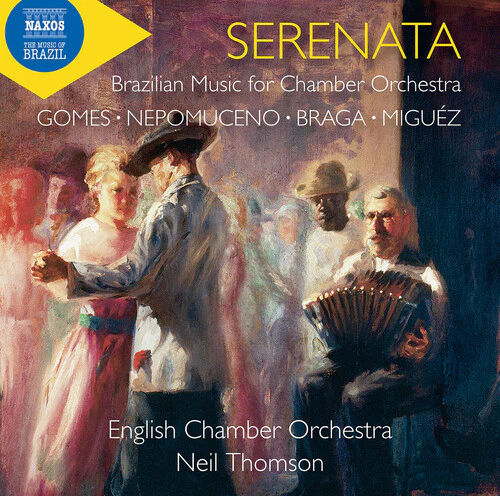
Serenata - Braga, Gomes, Miguez & Nepomuceno / Thomson, English Chamber Orchestra
You can’t go wrong with 68 minutes of gentle, relaxing, and intelligent music.
Brazilian composers in the 19th century often sought state scholarships to enable them to study in Europe where they were to become influenced by the German, Italian and French compositional schools. They also became involved in the vogue for writing suites based on ancient dances, such as Nepomuceno’s delightful Ancient Suite, premiered at Grieg’s home, or Braga’s Madrigal-Pavana which evokes the belle époque ballrooms of Rio de Janeiro. Miguéz’s Suite in the Old Style is polyphonic and lively, while Gomes’ Sonata for Strings is his finest non-operatic work.
REVIEWS:
Though these Brazilian composers—all born from 1836 to 1868—aren’t household names, they’re well worth your attention. Carlos Gomes's perky, witty Sonata for Strings reminds me a lot of Rossini; the melodies are reserved almost solely for the violins, and they sound like they should be arias instead of a sonata. Alberto Nepomuceno studied in Italy and Germany, but his Suite Antique is a cousin to the Holberg Suite by his friend Grieg. Brass, winds, and timpani join strings in Leopoldo Miguez’s Suite a Antiga, and the oboe solo in the “Aria e Double” is spare yet beautiful. His tunes are fetching, and his countermelodies are inventive and attractively detailed. He gets more chromatically adventurous than the others, too. You can’t go wrong with 68 minutes of gentle, relaxing, and intelligent music. The sound is reverberant though not plush.
-- The Absolute Sound
The English Chamber Orchestra give suitably refined performances, its elegant sound being ideal for this repertoire.
-- Gramophone
The delightful Sonata for Strings by Carlos Gomes (1836–96) that opens the disc may remind some of, say, Tchaikovsky’s Souvenir de Florence. The good humor continues thereafter in this enjoyable snapshot of the 19th-century Brazilian chamber orchestra music, all seemingly played with relish by the ECO.
-- BBC Music Magazine
You can’t go wrong with 68 minutes of gentle, relaxing, and intelligent music.
Brazilian composers in the 19th century often sought state scholarships to enable them to study in Europe where they were to become influenced by the German, Italian and French compositional schools. They also became involved in the vogue for writing suites based on ancient dances, such as Nepomuceno’s delightful Ancient Suite, premiered at Grieg’s home, or Braga’s Madrigal-Pavana which evokes the belle époque ballrooms of Rio de Janeiro. Miguéz’s Suite in the Old Style is polyphonic and lively, while Gomes’ Sonata for Strings is his finest non-operatic work.
REVIEWS:
Though these Brazilian composers—all born from 1836 to 1868—aren’t household names, they’re well worth your attention. Carlos Gomes's perky, witty Sonata for Strings reminds me a lot of Rossini; the melodies are reserved almost solely for the violins, and they sound like they should be arias instead of a sonata. Alberto Nepomuceno studied in Italy and Germany, but his Suite Antique is a cousin to the Holberg Suite by his friend Grieg. Brass, winds, and timpani join strings in Leopoldo Miguez’s Suite a Antiga, and the oboe solo in the “Aria e Double” is spare yet beautiful. His tunes are fetching, and his countermelodies are inventive and attractively detailed. He gets more chromatically adventurous than the others, too. You can’t go wrong with 68 minutes of gentle, relaxing, and intelligent music. The sound is reverberant though not plush.
-- The Absolute Sound
The English Chamber Orchestra give suitably refined performances, its elegant sound being ideal for this repertoire.
-- Gramophone
The delightful Sonata for Strings by Carlos Gomes (1836–96) that opens the disc may remind some of, say, Tchaikovsky’s Souvenir de Florence. The good humor continues thereafter in this enjoyable snapshot of the 19th-century Brazilian chamber orchestra music, all seemingly played with relish by the ECO.
-- BBC Music Magazine
Original: $13.99
-65%$13.99
$4.90Description
You can’t go wrong with 68 minutes of gentle, relaxing, and intelligent music.
Brazilian composers in the 19th century often sought state scholarships to enable them to study in Europe where they were to become influenced by the German, Italian and French compositional schools. They also became involved in the vogue for writing suites based on ancient dances, such as Nepomuceno’s delightful Ancient Suite, premiered at Grieg’s home, or Braga’s Madrigal-Pavana which evokes the belle époque ballrooms of Rio de Janeiro. Miguéz’s Suite in the Old Style is polyphonic and lively, while Gomes’ Sonata for Strings is his finest non-operatic work.
REVIEWS:
Though these Brazilian composers—all born from 1836 to 1868—aren’t household names, they’re well worth your attention. Carlos Gomes's perky, witty Sonata for Strings reminds me a lot of Rossini; the melodies are reserved almost solely for the violins, and they sound like they should be arias instead of a sonata. Alberto Nepomuceno studied in Italy and Germany, but his Suite Antique is a cousin to the Holberg Suite by his friend Grieg. Brass, winds, and timpani join strings in Leopoldo Miguez’s Suite a Antiga, and the oboe solo in the “Aria e Double” is spare yet beautiful. His tunes are fetching, and his countermelodies are inventive and attractively detailed. He gets more chromatically adventurous than the others, too. You can’t go wrong with 68 minutes of gentle, relaxing, and intelligent music. The sound is reverberant though not plush.
-- The Absolute Sound
The English Chamber Orchestra give suitably refined performances, its elegant sound being ideal for this repertoire.
-- Gramophone
The delightful Sonata for Strings by Carlos Gomes (1836–96) that opens the disc may remind some of, say, Tchaikovsky’s Souvenir de Florence. The good humor continues thereafter in this enjoyable snapshot of the 19th-century Brazilian chamber orchestra music, all seemingly played with relish by the ECO.
-- BBC Music Magazine