Vivaldi - The French Connection
REVIEW:
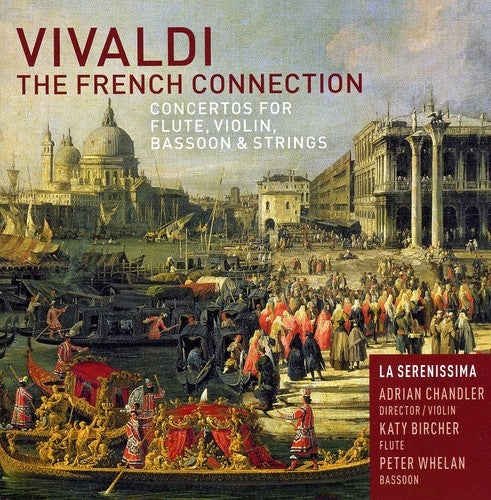
This CD has been given the title “The French Connection,” but it has nothing to do with the 1971 film in which Gene Hackman plays a New York City police detective trying to figure out where all the heroin is coming from. Instead, the title is an allusion to the increasing interest that French and Italian composers (and music lovers in general) had in each other’s music during the 1720s and 1730s. Vivaldi was an important player in this virtual exchange program, and supplied music—either new or recycled—for French patrons and printers. Even music intended for domestic use sometimes spoke with a French accent, as it were, during this period. Try the opening of RV 211 (probably composed as an operatic entr’acte) and you’ll immediately hear, in the dotted rhythms and swooping flourishes, an example of Vivaldi “speaking French.” This CD, then, is a varied compilation of works that fit into one of the above categories. As usual, one is impressed with Vivaldi’s fecundity and flexibility.
Adrian Chandler’s booklet notes are in two parts. The first is a discussion of Vivaldi’s impact on French music, and vice-versa. The second is “A note on the performance—a musician’s perspective.” This is a really terrific bit of musicology that even a layman should be able to get into. For example, in two of the so-called “Paris” concertos, a theorbo is used in the continuo, but in the fifth concerto, it is replaced with a guitar. Why, you might ask? Chandler argues that this concerto appears to have been specifically composed for a French audience and is the most typically French in style; therefore, it makes sense to use a guitar, which apparently was uncommon in Italian orchestral music at that time. Chandler also explains the two fragments included on this CD—concertos lacking one or more movements. Schubert’s “Unfinished” is, after all, a fragment, too, argues Chandler. I don’t think either of these fragments rises to Schubert’s level (or Bruckner’s Ninth!), but I agree with Chandler that works shouldn’t be ignored just because they are incomplete.
At first I thought that these performances were going to be too aggressive, but fortunately that is not the case, at least for the most part. The playing is lively (but not rushed) and very well articulated, and the fast movements have an appealing bounce. The musicians seem to be having fun. The slow movements sing nicely, without too much sweetness. La Serenissima was founded in 1994 and has recorded several discs for Avie. I am sorry to have missed them until now, but I hope to make up for that. Flutist Bircher and bassoonist Whelan are members of the ensemble. Whelan is particularly delightful to hear as he burbles through Vivaldi’s busier passages. His bassoon, a modern copy of an old Venetian instrument, even sounds a little like a saxophone at times, and to my ears, that only adds to the fun.
The recording is rich and brilliant, but not everyone will like how it brings the soloists so well into the foreground.
FANFARE: Raymond Tuttle
REVIEW:
This CD has been given the title “The French Connection,” but it has nothing to do with the 1971 film in which Gene Hackman plays a New York City police detective trying to figure out where all the heroin is coming from. Instead, the title is an allusion to the increasing interest that French and Italian composers (and music lovers in general) had in each other’s music during the 1720s and 1730s. Vivaldi was an important player in this virtual exchange program, and supplied music—either new or recycled—for French patrons and printers. Even music intended for domestic use sometimes spoke with a French accent, as it were, during this period. Try the opening of RV 211 (probably composed as an operatic entr’acte) and you’ll immediately hear, in the dotted rhythms and swooping flourishes, an example of Vivaldi “speaking French.” This CD, then, is a varied compilation of works that fit into one of the above categories. As usual, one is impressed with Vivaldi’s fecundity and flexibility.
Adrian Chandler’s booklet notes are in two parts. The first is a discussion of Vivaldi’s impact on French music, and vice-versa. The second is “A note on the performance—a musician’s perspective.” This is a really terrific bit of musicology that even a layman should be able to get into. For example, in two of the so-called “Paris” concertos, a theorbo is used in the continuo, but in the fifth concerto, it is replaced with a guitar. Why, you might ask? Chandler argues that this concerto appears to have been specifically composed for a French audience and is the most typically French in style; therefore, it makes sense to use a guitar, which apparently was uncommon in Italian orchestral music at that time. Chandler also explains the two fragments included on this CD—concertos lacking one or more movements. Schubert’s “Unfinished” is, after all, a fragment, too, argues Chandler. I don’t think either of these fragments rises to Schubert’s level (or Bruckner’s Ninth!), but I agree with Chandler that works shouldn’t be ignored just because they are incomplete.
At first I thought that these performances were going to be too aggressive, but fortunately that is not the case, at least for the most part. The playing is lively (but not rushed) and very well articulated, and the fast movements have an appealing bounce. The musicians seem to be having fun. The slow movements sing nicely, without too much sweetness. La Serenissima was founded in 1994 and has recorded several discs for Avie. I am sorry to have missed them until now, but I hope to make up for that. Flutist Bircher and bassoonist Whelan are members of the ensemble. Whelan is particularly delightful to hear as he burbles through Vivaldi’s busier passages. His bassoon, a modern copy of an old Venetian instrument, even sounds a little like a saxophone at times, and to my ears, that only adds to the fun.
The recording is rich and brilliant, but not everyone will like how it brings the soloists so well into the foreground.
FANFARE: Raymond Tuttle
Description
REVIEW:
This CD has been given the title “The French Connection,” but it has nothing to do with the 1971 film in which Gene Hackman plays a New York City police detective trying to figure out where all the heroin is coming from. Instead, the title is an allusion to the increasing interest that French and Italian composers (and music lovers in general) had in each other’s music during the 1720s and 1730s. Vivaldi was an important player in this virtual exchange program, and supplied music—either new or recycled—for French patrons and printers. Even music intended for domestic use sometimes spoke with a French accent, as it were, during this period. Try the opening of RV 211 (probably composed as an operatic entr’acte) and you’ll immediately hear, in the dotted rhythms and swooping flourishes, an example of Vivaldi “speaking French.” This CD, then, is a varied compilation of works that fit into one of the above categories. As usual, one is impressed with Vivaldi’s fecundity and flexibility.
Adrian Chandler’s booklet notes are in two parts. The first is a discussion of Vivaldi’s impact on French music, and vice-versa. The second is “A note on the performance—a musician’s perspective.” This is a really terrific bit of musicology that even a layman should be able to get into. For example, in two of the so-called “Paris” concertos, a theorbo is used in the continuo, but in the fifth concerto, it is replaced with a guitar. Why, you might ask? Chandler argues that this concerto appears to have been specifically composed for a French audience and is the most typically French in style; therefore, it makes sense to use a guitar, which apparently was uncommon in Italian orchestral music at that time. Chandler also explains the two fragments included on this CD—concertos lacking one or more movements. Schubert’s “Unfinished” is, after all, a fragment, too, argues Chandler. I don’t think either of these fragments rises to Schubert’s level (or Bruckner’s Ninth!), but I agree with Chandler that works shouldn’t be ignored just because they are incomplete.
At first I thought that these performances were going to be too aggressive, but fortunately that is not the case, at least for the most part. The playing is lively (but not rushed) and very well articulated, and the fast movements have an appealing bounce. The musicians seem to be having fun. The slow movements sing nicely, without too much sweetness. La Serenissima was founded in 1994 and has recorded several discs for Avie. I am sorry to have missed them until now, but I hope to make up for that. Flutist Bircher and bassoonist Whelan are members of the ensemble. Whelan is particularly delightful to hear as he burbles through Vivaldi’s busier passages. His bassoon, a modern copy of an old Venetian instrument, even sounds a little like a saxophone at times, and to my ears, that only adds to the fun.
The recording is rich and brilliant, but not everyone will like how it brings the soloists so well into the foreground.
FANFARE: Raymond Tuttle